
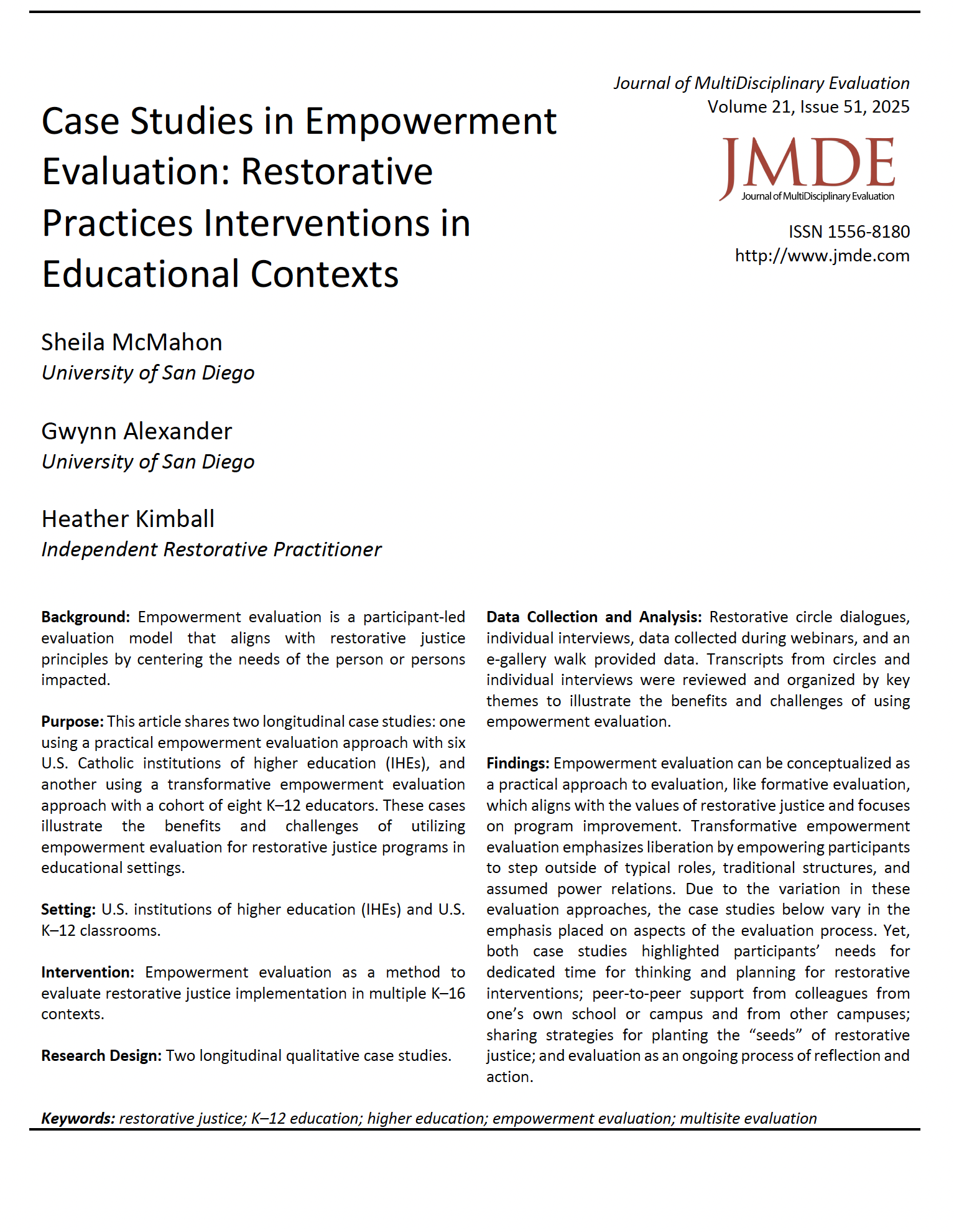
Case Studies in Empowerment Evaluation: Restorative Practices Interventions in Educational Contexts
Article Sidebar
Main Article Content
Abstract
Background: Empowerment evaluation (EE) is a participant-led evaluation model that aligns with restorative justice (RJ) principles by centering the needs of the person or persons impacted.
Purpose: This article shares two longitudinal case studies, one using a practical empowerment evaluation approach with six U.S. Catholic institutions of higher education (IHEs), and another using a transformative empowerment evaluation approach with a cohort of 8 K-12 educators. These cases illustrate the benefits and challenges of utilizing empowerment evaluation for restorative justice programs in educational settings.
Setting: U.S. institutions of higher education (IHEs) and U.S. K-12 classrooms.
Intervention: Empowerment evaluation as a method to evaluate restorative justice implementation in multiple K-16 contexts.
Research Design: Two longitudinal qualitative case studies.
Data Collection and Analysis: Restorative circle dialogues; individual interviews; data collected during webinars; and an e-gallery walk provided data. Transcripts from circles and individual interviews were reviewed and organized by key themes to illustrate the benefits and challenges of using empowerment evaluation.
Findings: Empowerment evaluation can be conceptualized as a practical approach to evaluation, like formative evaluation, which aligns with the values of restorative justice, and focuses on program improvement. Transformative empowerment evaluation emphasizes liberation by empowering participants to step outside of typical roles, traditional structures, and assumed power relations. Due to the variation in these evaluation approaches, the case studies below vary in the emphasis placed on aspects of the evaluation process. Yet, both case studies highlighted participants’ needs for dedicated time for thinking and planning for restorative interventions; peer-to-peer support from colleagues from one’s own school or campus and from other campuses; sharing strategies for planting the “seeds” of restorative justice; and evaluation as an ongoing process of reflection and action.
Downloads
Article Details

This work is licensed under a Creative Commons Attribution-NonCommercial 4.0 International License.
Copyright and Permissions
Authors retain full copyright for articles published in JMDE. JMDE publishes under a Creative Commons Attribution-NonCommercial 4.0 International License (CC BY - NC 4.0). Users are allowed to copy, distribute, and transmit the work in any medium or format for noncommercial purposes, provided that the original authors and source are credited accurately and appropriately. Only the original authors may distribute the article for commercial or compensatory purposes. To view a copy of this license, visit creativecommons.org
Funding data
References
Alexander, G. (2023). Becoming restorative: Discomfort, praxis, and ecstasy at the intersections of restorative practices and teacher identity development. USD Dissertations 928. https://doi.org/10.22371/05.2023.013
Alexander, G., Mahmood, S., Sunio, J., & Romolini, M. (2024). Institutional transformation to nurture restorative justice practitioners: a cross-sector exploration of a regional community practice in Southern California. Journal of Community Practice, 32(1), 127-147. https://doi.org/10.1080/10705422.2024.2311251
Allen, S. (2022 Fall). Rooted in justice. UChicago Magazine. https://mag.uchicago.edu/law-policy-society/rooted-justice
Armour, M. (2016). Restorative practices: Righting the wrongs of exclusionary school discipline. University of Richmond Law Review, 50, 999-1037.
Association of Catholic Colleges and Universities (2016). Catholic Higher Education. https://www.accunet.org/data.html
Boyes-Watson, C., & Pranis, K. (2020). Circle forward: Building a restorative school community (Revised ed.). Living Justice Press.
Davis, F. (2019). The little book of race and restorative justice: Black lives, healing, and US social transformation. Good Books.
DePaoli, J. L., Hernández, L. E., Furger, R. C., & Darling-Hammond, L. (2021). A restorative approach for equitable education. Learning Policy Institute.
Fetterman, D. M. (1994). Empowerment evaluation. Evaluation Practice, 15(1), 1-15. https://doi.org/10.1177/109821409401500101
Fetterman, D. (2012). Empowerment evaluation in the digital villages: Hewlett-Packard's $15 million race toward social justice. Stanford University Press.
Fetterman, D. (2017). Transformative empowerment evaluation and Freirean pedagogy: Alignment with an emancipatory tradition. New Directions for Evaluation, 155, 111-126. https://doi.org/10.1002/ev.20257
Fetterman, D. M., Rodriguez-Campos, L., & Zukoski, A. P. (2018). Collaborative, participatory, and empowerment evaluation: Stakeholder involvement approaches. Health Promotion Journal of Australia, 29(3), 363.
Fetterman, D. M. & Wandersman, A. (2018). Essentials of empowerment evaluation. In D. M. Fetterman, L. Rodríguez-Campos, & A. P. Zukosi (Eds.), Collaborative, participatory, and empowerment evaluation: Stakeholder involvement approaches (pp. 74-88). Guilford Press.
Freire, P. (2012). Pedagogy of the oppressed (30th anniversary ed..; M. Bergman Ramos, Trans.). Continuum International Publishing Group. (Original work published 1968).
Fronius, T., Darling-Hammond, S., Persson, H. Guckenburg, S., Hurley, N., Petrosino, A. (2019 March). Restorative justice in U.S. schools: An updated research review. WestEd Justice & Prevention Research Center.
González, T. (2012). Keeping kids in schools: Restorative justice, punitive discipline, and the school to prison pipeline. Journal of Law and Education, 41(2), 281-335.
González, T., Sattler, H., & Buth, A. J. (2019). New directions in whole-school restorative justice implementation. Conflict Resolution Quarterly, 36(3), 207-220. https://doi.org/10.1002/crq.21236
Hollweck, T., Reimer, K., & Bouchard, K. (2019). A missing piece: Embedding restorative justice and relational pedagogy into the teacher education classroom. The New Educator, 15(3), 246-267. https://doi.org/10.1080/1547688X.2019.1626678
Karp, D. (2024). Becoming a restorative university: The role of restorative justice in higher education. International Journal of Restorative Justice, 7(2). https://doi.org/10.5553/TIJRJ.000175
Karp, D. R. (2004). Integrity boards. In D. R. Karp & T. Allena (Eds.), Restorative justice on the college campus: Promoting student growth and responsibility, and reawakening the spirit of campus community, (pp. 29-41). Charles C. Thomas.
Karp, D. R., & Sacks, C. (2014). Student conduct, restorative justice, and student development: Findings from the STARR project: A student accountability and restorative research project. Contemporary Justice Review, 17(2), 154-172. https://doi.org/10.1080/10282580.2014.915140
Kim, M. E., Fonseka, R., Alon, T., Arthur, D., Berrios, A., Dobson, S., ... & Burford, G. (2022). Non-law enforcement restorative justice addressing domestic and sexual violence: Evaluation results from the CHAT Project pilot.
Kimball, H. R. (2017). Adoption of restorative justice practices in student conduct (Master's thesis, University of Maryland, College Park).
LaCroix, L. L. (2018). Restorative justice in higher education: A case study of program implementation and sustainability. University of California, San Diego.
McMahon, S.M. and Karp, D. (2020). Building Relational and Critical Thinking Skills: The Power of Peer-Led RJ Circles Among First-Year College Students. In Reframing Campus Conflict: Student Conduct Practice through the lens of inclusive excellence, 2nd Edition. Jennifer Meyer Schrage and Nancy Geist Giacomini, Eds. Sterling, VA: Stylus Publishing, Inc.
McMahon, S. M., Williamsen, K. M., Mitchell, H. B., & Kleven, A. (2023). Initial reports from early adopters of restorative justice for reported cases of campus sexual misconduct: A qualitative study. Violence against women, 29(6-7), 1183-1205. https://doi.org/10.1177/10778012221108419
McMurtrie, Beth. (2015, June 3). With restorative justice, students learn how to make amends. The Chronicle of Higher Education. https://www.chronicle.com/article/with-restorative-justice-students-learn-how-to-make-amends/
Morrison, B., Blood, P., & Thorsborne, M. (2005). Practicing restorative justice in school communities: Addressing the challenge of culture change. Public Organization Review, 5(4), 335-357. https://doi.org/10.1007/s11115-005-5095-6
O'Connor, C., & Joffe, H. (2020). Intercoder reliability in qualitative research: Debates and practical guidelines. International Journal of Qualitative Methods, 19. https://doi.org/10.1177/1609406919899220
O'Nolan, C., Zinsstag, E., & Keenan, M. (2018). Researching 'under the radar' practices: Exploring restorative practices in sexual violence cases. Temida: The journal on victimization, gender and human rights, 21(1), 107-129. https://doi.org/10.2298/TEM1801107O
Peterson, N. A., & Zimmerman, M. A. (2004). Beyond the individual: Toward a nomological network of organizational empowerment. American Journal of Community Psychology, 34(1-2), 129-145. https://doi.org/10.1023/B:AJCP.0000040151.77047.58
Phillips, G., Lindeman, P., Adames, C. N., Bettin, E., Bayston, C., Stonehouse, P., Kern, D., Johnson, A. K., Brown, C. H., & Greene, G. J. (2019). Empowerment evaluation: A case study of citywide implementation within an HIV prevention context. American Journal of Evaluation, 40(3), 318-334. https://doi.org/10.1177/1098214018796991
Rizzi, M. (2019). Defining Catholic higher education in positive, not negative, terms. Journal of Catholic Education, 22(2), 1. https://doi.org/10.15365/joce.2202012019
Ruffin, T. M. (2020). Remove systemic barriers, engage in systemic reform, and implement systemic solutions: Transformative justice, good teachers, and identity safe classrooms. An Interdisciplinary Journal of Africana Studies, 1, 1.
Saldaña, J., & Omasta, M. (2016). Qualitative research: Analyzing life. Sage Publications.
Sebok, T., & Goldblum, A., (1999). Establishing a campus restorative justice program. California Caucus of College and University Ombuds, 2, 12-22.
Smith, D., Fisher, D., & Frey, N. (2015). Better than carrots or sticks: Restorative practices for positive classroom management. ASCD.
Thorsborne, M. & Blood, P. (2013). Implementing restorative practices in schools: A practical guide to transforming school communities. Jessica Kingsley Publishers. https://doi.org/10.5040/9781805014478
Umbreit, M. (2022). Crime and reconciliation: Creative options for victims and offenders. Wipf and Stock Publishers.
Vaandering, D. (2010). The significance of critical theory for restorative justice in education. The Review of Education, Pedagogy, and Cultural Studies, 32(2), 145-176. https://doi.org/10.1080/10714411003799165
Wadhwa, A. (2016). Restorative justice in urban schools: Disrupting the school-to-prison pipeline. Routledge. https://doi.org/10.4324/9781315692821
Wood, W., Suzuki, M., & Hayes, H. (2022). Restorative justice in youth and adult criminal justice. In Oxford research encyclopedias of criminology and criminal justice. https://doi.org/10.1093/acrefore/9780190264079.013.658
WorldTrustTV. (2016, July 6). An example of restorative justice with Sujatha Baliga [Video]. YouTube. https://youtu.be/6ih_IQ2MOpU?feature=shared
Zakszeski, B., & Rutherford, L. (2021). Mind the gap: A systematic review of research on restorative practices in schools. School Psychology Review, 50(2-3), 371-387. https://doi.org/10.1080/2372966X.2020.1852056
Zehr, H. (2015). Changing lenses: Restorative justice for our times. MennoMedia, Inc.