
Democracy, Accountability, and Evaluation
Article Sidebar
Main Article Content
Abstract
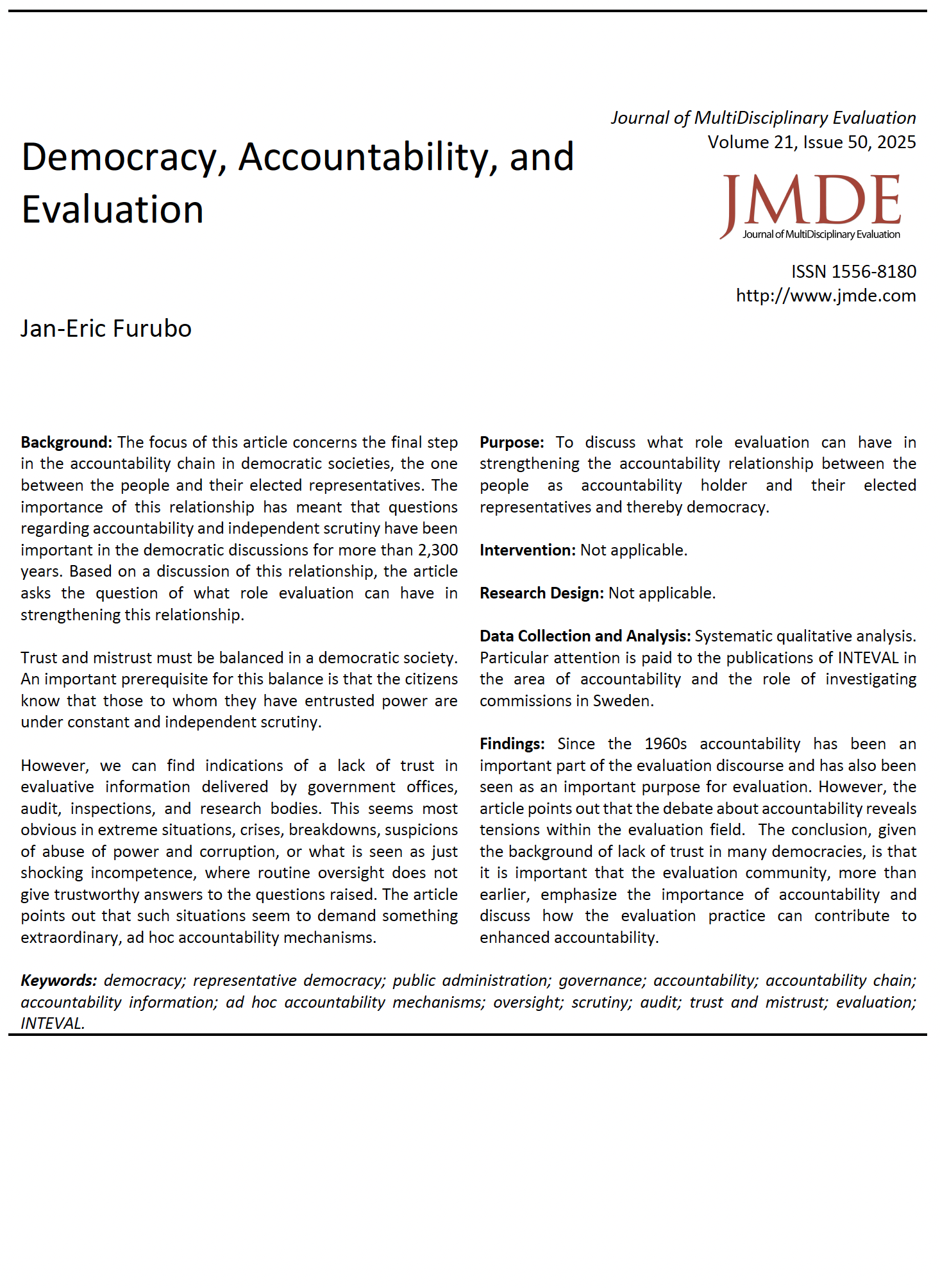
Background: The focus of the article concerns the final step in the accountability chain in democratic societies, the one between the people and their elected representatives. The importance of this relationship has meant that questions regarding accountability and independent scrutiny have been important in the democratic discussions for more than 2300 years. Based on a discussion of this relationship, the article asks the question of what role evaluation can have in strengthening this relationship.
Purpose: Trust and mistrust must be balanced in a democratic society. An important prerequisite for this balance is that the citizens know that those to whom they have entrusted power are under constant and independent scrutiny.
Setting: The expansion of evaluation has meant that the amount of information, which potentially can be useful in the final step of the accountability chain, has increased. This development suggests that it is today easier than in previous times to hold the elected accountable. However, surveys and indexes show a different picture. More “old” democracies are described as flawed democracies. And it is not difficult to note developments in many democratic nations which seem to reflect increased mistrust in the elected.
We can also find indications of a lack of trust in evaluative information delivered by government offices, audit, inspections and research bodies. This seems most obvious in extreme situations, crises, breakdowns, suspicions of abuse of power and corruption or what is seen as just shocking incompetence, where routine oversight does not give trustworthy answers to the questions raised. The article points out that such situations seem to demand something extraordinary, ad hoc accountability mechanisms.
Intervention: N/a
Research design: N/a
Data collection and analysis: Systematic qualitative analysis. Particular attention is paid to the publications of Inteval in the area of accountability, and the role of investigating commissions in Sweden.
Findings: Since the 1960s accountability has been an important part of the evaluation discourse and has also been seen as an important purpose for evaluation. However, the article points out that the debate about accountability reveals tensions within the evaluation field.
The conclusion, given the background of lack of trust in many democracies, is that it is important that the evaluation community, more than earlier, emphasizes the importance of accountability and discuss how the evaluation practice can contribute to enhanced accountability.
Downloads
Article Details

This work is licensed under a Creative Commons Attribution-NonCommercial 4.0 International License.
Copyright and Permissions
Authors retain full copyright for articles published in JMDE. JMDE publishes under a Creative Commons Attribution-NonCommercial 4.0 International License (CC BY - NC 4.0). Users are allowed to copy, distribute, and transmit the work in any medium or format for noncommercial purposes, provided that the original authors and source are credited accurately and appropriately. Only the original authors may distribute the article for commercial or compensatory purposes. To view a copy of this license, visit creativecommons.org
References
Alkin, M. C., & Christie, C. A. (2004). An evaluation theory tree. In M. C. Alkin (Ed.), Evaluation roots: Tracing theorists' views and influences. Sage Publications. https://doi.org/10.4135/9781412984157.n2
Aristotle. (1996). The politics and the constitution of Athens. S. Everson (Ed.). Cambridge University Press.
Barrados, M., & Lonsdale, J. (Eds.). (2020). Crossover of audit and evaluation practices: Challenges and opportunities. Routledge. https://doi.org/10.4324/9781003021025
Behn, R. D. (2001). Rethinking democratic accountability. Brookings Institution Press.
Bemelmans-Videc, M.-L. (2007). Accountability: A classic concept in modern context: Implications for evaluation and auditing roles. In M.-L. Bemelmans-Videc, J. Lonsdale, & B. Perrin (Eds.), Making accountability work: Dilemmas for evaluation and for audit. Transaction Publishers.
Bemelmans-Videc, M.-L., Lonsdale, J., & Perrin, B. (Eds.). (2007). Making accountability work: Dilemmas for evaluation and for audit. Transaction Publishers.
Blasi, V. A. (1995). Milton's Areopagitica and the modern first amendment [Lecture at Yale Law School in March 1995, as the third annual Ralph Gregory Elliot First Amendment Lecture]. http://hdl.handle.net/20.500.13051/17678
Eliadis, P., Naidoo, I. A., & Rist, R. C. (Eds.). (2023). Policy evaluation in the Era of Covid-19. Routledge. https://doi.org/10.4324/9781003376316
Federalist Papers (1788). https://www.congress.gov/resources/display/content/The+Federalist+Papers#TheFederalistPapers-55https://www.congress.gov/resources/display/content/The+Federalist+Papers#TheFederalistPapers-55 (Original work published 1788)
Fetterman, D. M., Kaftarian, S.J. & Wandersman, A. (1996). Empowerment evaluation: Knowledge and tools for self-assessment & accountability. Sage.
Gray, A., Jenkins, B., & Segsworth, B. (Eds.). (1993). Budgeting, auditing and evaluation. Transaction Publishers.
Gustavsson, M. (2013). Democratic origins of auditing: "Good auditing" in democratic perspectives (Working Paper Series No. 13). The Quality of Government Institute, Department of Political Science, University of Gothenburg.
Hirschfeldt, J. (2013). Undersökningskommissioner -extraordinära inslag i 'the Audit Society.' In T. Bull, O. Lundin, & E. Rynning (Eds.), Allmänt och enskilt. Festskrift till Lena Marcusson. Iustus förlag.
Hood, C. (1991). A public management for all seasons? Public Administration, 69(1), 3-19. https://doi.org/10.1111/j.1467-9299.1991.tb00779.x
Hood, C. (1995). The New Public Management in the 1980s: Variations on a theme. Accounting, Organizations and Society, 20(2/3), 93-109. https://doi.org/10.1016/0361-3682(93)E0001-W
Lewin, L. (2007). Democratic accountability: Why choice in politics is both possible and necessary. Harvard University Press. https://doi.org/10.4159/9780674274792
Light, P. C. (2014). Government by investigation: Congress, presidents and the search for answers. Brookings Institution Press.
Mark, M., Henry, H. G., & Julnes, G. (2000). Evaluation: An integrated framework for understanding, guiding, and improving policies and programs. Jossey-Bass Inc.
Milton, J. (n.d.). Areopagitica [Speech transcript]. https://milton.host.dartmouth.edu/reading_room/areopagitica/text.shtml (Original work 1644)
NOU 2012:14. Rapport fra 22. juli-kommisjonen (report of the 22 of July Commission).
Perrin, B. (2019). Accountability's two solitudes and the questions it raises: Accountability to whom? By whom? And for what? In J.-E. Furubo & N. Stame (Eds.), The evaluation enterprise: A critical view. Routledge. https://doi.org/10.4324/9780429470202-6
Pollitt, C., & Bouckaert, G. (2004). Public management reform: A comparative analysis (2nd ed.). Oxford University Press. https://doi.org/10.1093/oso/9780199268481.001.0001
Pollitt, C., & Bouckaert, G. (2011). Public management reform: A comparative analysis (3rd ed.). Oxford University Press.
Power, M. (1994). The audit explosion. Demos.
Power, M, (1997). The audit society: Rituals of verification. Oxford University Press.
Riksdagen (2019/20:136). Riksdagens protokoll 2019/20:136. A15EFA54-EFB5-4C8C-B969-240B47949107
Rist, R. C. (Ed.). (1990). Program evaluation and the management of government. Transaction Publishers.
Rossi, P. H., Freeman, E. E., & Lipsey, M. W. (1999). Evaluation: A systematic approach. Sage.
SOU 2000:20. Steriliseringsfrågan i Sverige. Historisk belysning - Kartläggning, Intervjuer jämte bilagor). (The Sterilization issue in Sweden 1935-1975. Descriptions interviews and attachments).
SOU 2002:87. Rikets säkerhet och den personliga integriteten. De svenska säkerhetstjänsternas författningsskyddande verksamhet sedan år 1945. Säkerhetskommissionen. (National security and personal integrity. The Swedish security services' constitutional protection activities since 1945).
SOU 2003:18. Ett diplomatiskt misslyckande: Fallet Raoul Wallenberg och den svenska utrikesledningen. (A diplomatic failure: The case of Raoul Wallenberg and the Swedish foreign affairs leadership).
Tarschys, D. (2002). "Huru skall statsvercket granskas" - Riksdagen som arena för genomlysning och kontroll, Ds 2002:58. Rapport till ESO.
Todd, S. C. (1993). The shape of the Athenian law. Clarendon Press. https://doi.org/10.1093/oso/9780198148944.001.0001
United Nations (UN). Promoting and fostering the efficiency, accountability, effectiveness and transparency of public administration by strengthening supreme audit institutions. 69/228, United Nations General Assembly, 19 December 2014.
Weber, M., Roth, G., & Wittich, C. (1978). Economy and society. University of California Press.
Weiss, C.H. (1972). Evaluating Actions Programs: Readings in Social Action and Evaluation. Allyn and Bacon.
Wilson, W. (1885). Congressional government. Houghton Mifflin. https://books.google.pt/books?redir_esc=y&hl=sv&id=Xx5EAQAAIAAJ&q=oversight#v=snippet&q=oversight&f=false