
How It All Started and How It Evolved: Ray’s Whip
Article Sidebar
Main Article Content
Abstract
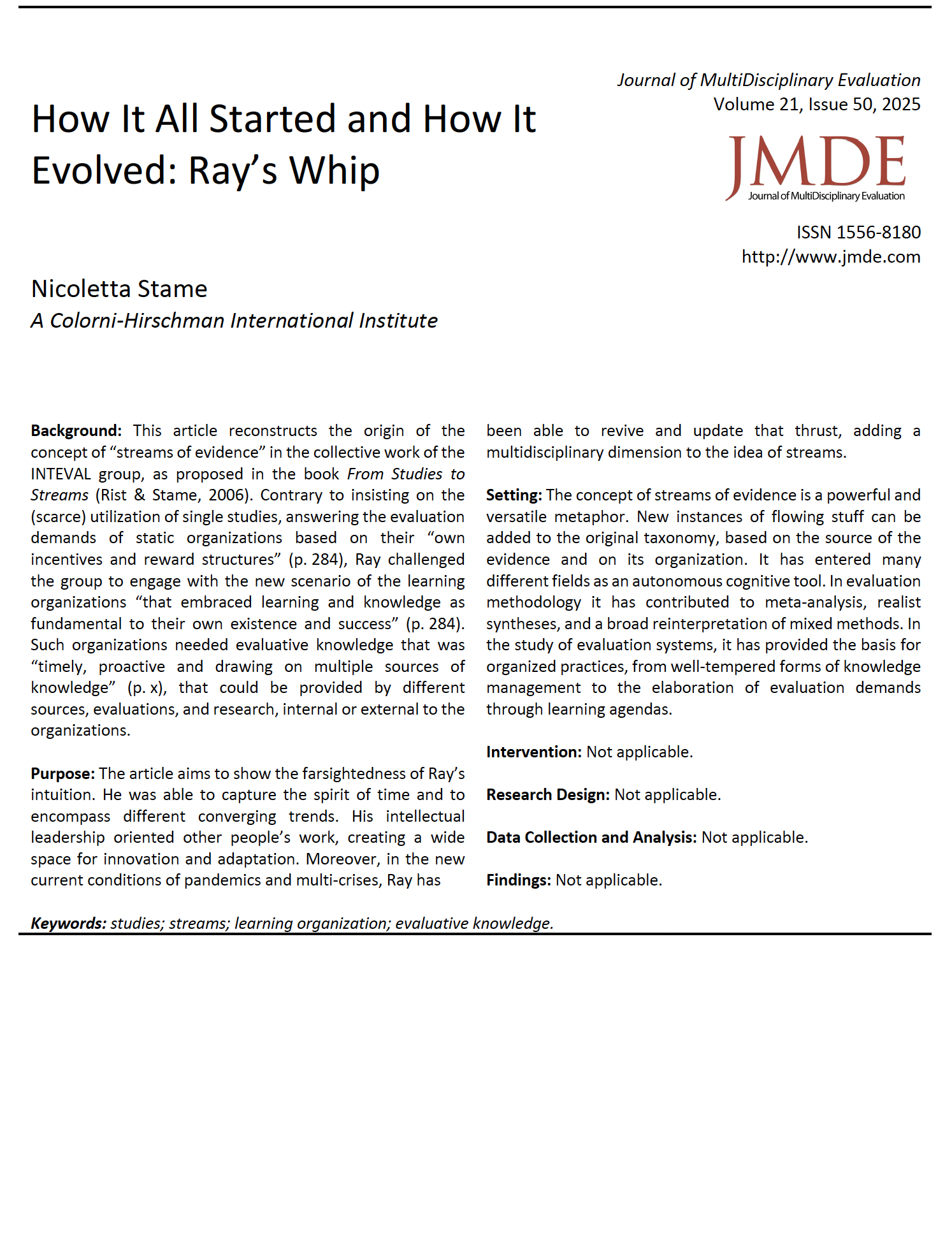
Background: The chapter reconstructs the origin of the concept of “streams of evidence” in the collective work of the Inteval group, as proposed in the book From Studies to Streams (Rist, Stame, 2006). Contrary to insisting on the (scarce) utilization of single studies, answering the evaluation demands of static organizations, based on their “own incentives and reward structures”, Ray challenged the group to engage with the new scenario of the learning organizations “that embraced learning and knowledge as fundamental to their own existence and success”. Such organizations needed evaluative knowledge that was “timely, proactive and drawing on multiple sources of knowledge”, that could be provided by different sources, evaluations and research, internal or external to the organizations.
Purpose: The chapter aims to show the far-sightedness of Ray’s intuition. He was able to capture the spirit of time and to encompass different converging trends. His intellectual leadership oriented other people’s work, creating a wide space for innovation and adaptation. Moreover, in the new current conditions of pandemics and multi-crises, Ray has been able to revive and update that thrust, adding a multidisciplinary dimension to the idea of streams.
Setting: The concept of streams of evidence is a powerful and versatile metaphor. New instances of flowing stuff can be added to the original taxonomy, based on the source of the evidence and on its organization. It has entered many different fields as an autonomous cognitive tool. In evaluation methodology it has contributed to meta-analysis, realist syntheses, and a broad reinterpretation of mixed methods. In the study of evaluation systems, it has provided the basis for organized practices, from well-tempered forms of Knowledge Management to the elaboration of evaluation demands through Learning Agendas.
Intervention: N.A.
Research design: N.A.
Data collection and analysis and findings: N.A.
Downloads
Article Details

This work is licensed under a Creative Commons Attribution-NonCommercial 4.0 International License.
Copyright and Permissions
Authors retain full copyright for articles published in JMDE. JMDE publishes under a Creative Commons Attribution-NonCommercial 4.0 International License (CC BY - NC 4.0). Users are allowed to copy, distribute, and transmit the work in any medium or format for noncommercial purposes, provided that the original authors and source are credited accurately and appropriately. Only the original authors may distribute the article for commercial or compensatory purposes. To view a copy of this license, visit creativecommons.org
References
Eliadis, P., Naidoo, I, & Rist, R, (2023), Policy Evaluation in the Era of Covid 19, Routledge, New York. https://doi.org/10.4324/9781003376316 DOI: https://doi.org/10.4324/9781003376316
Newcomer, K., Olejniczak, K., & Hart, N. (2022). "Learning agendas: Motivation, engagement, and potential". New Directions for Evaluation, 173, 63-83. https://doi.org/10.1002/ev.20495 DOI: https://doi.org/10.1002/ev.20495
Patton, M. (2021), "Evaluation, Knowledge Management, Best Practices, and High-Quality Lessons Learned", American Journal of Evaluation, 22 (3). https://doi.org/10.1016/S1098-2140(01)00147-3 DOI: https://doi.org/10.1016/S1098-2140(01)00147-3
Pawson, R. (2006), Evidence-Based Politics: A Realist Perspective, Sage, London. https://doi.org/10.4135/9781849209120 DOI: https://doi.org/10.4135/9781849209120
Perrin, B. (2006), "How Evaluation can help make knowledge management real", in Rist and Stame, eds. From Studies to Streams.
Petticrew M. and Roberts H. (2006), Systematic reviews in the social sciences, Blackwell, Oxford. https://doi.org/10.1002/9780470754887 DOI: https://doi.org/10.1002/9780470754887
Rist, R. (2006), "The 'E' in Monitoring and Evaluation - Using Evaluative Knowledge to Support a Results-Based Management Systems", in Rist and Stame, eds., From Studies to Streams.
Rist, R. (2006), "Conclusion: a brief critique", in Rist and Stame, eds., From Studies to Streams.
Rist, R. and Stame, N. (2006), From Studies to Streams: Managing Evaluative Systems. Transaction Publishers, New Brunswick NJ. https://doi.org/10.4324/9780203791189 DOI: https://doi.org/10.4324/9780203791189
Toye, J. and Toye, R. (2005), The World Bank as a Knowledge Agency, United Nations Research Institute for Social Development,
Stone, D. (2003), The 'Knowledge Bank' and the Global Development Network", Global Governance, 9: 43-61 https://doi.org/10.1163/19426720-00901005 DOI: https://doi.org/10.1163/19426720-00901005