
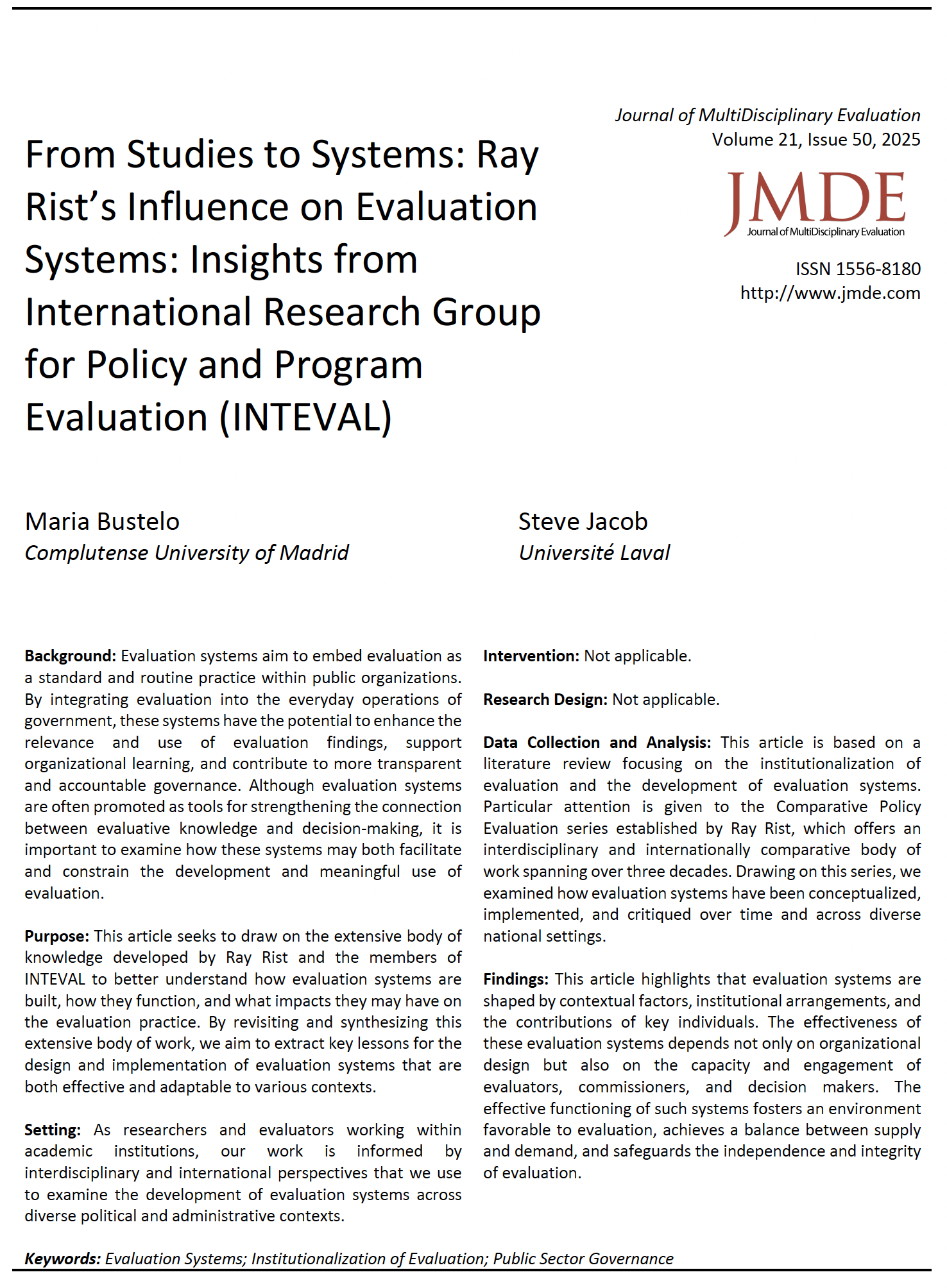
From Studies to Systems: Ray Rist’s Influence on Evaluation Systems: Insights from International Research Group for Policy and Program Evaluation (INTEVAL)
Article Sidebar
Main Article Content
Abstract
Background: Evaluation systems aim to embed evaluation as a standard and routine practice within public organizations. By integrating evaluation into the everyday operations of government, these systems have the potential to enhance the relevance and use of evaluation findings, support organizational learning, and contribute to more transparent and accountable governance. Although evaluation systems are often promoted as tools for strengthening the connection between evaluative knowledge and decision-making, it is important to examine how these systems may both facilitate and constrain the development and meaningful use of evaluation.
Purpose: This article seeks to draw on the extensive body of knowledge developed by Ray Rist and the members of INTEVAL to better understand how evaluation systems are built, how they function, and what impacts they may have on the evaluation practice. By revisiting and synthesizing this extensive body of knowledge, we aim to extract key lessons for the design and implementation of evaluation systems that are both effective and adaptable to various contexts.
Setting: As researchers and evaluators working within academic institutions, our work is informed by interdisciplinary and international perspectives that we use to examine the development of evaluation systems across diverse political and administrative contexts.
Intervention: Not applicable.
Research Design: Not applicable.
Data Collection and Analysis: This article is based on a literature review focusing on the institutionalization of evaluation and the development of evaluation systems. Particular attention is given to the Comparative Policy Evaluation series established by Ray Rist, which offers an interdisciplinary and internationally comparative body of work spanning over three decades. Drawing on this series, we examined how evaluation systems have been conceptualized, implemented, and critiqued over time and across diverse national settings.
Findings: This article highlights that evaluation systems are shaped by contextual factors, institutional arrangements, and the contributions of key individuals. The effectiveness of these evaluation systems depends not only on organizational design but also on the capacity and engagement of evaluators, commissioners, and decision makers. The effective functioning of such systems fosters an environment favorable to evaluation, achieves a balance between supply and demand, and safeguards the independence and integrity of evaluation.
Downloads
Article Details

This work is licensed under a Creative Commons Attribution-NonCommercial 4.0 International License.
Copyright and Permissions
Authors retain full copyright for articles published in JMDE. JMDE publishes under a Creative Commons Attribution-NonCommercial 4.0 International License (CC BY - NC 4.0). Users are allowed to copy, distribute, and transmit the work in any medium or format for noncommercial purposes, provided that the original authors and source are credited accurately and appropriately. Only the original authors may distribute the article for commercial or compensatory purposes. To view a copy of this license, visit creativecommons.org
References
Andersen, N. A. (2021). The Power and Paradoxes of Evaluation Systems – Increasing Use but Impeding Change. Scandinavian Journal of Public Administration, 25(3/4), 39–59. https://doi.org/10.58235/sjpa.v25i3-4.7063 DOI: https://doi.org/10.58235/sjpa.v25i3-4.7063
Barbier J-C and Hawkins P (eds.) (2012). Evaluation Cultures: sense-making in complex times. New Brunswick: Transaction Publishers; Comparative Policy Evaluation Vol 19
Barnett, M. N. & Finnemore, M. ( 2004 ). Rules for the world: International organizations in world politics. Ithaca, NY: Cornell University Press
Bemelmans-Videc M-L, Rist RC, & Vedung E (eds.) (1998), Carrots, Sticks and Sermons: policy instruments and their evaluation. New Brunswick: Transaction Publishers; Comparative Policy Evaluation Vol 7
Boyle R & Lemaire D (eds.) (1999), Building Effective Evaluation Capacity: Lessons from Practice. New Brunswick: Transaction Publishers; Comparative Policy Evaluation Vol 8
Boyle R, Breul J & Dahler-Larsen P (eds.) (2007), Open to the Public: Evaluation in the
Public Arena. New Brunswick: Transaction Publishers; Comparative Policy Evaluation Vol 13
Chelimsky, E. (1997). Thoughts for a New Evaluation Society. Evaluation, 3(1), 97-109. https://doi.org/10.1177/135638909700300107 DOI: https://doi.org/10.1177/135638909700300107
Chen, H.-T. (2001). Development of a National Evaluation System to Evaluate CDC-Funded Health Department HIV Prevention Programs. American Journal of Evaluation, 22(1), 55-70. https://doi.org/10.1177/109821400102200106 DOI: https://doi.org/10.1016/S1098-2140(01)00112-6
Dahler-Larsen, P. (2012). Evaluation as a situational or a universal good? Why evaluability assessment for evaluation systems is a good idea, what it might look like in practice, and why it is not fashionable. Scandinavian Journal of Public Administration, 16(3), 29–46. https://doi.org/10.58235/sjpa.v16i3.16249 DOI: https://doi.org/10.58235/sjpa.v16i3.16249
Dahler-Larsen, P. (2018). The Skeptical Turn in Evaluation. In Furubo J-E and Stame N (eds.) (2018). The Evaluation Enterprise: a critical view, New York: Routledge. Comparative Policy Evaluation. https://doi.org/10.4324/9780429470202-3 DOI: https://doi.org/10.4324/9780429470202-3
Derlien, H.U. (1990). «Genesis and Structure of Evaluation Efforts in Comparative Perspective”. In Ray C. Rist (ed.) Program Evaluation and the Management of Government: Patterns and Prospects across Eight Nations. New Brunswick, NJ: Transaction Publishers.
Dediu, B.I., Moga, L.M., Mirica, S.C. (2019). An Overview of the Trends in the Evaluation System for the Public Management Performance. In: Bilgin, M., Danis, H., Demir, E., Can, U. (eds) Eurasian Economic Perspectives. Eurasian Studies in Business and Economics, vol 11/1. Springer, Cham. https://doi.org/10.1007/978-3-030-18565-7_8 DOI: https://doi.org/10.1007/978-3-030-18565-7_8
Forss K, Marra M, & Schwartz R (eds.) (2011), Evaluating the Complex: attribution, contribution and beyond. New Brunswick: Transaction Publications. Comparative Policy Evaluation Vol 18
Furubo J-E, Rist RC & Sandahl R (eds.) (2002), International Atlas of Evaluation, New Brunswick: Transaction Publications. Comparative Policy Evaluation Vol 9
Furubo J-E and Stame N (eds.) (2018). The Evaluation Enterprise: a critical view, New York: Routledge. https://doi.org/10.4324/9780429470202 DOI: https://doi.org/10.4324/9780429470202
Gray AG, Jenkins WI and Segsworth RV (eds.) (1993), Budgeting, Auditing and Evaluation: Patterns and Integration in Seven Governments. New Brunswick: Transaction Publications. Comparative Policy Evaluation Vol 2
Jacob, S. (2023). The institutionalization of evaluation around the globe: Understanding the main drivers and effects over the past decades. In F. Varone, S. Jacob, & P. Bundi (Eds.), Handbook of public policy evaluation (pp. 187–205). Edward Elgar. https://doi.org/10.4337/9781800884892.00021 DOI: https://doi.org/10.4337/9781800884892.00021
Jacob, S., Speer, S., & Furubo, J.-E. (2015). The institutionalization of evaluation matters: Updating the International Atlas of Evaluation 10 years later. Evaluation, 21(1), 6–31. https://doi.org/10.1177/1356389014564248 DOI: https://doi.org/10.1177/1356389014564248
Leeuw, F.L. & Sonnichsen, R.C (1994). Introduction. In Leeuw FL, Rist RC, & Sonnichsen RC (eds) Can Governments Learn? Comparative Perspectives on Evaluation and Organizational Learning, New Brunswick: Transaction Publishers.
Leeuw, F. L., & Furubo, J.-E. (2008). Evaluation Systems: What Are They and Why Study Them? Evaluation, 14(2),157–169 https://doi.org/10.1177/1356389007087537 DOI: https://doi.org/10.1177/1356389007087537
Leeuw, F., & Pleger , L. (2023). Evaluation Capture, Evaluator Resilience, and the Need for Competencies of Evaluators. Journal of MultiDisciplinary Evaluation, 19(46), 45–53. https://doi.org/10.56645/jmde.v19i46.863 DOI: https://doi.org/10.56645/jmde.v19i46.863
Martinaitis, Ž., Christenko, A., & Kraučiūnienė, L. (2019). Evaluation systems: How do they frame, generate and use evidence? Evaluation, 25(1), 46-61. https://doi.org/10.1177/1356389018802135 DOI: https://doi.org/10.1177/1356389018802135
Mayne J & Zapico-Goñi, (eds.) (1997). Monitoring Performance in the Public Sector: future directions from international experience. New Brunswick, NJ: Transaction Publishers. Comparative Policy Evaluation Vol 5
OECD (2004). Evaluation Systems in DAC members’ agencies. A study based on DAC Peer Reviews.
OECD (2016). Evaluation Systems in Development Co-operation: 2016 Review. https://doi.org/10.1787/9789264262065-en. DOI: https://doi.org/10.1787/9789264262065-en
Palenberg M and Paulson A (eds.) (2022). The Realpolitik of Evaluation: Why Demand and Supply Rarely Intersect. New York: Routledge. Comparative Policy Evaluation
Perrin, B. & T. Tyrell (Eds.). (2022). Changing bureaucracies: Adapting to uncertainty, and how evaluation can help. New York: Routledge. Comparative Policy Evaluation. https://doi.org/10.31244/zfe.2022.02.08 DOI: https://doi.org/10.31244/zfe.2022.02.08
Raimondo, E. (2018). The power and dysfunction of evaluation systems in international organizations. Evaluation, 24(1), 26–41. https://doi.org/10.1177/1356389017749068 DOI: https://doi.org/10.1177/1356389017749068
Raimondo, E., & Leeuw, F. L. (2022). Evaluation systems and bureaucratic capture: Locked. In B. Perrin & T. Tyrell (Eds.), Changing bureaucracies: Adapting to uncertainty, and how evaluation can help (pp. 143–160). New York: Routledge. https://doi.org/10.4324/9781003100584-12 DOI: https://doi.org/10.4324/9781003100584-12
Rieper O & Toulemonde J (eds.) (1997). Politics and Practices of Intergovernmental Evaluation, New Brunswick, NJ: Transaction Publishers. Comparative Policy Evaluation Vol 4.
Rist, R.C. (1990). “Managing of evaluations or managing by evaluations: choices and consequences”. In Ray C. Rist (ed.) Program Evaluation and the Management of Government: Patterns and Prospects across Eight Nations. New Brunswick, NJ: Transaction Publishers. Comparative Policy Evaluation Vol 1.
Rist R.C. & Stame N. (eds.) (2006). From Studies to Streams: Managing Evaluative Systems. New Brunswick, NJ: Transaction Publishers.; Comparative Policy Evaluation Vol 12
Schwandt, T.A. (2018). The Concerted Effort to Professionalize Evaluation Practice: Whither Are We Bound? In Furubo J-E and Stame N (eds.) (2018). The Evaluation Enterprise: a critical view. New York: Routledge. https://doi.org/10.4324/9780429470202-10 DOI: https://doi.org/10.4324/9780429470202-10
Stockmann, Reinhard, Meyer, Wolfgang, & Taube, Lena (Eds.) (2020).The Institutionalisation of Evaluation in Europe. Cham: Palgrave Macmillan. https://doi.org/10.1007/978-3-030-32284-7 DOI: https://doi.org/10.1007/978-3-030-32284-7
Stockmann, Reinhard, Meyer, Wolfgang, & Szentmarjay, Laszlo (Eds.) (2022). The Institutionalisation of Evaluation in The Americas. Cham: Palgrave Macmillan. https://doi.org/10.1007/978-3-030-81139-6 DOI: https://doi.org/10.1007/978-3-030-81139-6
Stockmann, R., Meyer, W., Zierke, N. (Eds.) (2023). The Institutionalisation of Evaluation in Asia-Pacific. Cham: Palgrave Macmillan. https://doi.org/10.1007/978-3-031-36918-6 DOI: https://doi.org/10.1007/978-3-031-36918-6
Varone, F., & Jacob, S. (2004). Institutionnalisation de l’évaluation et nouvelle gestion publique: Un état des lieux comparatif. Revue internationale de politique comparée, 11(2), 271–292. https://doi.org/10.3917/ripc.112.0271 DOI: https://doi.org/10.3917/ripc.112.0271