
Implementing Photovoice in School-based Evaluations: Navigating Challenges and Leveraging Benefits
Article Sidebar
Main Article Content
Abstract
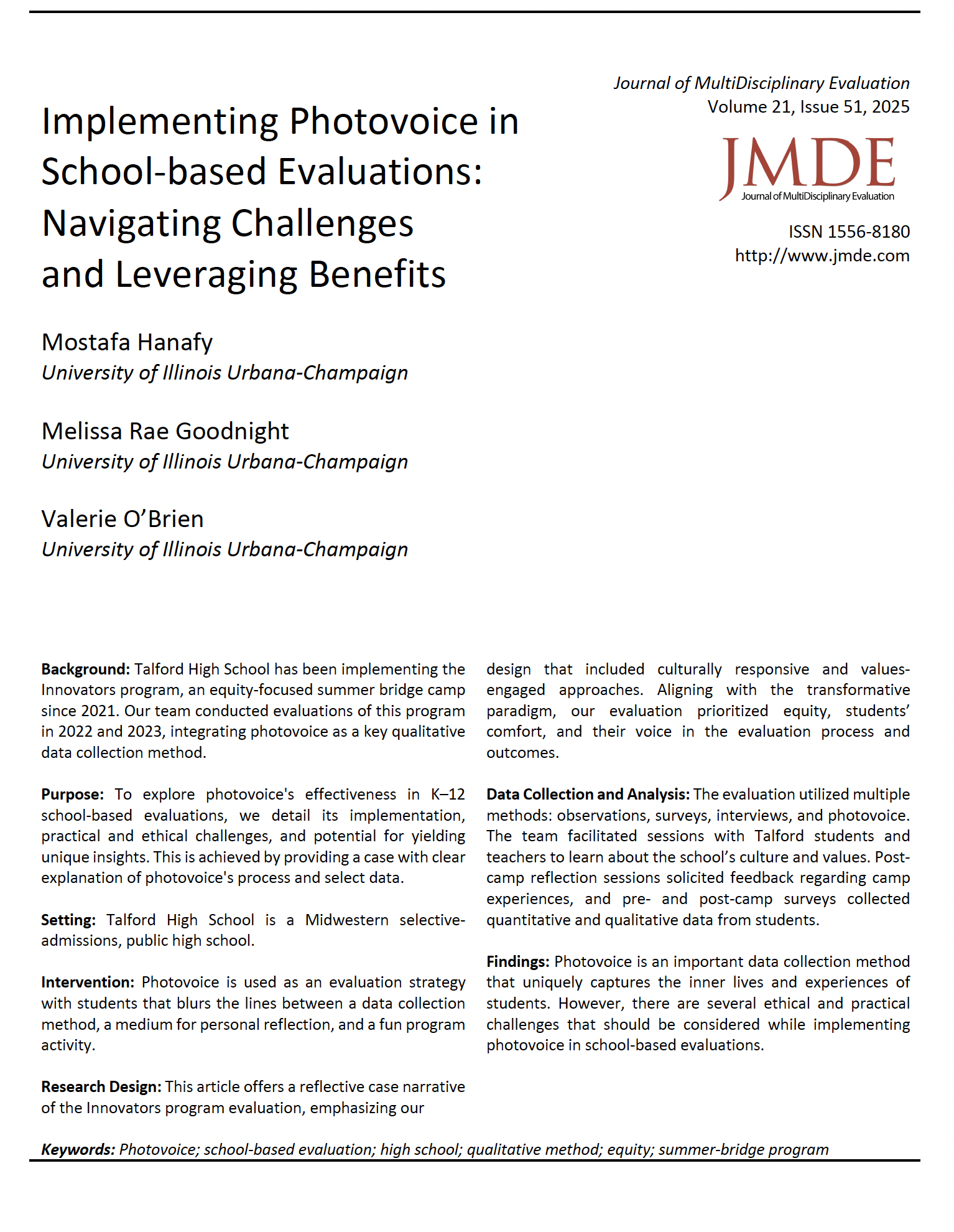
This article explores the use of photovoice as an evaluation method in a high school summer bridge program (the Innovators program). Photovoice is a participatory research method where participants take photographs and share narratives in response to prompts that solicit their perspectives and experiences. With the goal of promoting critical dialogue between participants, photovoice method leverages the power of emic knowledge and visual representation to influence programmatic change. We explain how photovoice was implemented in a K-12 mixed methods evaluation and the practical and ethical considerations that evaluators must weigh. Findings indicate that photovoice not only enhances participant engagement but also serves as a valuable tool for program evaluation, yielding rich, qualitative data that traditional methods may overlook. Drawing on a multi-year evaluation of the Innovators program, the article contributes to the growing literature on photovoice by examining what the method means for young participants, in addition to describing the photovoice design and implementation processes.
Downloads
Article Details

This work is licensed under a Creative Commons Attribution-NonCommercial 4.0 International License.
Copyright and Permissions
Authors retain full copyright for articles published in JMDE. JMDE publishes under a Creative Commons Attribution-NonCommercial 4.0 International License (CC BY - NC 4.0). Users are allowed to copy, distribute, and transmit the work in any medium or format for noncommercial purposes, provided that the original authors and source are credited accurately and appropriately. Only the original authors may distribute the article for commercial or compensatory purposes. To view a copy of this license, visit creativecommons.org
References
Abma, T., Breed, M., Lips, S., & Schrijver, J. (2022). Whose voice is it really? Ethics of photovoice with children in health promotion. International Journal of Qualitative Methods, 21, 1-10. https://doi.org/10.1177/16094069211072419
Abma, T. A. & Schrijver, J. (2020) 'Are we famous or something?' participatory health research with children using photovoice. Educational Action Research, 28(3), 405-426. https://doi.org/10.1080/09650792.2019.1627229
Allen, Q. (2012). Photographs and stories: Ethics, benefits, and dilemmas of using participant photography with Black middle-class male youth. Qualitative Research, 12(4), 443-458. https://doi.org/10.1177/1468794111433088
Behrendt, M., & Machtmes, K. (2016). Photovoice as an evaluation tool for student learning on a field trip. Research in Science & Technological Education, 34(2), 187-203. https://doi.org/10.1080/02635143.2015.1124410
Budig, K., Diez, J., Conde, P., Sastre, M., Hernán, M., & Franco, M. (2018). Photovoice and empowerment: Evaluating the transformative potential of a participatory action research project. BMC Public Health, 18, 1-9. https://doi.org/10.1186/s12889-018-5335-7
Boyce, A. S. (2017). Lessons learned using a values-engaged approach to attend to culture, diversity, and equity in a STEM program evaluation. Evaluation and Program Planning, 64, 33-43. https://doi.org/10.1016/j.evalprogplan.2017.05.018
Carlson, E. D., Engebretson, J., & Chamberlain, R. M. (2006). Photovoice as a social process of critical consciousness. Qualitative Health Research, 16(6), 836-852. https://doi.org/10.1177/1049732306287525
Chio, V. C., & Fandt, P. M. (2007). Photovoice in the diversity classroom: Engagement, voice, and the "eye/I" of the camera. Journal of Management Education, 31(4), 484-504. https://doi.org/10.1177/1052562906288124
Evans-Agnew, R. A., & Rosemberg, M. A. S. (2016). Questioning photovoice research: Whose voice?. Qualitative Health Research, 26(8), 1019-1030. https://doi.org/10.1177/1049732315624223
Exner-Cortens, D., Sitter, K. C., Van Bavel, M., & Wright, A. (2022). Photo-based evaluation: A method for participatory evaluation with adolescents. American Journal of Evaluation, 43(1), 132-147. https://doi.org/10.1177/1098214020927785
Freire, P. (1973). Education for critical consciousness. Continuum.
Golden, T. (2020). Reframing photovoice: Building on the method to develop more equitable and responsive research practices. Qualitative Health Research, 30(6), 960-972. https://doi.org/10.1177/1049732320905564
Goodnight, M., Hanafy, M., Sullers, Jr., A., O'Brien, V., Johnson, J., & Galloway, M. (under review). A Mixed-Methods Evaluation Design for a Secondary School Equity Program: Utilizing Culturally Responsive and Values-Engaged Approaches. American Journal of Evaluation
Greene, J. C., DeStefano, L., Burgon, H., & Hall, J. (2006). An educative, values-engaged approach to evaluating STEM educational programs. New Directions for Evaluation, 109, 53-71. https://doi.org/10.1002/ev.178
Hall, J. N., Freeman, M., & Colomer, S. E. (2020). Being culturally responsive in a formative evaluation of a professional development school: Successes and missed opportunities of an educative, values-engaged evaluation. American Journal of Evaluation, 41(3), 384-403. https://doi.org/10.1177/1098214019885632
Harkness, S. S., & Stallworth, J. (2013). Photovoice: Understanding high school females' conceptions of mathematics and learning mathematics. Educational Studies in Mathematics, 84, 329-347. https://doi.org/10.1007/s10649-013-9485-3
Hergenrather, K. C., & Rhodes, S. D. (2008). Community-based participatory research: Applications for research in health and disability. Focus on Disability: Trends in Research and Application, 2, 59-87.
Hergenrather, K. C., Rhodes, S. D., Cowan, C. A., Bardhoshi, G., & Pula, S. (2009). Photovoice as community-based participatory research: A qualitative review. American Journal of Health Behavior, 33(6), 686-698. https://doi.org/10.5993/AJHB.33.6.6
Hieftje, K., Duncan, L. R., & Fiellin, L. E. (2014). Novel methods to collect meaningful data from adolescents for the development of health interventions. Health Promotion Practice, 15(5), 714-722. https://doi.org/10.1177/1524839914521211
Hood, S., Hopson, R. K., & Kirkhart, K. E. (2015). Culturally responsive evaluation: Theory, practice, and future implications. In K. E. Newcomer, H. P. Hatry, & J. S. Wholey (Eds.), Handbook of practical program evaluation (pp. 281-317). John Wiley & Sons, Inc. https://doi.org/10.1002/9781119171386.ch12
Hunter, O., Leeburg, E., & Harnar, M. (2020). Using PhotoVoice as an evaluation method. Journal of MultiDisciplinary Evaluation, 16(34), 14-20. https://doi.org/10.56645/jmde.v16i34.603
Joanou, J. P. (2009). The bad and the ugly: Ethical concerns in participatory photographic methods with children living and working on the streets of Lima, Peru. Visual Studies, 24(3), 214-223. https://doi.org/10.1080/14725860903309120
Jones, T. (2013). Through the lens of home-educated children: Engagement in education. Educational Psychology in Practice, 29(2), 107-121. https://doi.org/10.1080/02667363.2012.755614
Keller, E. F., & Longino, H. E. (1996). Introduction. In E. F. Keller & H. E. Longino (Eds.), Feminism and science (pp. 1-14). Oxford University Press. https://doi.org/10.1093/oso/9780198751458.003.0001
Keller, K. J., & Mott, R. (2020). Tips for using photovoice in evaluation of extension programs. The Journal of Extension, 58(5), 10. https://doi.org/10.34068/joe.58.05.10
Liebenberg, L. (2018). Thinking critically about photovoice: Achieving empowerment and social change. International Journal of Qualitative Methods, 17(1), 1609406918757631. https://doi.org/10.1177/1609406918757631
Mertens, D. M., & Wilson, A. T. (2019). Program evaluation theory and practice: a comprehensive guide (Second edition.). Guilford Press.
Nelson, E., & Christensen, K. (2009). Photovoice in the middle: How our students experience learning at school and beyond. Teachers' Work, 6(1), 35-46. https://doi.org/10.24135/teacherswork.v6i1.505
Seitz, C. M., & Orsini, M. M. (2022). Thirty years of implementing the photovoice method: Insights from a review of reviews. Health Promotion Practice, 23(2), 281-288. https://doi.org/10.1177/15248399211053878
Shaw, P. A. (2021). Photo-elicitation and photo-voice: Using visual methodological tools to engage with younger children's voices about inclusion in education. International Journal of Research & Method in Education, 44(4), 337-351. https://doi.org/10.1080/1743727X.2020.1755248
Smith, S. E., Willms, D. G., & Johnson, N. A. (1997). Nurtured by knowledge: Learning to do participatory action research. IDRC.
Stevens, C. A. (2006). Being healthy: Voices of adolescent women who are parenting. Journal for Specialists in Pediatric Nursing, 11(1), 28-40. https://doi.org/10.1111/j.1744-6155.2006.00041.x
Strack, R. W., Lovelace, K. A., Jordan, T. D., & Holmes, A. P. (2010). Framing photovoice using a social-ecological logic model as a guide. Health Promotion Practice, 11(5), 629-636. https://doi.org/10.1177/1524839909355519
Strack, R. W., Magill, C., & McDonagh, K. (2004). Engaging youth through photovoice. Health Promotion Practice, 5(1), 49-58. https://doi.org/10.1177/1524839903258015
Strack, R. W., Orsini, M. M., & Ewald, D R. (2022). Revisiting the roots and aims of photovoice. Health Promotion Practice, 23(2), 221-229. https://doi.org/10.1177/15248399211061710
Suprapto, N., Sunarti, T., Wulandari, D., Hidayaatullaah, H. N., Adam, A. S., & Mubarok, H. (2020). A systematic review of photovoice as participatory action research strategies. International Journal of Evaluation and Research in Education, 9(3), 675-683. https://doi.org/10.11591/ijere.v9i3.20581
Teti, M., Pichon, L., Kabel, A., Farnan, R., & Binson, D. (2013). Taking pictures to take control: Photovoice as a tool to facilitate empowerment among poor and racial/ethnic minority women with HIV. Journal of the Association of Nurses in AIDS Care, 24(6), 539-553. https://doi.org/10.1016/j.jana.2013.05.001
Tracy, S. J. (2020). Qualitative research methods: collecting evidence, crafting analysis, communicating impact (Second edition.). Wiley Blackwell.
Wang, C. C. (1999). Photovoice: A participatory action research strategy applied to women's health. Journal of Women's Health, 8(2), 185-192. https://doi.org/10.1089/jwh.1999.8.185
Wang, C. C. (2003). Using Photovoice as a participatory assessment and issue selection tool: A case study with the homeless in Ann Arbor. In M. Minkler & N. Wallerstein (Eds.), Community based participatory research for health (pp. 179-196). Jossey-Bass/Wiley.
Wang, C. C. (2006). Youth participation in photovoice as a strategy for community change. Journal of Community Practice, 14(1-2), 147-161. https://doi.org/10.1300/J125v14n01_09
Wang, C., & Burris, M. A. (1994). Empowerment through photo novella: Portraits of participation. Health Education Quarterly, 21(2), 171-186. https://doi.org/10.1177/109019819402100204
Wang, C., & Burris, M. A. (1997). Photovoice: Concept, methodology, and use for participatory needs assessment. Health Education & Behavior, 24(3), 369-387 https://doi.org/10.1177/109019819702400309
Wang, C., Burris, M. A., & Ping, X. Y. (1996). Chinese village women as visual anthropologists: A participatory approach to reaching policymakers. Social Science & Medicine, 42(10), 1391-1400. https://doi.org/10.1016/0277-9536(95)00287-1
Wang, C. & Redwood-Jones, Y. (2001). Photovoice ethics: Perspectives from Flint Photovoice. Health Education & Behavior, 28(5), 560-572. https://doi.org/10.1177/109019810102800504
Windschitl, M. (1999). The challenges of sustaining a constructivist classroom culture. Phi Delta Kappan, 80(10), 751