
INTEVAL as a Positively Charged Social Network
Article Sidebar
Main Article Content
Abstract
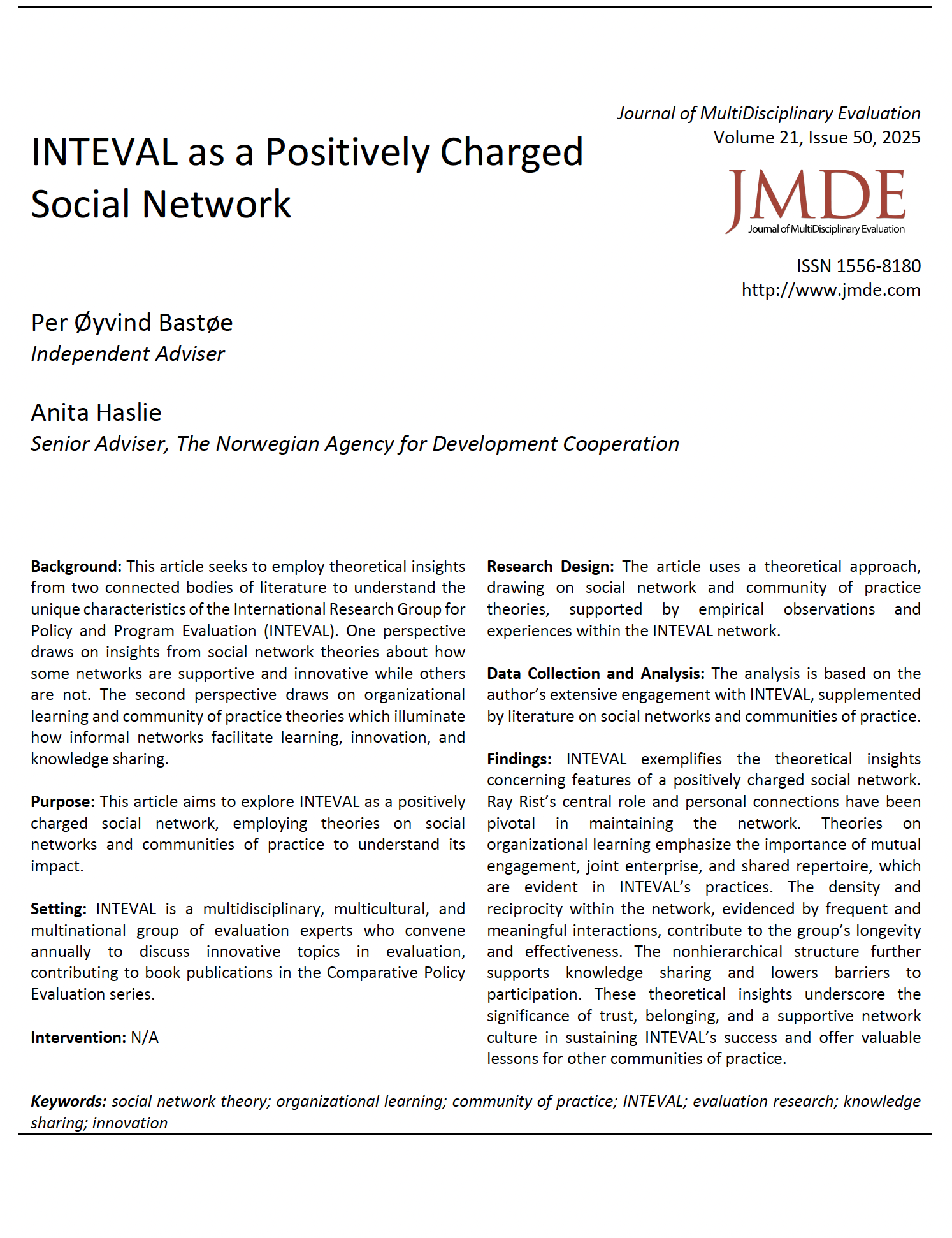
Background: In this article Bastøe and Haslie seeks to employ theoretical insights from two connected bodies of literature to understand the unique characteristics of The International Evaluation Research Group (Inteval). One perspective draws on insights from social network theories about how some networks are supportive and innovative while others are not. The second perspective draws on organizational learning and Community of Practice theories which illuminate how informal networks facilitate learning, innovation, and knowledge sharing.
Purpose: This article aims to explore Inteval as a positively charged social network, employing theories on social networks and communities of practice to understand its impact.
Setting: Inteval is a multidisciplinary, multicultural, and multinational group of evaluation experts who convene annually to discuss innovative topics in evaluation, contributing to book publications in the Comparative Policy Evaluation Series.
Intervention: N/A
Research Design: The article uses a theoretical approach, drawing on social network and community of practice theories, supported by empirical observations and experiences within the Inteval network.
Data Collection and Analysis: The analysis is based on the author's extensive engagement with Inteval, supplemented by literature on social networks and communities of practice.
Findings: Inteval exemplifies the theoretical insights concerning features of a positively charged social network. Ray Rist's central role and personal connections have been pivotal in maintaining the network. Theories on organizational learning emphasize the importance of mutual engagement, joint enterprise, and shared repertoire, which are evident in Inteval's practices. The density and reciprocity within the network, evidenced by frequent and meaningful interactions, contribute to the group's longevity and effectiveness. The non-hierarchic structure further supports knowledge sharing and lowers barriers to participation. These theoretical insights underscore the significance of trust, belonging, and a supportive network culture in sustaining Inteval’s success and offer valuable lessons for other communities of practice.
Downloads
Article Details

This work is licensed under a Creative Commons Attribution-NonCommercial 4.0 International License.
Copyright and Permissions
Authors retain full copyright for articles published in JMDE. JMDE publishes under a Creative Commons Attribution-NonCommercial 4.0 International License (CC BY - NC 4.0). Users are allowed to copy, distribute, and transmit the work in any medium or format for noncommercial purposes, provided that the original authors and source are credited accurately and appropriately. Only the original authors may distribute the article for commercial or compensatory purposes. To view a copy of this license, visit creativecommons.org
References
Filstad, C., Traavik, L. E. M., & Gorli, M. (2019). Belonging at work: The experiences, representations and meanings of belonging. Journal of Workplace Learning, 31(2), 116-142. https://doi.org/10.1108/JWL-06-2018-0081
Freeman, L. C. (2004). The development of social network analysis: A study in the sociology of science. Empirical Press.
Gamper, M. (2022). Social network theories: An overview. In A. Klärner, M. Gamper, S. Keim-Klärner, I. Moor, H. von der Lippe, & N. Vonneilich (Eds.). Social Networks and Health Inequalities. Springer. https://doi.org/10.1007/978-3-030-97722-1_3
Granovetter, M. (1973). Strength of weak ties. American Journal of Sociology, 78(6), 1360-1380. https://doi.org/10.1086/225469
Granovetter, M. (1985). Economic action and social structure: The problem of embeddedness. American Journal of Sociology, 91(3), 481-510. https://doi.org/10.1086/228311
Granovetter, M. (1983). The strength of weak ties: A network theory revisited. Sociological Theory, 1, 201-233. https://doi.org/10.2307/202051
Rist, R. C. (1999) The Preconditions for Learning: Lessons from the Public Sector. Chapter in Leeuw F, R.C. Rist and R.C. Sonnichsen (eds.) Can Governments Learn? Comparative Perspectives on Evaluation and Organizational Learning. Transaction Publishers.
Rist, R. C & Stame, N. (Eds.). (2006). From studies to streams. Transaction Publishers.
Schaut, P. (2022). The art of networking. Forbes.
Senge, P., Kleiner, A., Roberts, C., Ross, R., Roth, G., & Smith, B. (1999). The dance of change. Currency Doubleday.
Wenger, E. (1998). Communities of practice: Learning, meaning, and identity. Cambridge University Press. https://doi.org/10.1017/CBO9780511803932