
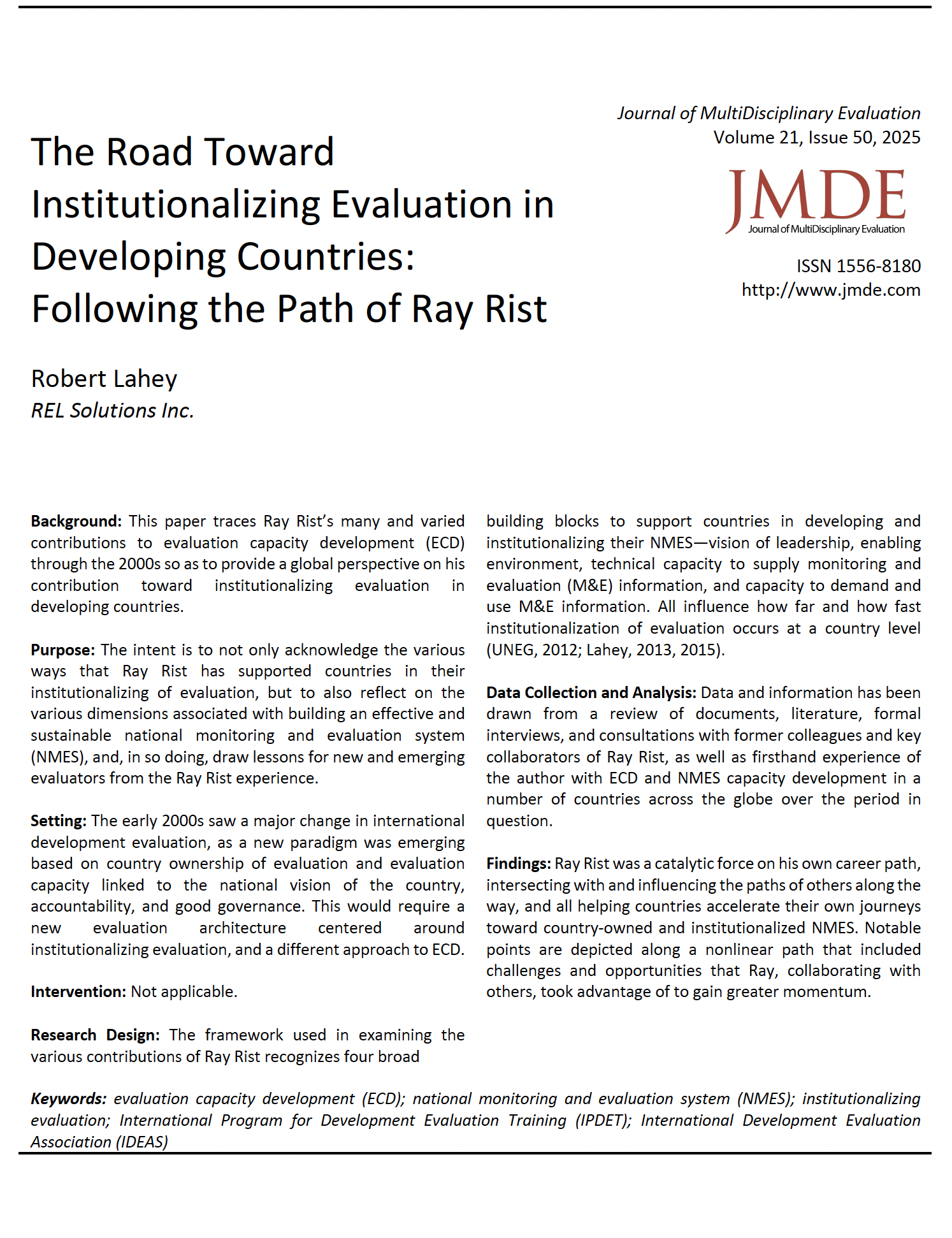
The Road Toward Institutionalizing Evaluation in Developing Countries: Following the Path of Ray Rist
Article Sidebar
Main Article Content
Abstract
Background: This paper traces Ray Rist’s many and varied contributions to evaluation capacity development (ECD) through the 2000s so as to provide a global perspective on his contribution towards institutionalizing evaluation in developing countries.
Purpose: The intent is to not only acknowledge the various ways that Ray Rist has supported countries in their institutionalizing of evaluation, but to also reflect on the various dimensions associated with building an effective and sustainable national monitoring and evaluation system (NMES), and, in so doing, draw lessons for new and emerging evaluators from the Ray Rist experience.
Setting: The early 2000s saw a major change in international development evaluation, as a new paradigm was emerging based on country ownership of evaluation and evaluation capacity that is linked to the national vision of the country, accountability, and good governance. This would require a new evaluation architecture centred around institutionalizing evaluation, and a different approach to ECD.
Intervention: Not applicable
Research design: The framework used in examining the various contributions of Ray Rist recognizes four broad building blocks to support countries develop and institutionalize their NMES – vision of leadership, enabling environment, technical capacity to supply monitoring and evaluation (M&E) information, and capacity to demand and use M&E information. All influence how far and how fast institutionalization of evaluation would occur at a country level (UNEG 2012; Lahey 2013; Lahey 2015).
Data collection and analysis: Data and information has been drawn from a review of documents, literature, formal interviews and consultations with former colleagues and key collaborators of Ray Rist, as well as first-hand experience of the author with ECD and NMES capacity development in a number of countries across the globe over the period in question.
Findings: Ray Rist was a catalytic force on his own career path, intersecting with and influencing the paths of others along the way, and all helping countries accelerate their own journeys towards country-owned and institutionalized NMES. Notable points are depicted along a non-linear path that included challenges and opportunities that Ray, collaborating with others, took advantage of to gain greater momentum.
Downloads
Article Details

This work is licensed under a Creative Commons Attribution-NonCommercial 4.0 International License.
Copyright and Permissions
Authors retain full copyright for articles published in JMDE. JMDE publishes under a Creative Commons Attribution-NonCommercial 4.0 International License (CC BY - NC 4.0). Users are allowed to copy, distribute, and transmit the work in any medium or format for noncommercial purposes, provided that the original authors and source are credited accurately and appropriately. Only the original authors may distribute the article for commercial or compensatory purposes. To view a copy of this license, visit creativecommons.org
References
Cousins, J. B., Elliott, C. E., & Gilbert, N. (2010). International Program for Development Evaluation Training (IPDET): Evaluation of program impact. IED, World Bank, and Carleton University.
Hagel, J., III. (2021, October 11). What motivates lifelong learners. Harvard Business Review.
Hamalainen, R., & Saarinen, E. (2007). Systems intelligence in leadership and everyday life. Systems Analysis Laboratory, Helsinki University of Technology.
Kusek, J., & Rist, R. C. (2004). Ten steps to a results-based monitoring and evaluation system: A handbook for development practitioners. World Bank.
Lahey, R. (2013). National performance reporting as a driver for national M&E development. In R. C. Rist, M.-H. Boily, & F. R. Martin (Eds.), Development evaluation in times of turbulence: Dealing with crises that endanger our future. World Bank. https://doi.org/10.1596/9780821398791_CH12 DOI: https://doi.org/10.1596/9780821398791_CH12
Lahey, R. (2015). Devising an appropriate strategy for capacity building of a national Monitoring and Evaluation system: Lessons from selected African countries. World Bank. https://doi.org/10.1596/22079 DOI: https://doi.org/10.1596/22079
Lahey, R. (2016). Why developing monitoring and evaluation capacity is critical to understanding and addressing issues of poverty and inequality. In R. C. Rist, F. P. Martin, & A. M. Fernandez (Eds.), Poverty, inequality, and evaluation: Changing perspectives. World Bank. https://doi.org/10.1596/978-1-4648-0703-9_ch11 DOI: https://doi.org/10.1596/978-1-4648-0703-9_ch11
Mackay, K. (2007). How to build M&E systems to support better government. World Bank. https://doi.org/10.1596/978-0-8213-7191-6 DOI: https://doi.org/10.1596/978-0-8213-7191-6
Menon, S. (2010). A perspective from the United Nations on national ownership and capacity in evaluation. In M. Segone (Ed.), From policies to results: Developing capacities for country monitoring and evaluation systems, UNICEF.
Morra-Imas, L., & Rist, R. C. (2023). What we can learn from the International Program for Development Evaluation Training (IPDET). New Directions for Evaluation, 177, 57-64. https://doi.org/10.1002/ev.20540 DOI: https://doi.org/10.1002/ev.20540
Morra-Imas, L., & Rist, R. C. (2009). The road to results: Designing and conducting effective development evaluations. World Bank. https://doi.org/10.1596/978-0-8213-7891-5 DOI: https://doi.org/10.1596/978-0-8213-7891-5
Picciotto, R., (2007). The new environment for development evaluation. American Journal of Evaluation, 28(4), 509-21. https://doi.org/10.1177/1098214007306371 DOI: https://doi.org/10.1177/1098214007306371
Rist, R. C., Boily, M.-H., & Martin, F. (2011). Influencing change: Building evaluation capacity to strengthen governance. World Bank Training Series. https://doi.org/10.1596/978-0-8213-8403-9 DOI: https://doi.org/10.1596/978-0-8213-8403-9
Rist, R. C., Boily, M.-H., & Martin, F. (Eds.). (2013). Development evaluation in turbulent times: Dealing with crises that endanger our future. World Bank. https://doi.org/10.1596/978-0-8213-9879-1 DOI: https://doi.org/10.1596/978-0-8213-9879-1
Rist, R. C., Martin, F., & Fernandez, A. (2016). Poverty, inequality, and evaluation: Changing Perspectives. World Bank. https://doi.org/10.1596/978-1-4648-0703-9 DOI: https://doi.org/10.1596/978-1-4648-0703-9
United Nations Evaluation Group (UNEG). (2012). National evaluation capacity development: