
Capacity Development in Evaluation: The Role of the International Program for Development Evaluation Training (IPDET)
Article Sidebar
Main Article Content
Abstract
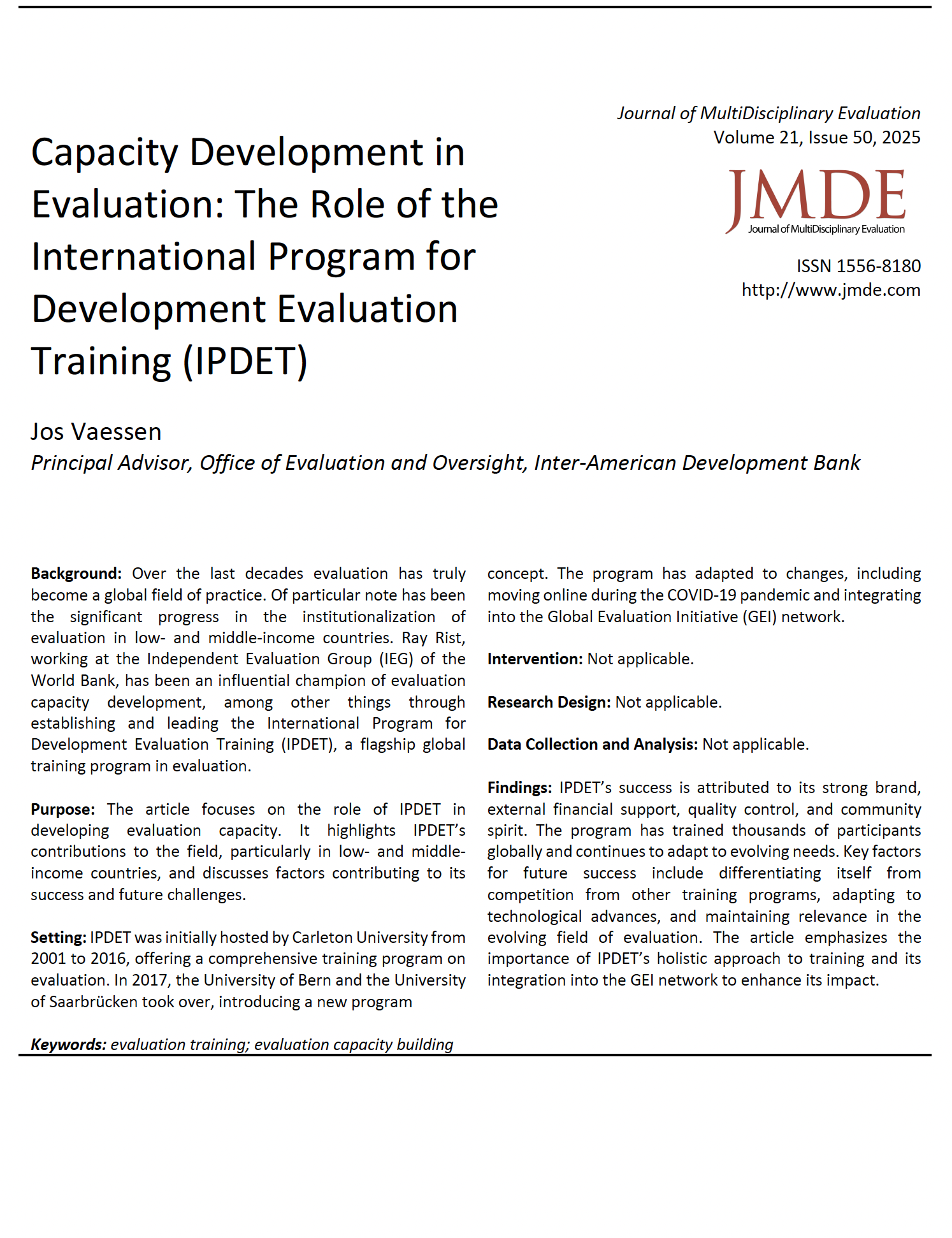
Background: Over the last decades evaluation has truly become a global field of practice. Of particular note has been the significant progress in the institutionalization of evaluation in low- and middle-income countries. Ray Rist, working at the Independent Evaluation Group (IPDET) of the World Bank, has been an influential champion of evaluation capacity development, among other things through establishing and leading the International Program for Development Evaluation Training (IPDET), a flagship global training program in evaluation.
Purpose: The article focuses on the role of IPDET in developing evaluation capacity. It highlights IPDET's contributions to the field, particularly in low- and middle-income countries, and discusses factors contributing to its success and future challenges.
Setting: IPDET was initially hosted by Carlton University from 2001 to 2016, offering a comprehensive training program on evaluation. In 2017, the University of Bern and the University of Saarbrücken took over, introducing a new program concept. The program has adapted to changes, including moving online during the COVID-19 pandemic and integrating into the Global Evaluation Initiative (GEI) network.
Findings: IPDET's success is attributed to its strong brand, external financial support, quality control, and community spirit. The program has trained thousands of participants globally and continues to adapt to evolving needs. Key factors for future success include differentiating itself from competition from other training programs, adapting to technological advances, and maintaining relevance in the evolving field of evaluation. The article emphasizes the importance of IPDET's holistic approach to training and its integration into the GEI network to enhance its impact.
Downloads
Article Details

This work is licensed under a Creative Commons Attribution-NonCommercial 4.0 International License.
Copyright and Permissions
Authors retain full copyright for articles published in JMDE. JMDE publishes under a Creative Commons Attribution-NonCommercial 4.0 International License (CC BY - NC 4.0). Users are allowed to copy, distribute, and transmit the work in any medium or format for noncommercial purposes, provided that the original authors and source are credited accurately and appropriately. Only the original authors may distribute the article for commercial or compensatory purposes. To view a copy of this license, visit creativecommons.org
References
Furubo, J. E., Rist, R. C., & Sandahl, R. (2002). International atlas of evaluation. Transaction Publishers.
World Bank Independent Evaluation Group. (2018). Independent evaluation group mandate. World Bank.
International Program for Development Evaluation Training. (2023). Tracer study 2014-2020.
Jacob, S., Speer, S., & Furubo, J. E. (2015). The institutionalization of evaluation matters: Updating the International Atlas of Evaluation 10 years later. Evaluation, 21(1), 6-31. https://doi.org/10.1177/1356389014564248
Kusek, J. Z., & Rist, R. C. (2004). Ten steps to a results-based monitoring and evaluation system: A handbook for development practitioners. World Bank Publications.
Morra Imas, L. G., & Rist, R. C. (2009). The road to results: Designing and conducting effective development evaluations. World Bank Publications. https://doi.org/10.1596/978-0-8213-7891-5
Morra Imas, L. G., and Rist, R. C. (2023). What we can learn from the international program for development evaluation training (IPDET). New Directions for Evaluation, 177, 57-64. https://doi.org/10.1002/ev.20540
Stockmann, R., Meyer, W., & Taube, L. (2020). The institutionalisation of evaluation in Europe. Palgrave Macmillan. https://doi.org/10.1007/978-3-030-32284-7