
The Interplay of Tangibles and Intangibles in Evaluation
Article Sidebar
Main Article Content
Abstract
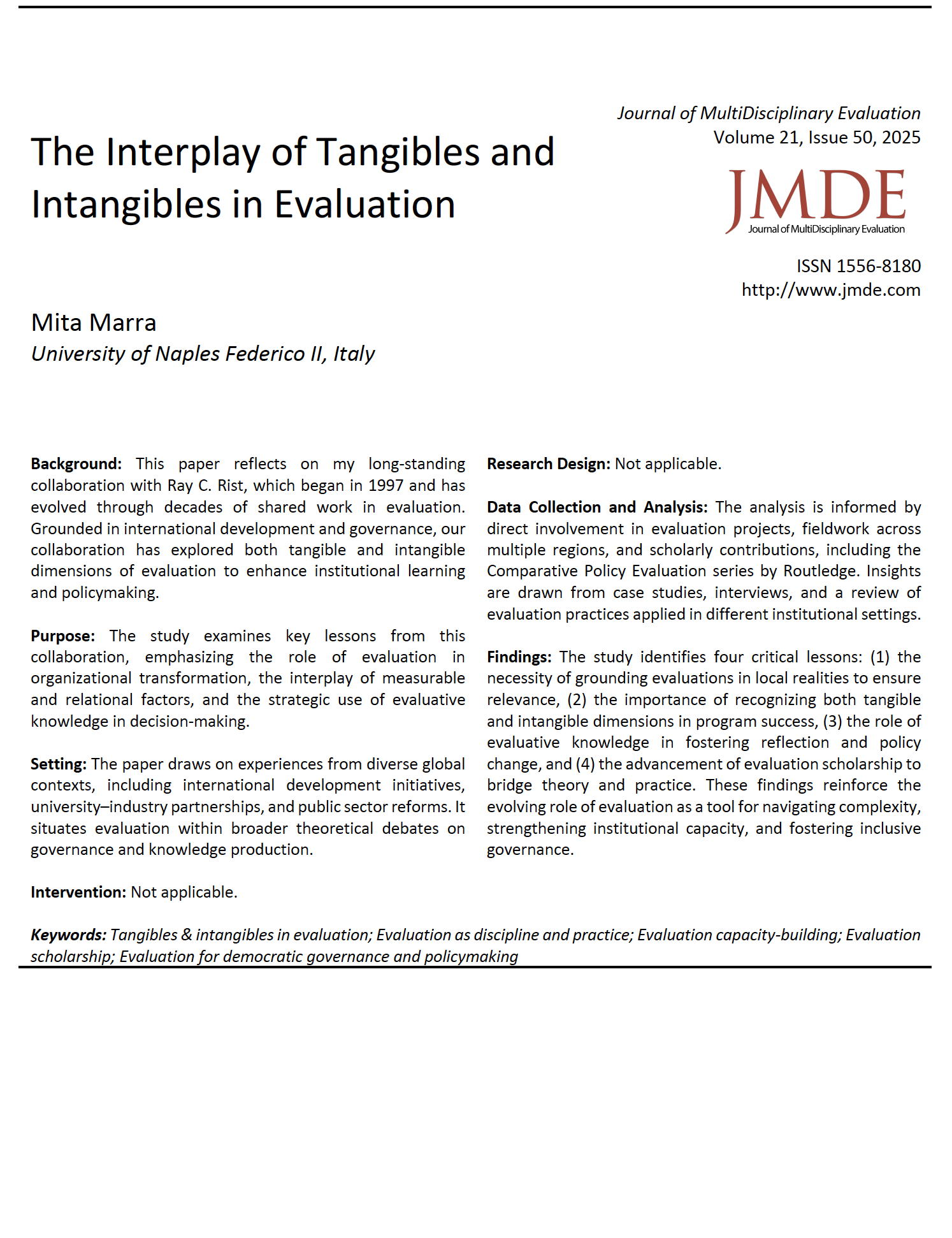
Background: This paper reflects on my long-standing collaboration with Ray C. Rist, which began in 1997 and has evolved through decades of shared work in evaluation. Grounded in international development and governance, our collaboration has explored both tangible and intangible dimensions of evaluation to enhance institutional learning and policymaking.
Purpose: The study examines key lessons from this collaboration, emphasizing the role of evaluation in organizational transformation, the interplay of measurable and relational factors, and the strategic use of evaluative knowledge in decision-making.
Setting: The paper draws on experiences from diverse global contexts, including international development initiatives, university-industry partnerships, and public sector reforms. It situates evaluation within broader theoretical debates on governance and knowledge production.
Data Collection: The analysis is informed by direct involvement in evaluation projects, fieldwork across multiple regions, and scholarly contributions, including the Comparative Policy Evaluation series. Insights are drawn from case studies, interviews, and a review of evaluation practices applied in different institutional settings.
Findings: The study identifies four critical lessons: (1) the necessity of grounding evaluations in local realities to ensure relevance, (2) the importance of recognizing both tangible and intangible dimensions in program success, (3) the role of evaluative knowledge in fostering reflection and policy change, and (4) the advancement of evaluation scholarship to bridge theory and practice. These findings reinforce the evolving role of evaluation as a tool for navigating complexity, strengthening institutional capacity, and fostering inclusive governance.
Downloads
Article Details

This work is licensed under a Creative Commons Attribution-NonCommercial 4.0 International License.
Copyright and Permissions
Authors retain full copyright for articles published in JMDE. JMDE publishes under a Creative Commons Attribution-NonCommercial 4.0 International License (CC BY - NC 4.0). Users are allowed to copy, distribute, and transmit the work in any medium or format for noncommercial purposes, provided that the original authors and source are credited accurately and appropriately. Only the original authors may distribute the article for commercial or compensatory purposes. To view a copy of this license, visit creativecommons.org
References
Colinet, L., & Marra, M. (2000). Fostering training partnerships in developing countries: An evaluation of the WBIEP partnership program FY98-FY99. World Bank Group.
Crouzet, N., Eberly, J. C., Eisfeldt, A. L., & Papanikolaou, D. (2022). The economics of intangible capital. Journal of Economic Perspectives, 36(3), 29-52. https://doi.org/10.1257/jep.36.3.29 DOI: https://doi.org/10.1257/jep.36.3.29
Doeringer, P. B., & Piore, M. J. (1985). Internal labor markets and manpower Analysis. M. E. Sharpe, Inc.
Forss, K., Marra, M., Schwartz, R. (2011) Evaluating the Complex. Attribution, Contribution and Beyond, New York, Routledge.
Furubo, J-E, Stame, N. (2019) The Evaluation Enterprise: A Critical View, New York, Routledge. https://doi.org/10.4324/9780429470202 DOI: https://doi.org/10.4324/9780429470202
Granovetter, M. (1985) Economic action and social structure: The problem of embeddedness. American Journal of Sociology, 91(3), 481-510. https://doi.org/10.1086/228311 DOI: https://doi.org/10.1086/228311
Guzman, J., Murray, F., Stern, S., & Williams, H. (2024). Accelerating innovation ecosystems: The promise and challenges of regional innovation engines. In B. Jones & J. Lerner (Eds.), Entrepreneurship and innovation policy and the economy (Vol. 3, pp. 9-76). The University of Chicago Press. https://doi.org/10.1086/727744 DOI: https://doi.org/10.1086/727744
Hagen-Zanker, J., Hennessey, G., & Mazzilli, C. (2023). Subjective and intangible factors in migration decision-making: A review of side-lined literature. Migration Studies, 11(2), 349-359. https://doi.org/10.1093/migration/mnad003 DOI: https://doi.org/10.1093/migration/mnad003
Hirschman, O. A. (1967). Development projects observed. The Brookings Institution.
Hirschman, O. A. (1984). Getting ahead collectively. Pergamon Press.
Marra, M. (2000) How much does evaluation matter? Some examples of the utilization of the evaluation of the World Bank's anti-corruption activities. Evaluation, 6(1), 22-36. https://doi.org/10.1177/13563890022209091 DOI: https://doi.org/10.1177/13563890022209091
Marra, M. (2004). Knowledge partnerships for development: What challenges for evaluation? Evaluation and Program Planning, 27, 151-160. https://doi.org/10.1016/j.evalprogplan.2004.01.003 DOI: https://doi.org/10.1016/j.evalprogplan.2004.01.003
Marra, M. (2005) Patterns of evaluative knowledge creation and utilization within the World Bank. In R. C. Rist & N. Stame (Eds.), From studies to streams: Managing evaluative systems. Routledge.
Marra, M. (2019) Italian Evaluation Policy. Centralization and Judicially Enforced Accountability. In Furubo, J-E, Stame, N. (Eds.) The Evaluation Enterprise: A Critical View, New York, Routledge.
Marra, M. (2021) A Behavioral Design to Reform Italy's Evaluation Policy, American Journal of Evaluation, 42(4), 483-504. https://doi.org/10.1177/1098214020972791 DOI: https://doi.org/10.1177/1098214020972791
Marra, M. (2024). Co-creating evaluation for policy relevance: The challenges of the post-truth world. In M. Marra, K. Olejniczak, & A. Paulson (Eds.), Evaluation in the post-truth world. New York, Routledge. https://doi.org/10.4324/9781032719979 DOI: https://doi.org/10.4324/9781032719979
Patton, M. Q. (2005). Qualitative research. Sage. https://doi.org/10.1002/0470013192.bsa514 DOI: https://doi.org/10.1002/0470013192.bsa514
Patton, M.Q. (2011) Developmental evaluation. Applying Complexity Concepts to Enhance Innovation and Use. New York, Guilford Press.
Polanyi, A. (1966). The tacit dimension. Chicago, University of Chicago Press.
Rist, R. C., & Stame, N. (2005). From studies to streams: Managing evaluative systems. New York, Routledge.