
What’s at Stake? Decolonization of Terminology in the United States
Article Sidebar
Main Article Content
Abstract
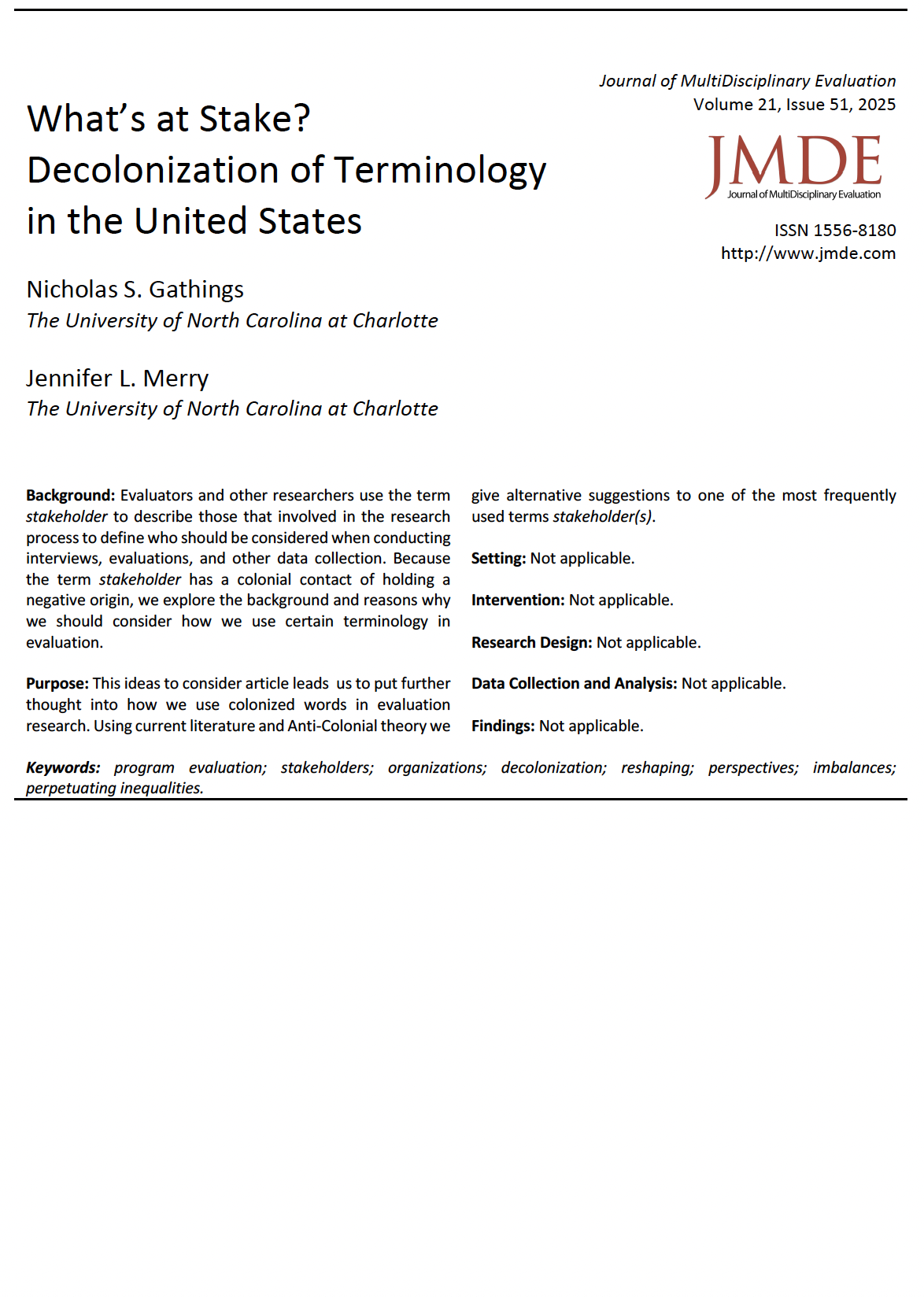
Every day in the United States, we use language that is oppressive and rooted in our colonial past. For this article, we specifically focus on the term stakeholder regarding evaluation research. Evaluators have defined this term as: “all of those individuals who have an interest (i.e., are somehow vested in) in the program that is to be evaluated." (Alkin & Vo, 2018, p. 51). However, little attention has been given to changing or reshaping this term to avoid perpetuating inequities to make program evaluations more culturally responsive to all parties involved. Historically, this terminology rooted in a colonial perspective is defined as “the person who drove a stake into the land to demarcate the land s/he was occupying/stealing from Indigenous territories” (Phipps, 2022). Even though the term is used frequently, many people may not understand the nature of the roots of this term and its involvement in the oppression of persons of color. Because of these points, it has been suggested that new terms be used in its stead (Sharfstein, 2016). We ask, after so many years of this country being independent of colonial rule, why are we still using terms that are oppressive and hold a connotation of being non-inclusive? This article aims to explore how terminology has been used in research and offers ideas to consider how to move forward with ensuring that the language used in program evaluation and other areas of research is culturally responsive to people and organizations affected by or show an interest in the findings of a given assessment.
Downloads
Article Details

This work is licensed under a Creative Commons Attribution-NonCommercial 4.0 International License.
Copyright and Permissions
Authors retain full copyright for articles published in JMDE. JMDE publishes under a Creative Commons Attribution-NonCommercial 4.0 International License (CC BY - NC 4.0). Users are allowed to copy, distribute, and transmit the work in any medium or format for noncommercial purposes, provided that the original authors and source are credited accurately and appropriately. Only the original authors may distribute the article for commercial or compensatory purposes. To view a copy of this license, visit creativecommons.org
References
Alkin, M. C., & Vo, A. T. (2018). Evaluation Essentials: From A to Z (2nd ed.). Guilford Publications.
Alm, K., & Guttormsen, D. S. (2021). Enabling the voices of marginalized groups of people in theoretical business ethics research. Journal of Business Ethics, 182, 1-18. https://doi.org/10.1007/s10551-021-04973-3
Altarriba, J., & Basnight-Brown, D. (2022). The psychology of communication: The interplay between language and culture through time. Journal of Cross-Cultural Psychology, 53(7-8), pp. 860-874. https://doi.org/10.1177/00220221221114046
Amin, H., Scheepers, H., & Malik, M. (2023). Project monitoring and evaluation to engage stakeholders of international development projects for community impact. International Journal of Managing Projects in Business, 16(2), 405-427. https://doi.org/10.1108/IJMPB-02-2022-0043
Banerjee, S. B. (2003). The practice of stakeholder colonialism: National interest and colonial discourses in the management of indigenous stakeholders. In A. Prasad (Ed.) Postcolonial theory and organizational analysis: A critical engagement (pp. 255-279). Palgrave Macmillan. https://doi.org/10.1057/9781403982292_11
Chowdhury, R. (2023). Misrepresentation of marginalized groups: A critique of epistemic neocolonialism. Journal of Business Ethics, 186(3), 553-570. https://doi.org/10.1007/s10551-022-05229-4
Daigneault, P., & Jacob,S.(2009). Toward accurate measurement of participation: Rethinking the conceptualization and operationalization of participatory evaluation. American Journal of Evaluation, 30, 330-348. https://doi.org/10.1177/1098214009340580
DeLancey, D. (2023). Decolonizing evaluation of Indigenous Land-based programs: A settler perspective on what we can learn from the landback movement. Journal of MultiDisciplinary Evaluation, 19(44). https://doi.org/10.56645/jmde.v19i44.773
Eskerod, P. (2020). A stakeholder perspective: Origins and core concepts. Oxford research encyclopedia of business and management. https://doi.org/10.1093/acrefore/9780190224851.013.3
Ladson-Billings, G. (2006, April). From the achievement gap to the education debt: Understanding achievement in US schools [Presidential address]. American Educational Research Association Annual Meeting, San Francisco, CA, USA. https://doi.org/10.3102/0013189X035007003
Library of Congress. (n.d.). Overview: Colonial settlement, 1600s-1763: U.S. history primary source timeline: Classroom materials at the Library of Congress: Library of Congress. https://www.loc.gov/classroom-materials/united-states-history-primary-source-timeline/colonial-settlement-1600-1763/overview/
Louie, D. W. (2024). Barriers to engaging with reconciliation in Canadian education: Confusing Colonial and Western Knowledge. Canadian Journal of Education / Revue Canadienne de l'éducation, 47(2), 466-491. https://doi.org/10.53967/cje-rce.6325
Macdonald, G., & McLees, A. (2021, August 3). Best of AEA365: As an evaluator, do I use words (e.g., stakeholder) that can be harmful to others? AEA 365. https://aea365.org/blog/best-of-aea365-as-an-evaluator-do-i-use-words-e-g-stakeholder-that-can-be-harmful-to-others-by-goldie-macdonald-anita-mclees/
Mark, M. M., Caracelli, V. J., Miller, R. L., & Bowman, N. (2025). The oral history of evaluation: Joan LaFrance, Indigenous evaluation, and attention to culture in evaluation. American Journal of Evaluation, 46(2), 172-186. https://doi.org/10.1177/10982140251319706
Narayanan, A. (2023). Decolonization near and far. Psychodynamic Practice, 29(4), 416-422. https://doi.org/10.1080/14753634.2023.2256736
National Museum of the American Indian | Smithsonian. (n.d.). Native knowledge 360°: The impact of words and tips for using appropriate terminology: Am I using the right word? https://americanindian.si.edu/nk360/informational/impact-words-tips
O'Connor, J., Parman, M., Bowman, N., & Evergreen, S. (2023). Decolonizing data visualization: A history and future of Indigenous data visualization. Journal of Multidisciplinary Evaluation, 19(44). https://doi.org/10.56645/jmde.v19i44.783
O'Day, J. A., & Smith, M. S. (2016). Quality and equality in American education: Systemic problems, systemic solutions. In I. Kirsch & H. Braun (Eds.), The dynamics of opportunity in America: Evidence and perspectives (pp. 297-358). Springer. https://doi.org/10.1007/978-3-319-25991-8_9
Patel, L. (2016). Decolonizing educational research: From ownership to answerability. Routledge. https://doi.org/10.4324/9781315658551
Phillips, R., Freeman, R. E., & Wicks, A. C. (2003). What stakeholder theory is not. Business Ethics Quarterly, 13(4), 479-502. https://doi.org/10.5840/beq200313434
Phipps, D. (2022, December 5). Switching from stakeholders. Research Impact Canada. https://researchimpact.ca/featured/switching-from-stakeholder/#:~:text=The%20issue%20with%20the%20word,occupying%2Fstealing%20from%20Indigenous%20territories
Plys, E., Moss, K. O., Jacklin, K., Yazzie, M., Tambor, E., Luers, E., Elam, L., Ahmad, N., Kunicki, Z. J., Malone, C., & Epstein-Lubow, G. (2024). Discontinuing the term "stakeholder" from the NIA impact collaboratory engaging partners team: An example of the process of language change in an organization. The American Journal of Geriatric Psychiatry, 33(2), 192-199. https://doi.org/10.1016/j.jagp.2024.08.016
Reed, M. S., Merkle, B. G., Cook, E. J., Hafferty, C., Hejnowicz, A. P., Holliman, R., Marder, I. D., Pool, U., Raymond, C. M, Wallen, K. E., Whyte, D., Ballesteros, M., Bhanbhro, S., Borata, S., Boyle, F., Brennan, M. L., Carmen, E., Conway, E. A., Everett, R. ... & Stroobant, M. (2024). Reimagining the language of engagement in a post-stakeholder world. Sustainability Science, 19, 1481-1490. https://doi.org/10.1007/s11625-024-01496-4
Research Impact Canada. (2022). Switching from stakeholder. Research Impact. https://researchimpact.ca/featured/switching-from-stakeholder/
Rodríguez-Campos, L. (2012). Stakeholder involvement in evaluation: Three decades of The American Journal of Evaluation. Journal of MultiDisciplinary Evaluation, 17, 57-79. https://doi.org/10.56645/jmde.v8i17.335
Roeder, T. (2013). Managing project stakeholders: Building a foundation to achieve project goals. Wiley. https://doi.org/10.1002/9781118654491
Scriven, M. (1991). Evaluation thesaurus. Sage Publications.
Sharfstein, J. M. (2016). Banishing "stakeholders." The Milbank Quarterly, 94(3), 476-479. https://doi.org/10.1111/1468-0009.12208
Smith, G. H. (2000). Protecting and respecting Indigenous knowledge. In M. Battiste (Ed.), Reclaiming Indigenous voice and vision (pp. 209-224). UBC Press. https://doi.org/10.59962/9780774853170-020
Smith, L. T. (1999). Decolonizing methodologies: Research and indigenous people. Zed Books.
Swartz, S. (2023). Psychoanalysis and colonialism: A contemporary introduction. Routledge. https://doi.org/10.4324/9781003036463
Traoré, R. (2007). Implementing Afrocentricity: Connecting students of African descent to their cultural heritage. The Journal of Pan African Studies, 1(10), 62-78.
Tuck, E., & Yang, K. W. (2012). Decolonization is not a metaphor. Decolonization: Indigeneity, education & society, 1(1), 1-40.
Waapalaneexkweew. (2018). Looking backward but moving forward: Honoring the sacred and asserting the sovereign in Indigenous evaluation. American Journal of Evaluation, 39(4), 543-568. https://doi.org/10.1177/1098214018790412
Yoon, E.-S., & Kerr, J. (2024). Editorial: Disrupting the status quo: Critical research, decolonization, and Indigenization. Canadian Journal of Education / Revue Canadienne de l'éducation, 47(2), iii-vi. https://doi.org/10.53967/cje-rce.6707