
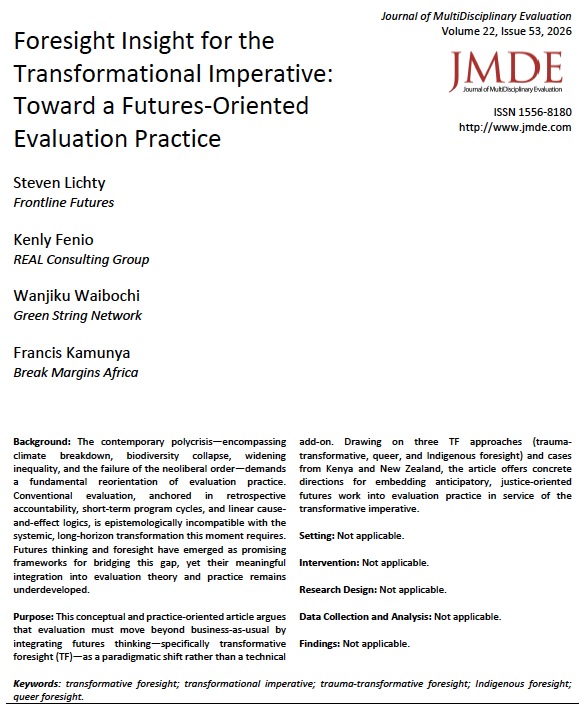
Foresight Insight for the Transformational Imperative: Toward a Futures-Oriented Evaluation Practice
Article Sidebar
Main Article Content
Abstract
This article argues that evaluation must radically reorient to meet the transformational imperative posed by the global polycrisis. It critiques evaluation-as-usual (e.g., retrospective, technocratic, and short-term) for reinforcing the systems it purports to assess, and proposes Transformative Foresight (TF) as not merely a technical shift, but as a paradigmatic reorientation that integrates anticipatory, participatory, and decolonial practices into evaluation, moving beyond incremental improvement toward systemic transformation. The authors use three TF subtypes—Trauma-Transformative, Queer, and Indigenous Foresight—that center healing, justice, and relationality in how futures are imagined, evidenced, and governed. A mini case study supports each subtype. This approach expands validity, rigor, and evidence to include affect, stories, ritual, and futures consciousness, and cultivate H2+ niches within the Three Horizons framework. Using Causal Layered Analysis and the Twelve Principles of Transformation-Focused Evaluation as scaffolds, the article repositions evaluators as companions of systemic transition rather than neutral auditors. It concludes with suggestions for funders, evaluators, and communities. They should adopt foresight-driven, justice-oriented practices. This will help make evaluation an anticipatory, reparative, and ecological tool. Together, they can co-create diverse, regenerative futures and support intergenerational accountability.
Downloads
Article Details

This work is licensed under a Creative Commons Attribution-NonCommercial 4.0 International License.
Copyright and Permissions
Authors retain full copyright for articles published in JMDE. JMDE publishes under a Creative Commons Attribution-NonCommercial 4.0 International License (CC BY - NC 4.0). Users are allowed to copy, distribute, and transmit the work in any medium or format for noncommercial purposes, provided that the original authors and source are credited accurately and appropriately. Only the original authors may distribute the article for commercial or compensatory purposes. To view a copy of this license, visit creativecommons.org
References
Bledsoe, K., Gonzales, F., & Guillen-Woods, B. (2022). The Eval Matrix. Strategic Learning Partners for Innovation. https://slp4i.com/matrix/
Buckton, S. J., Fazey, I., Ball, P., Ofir, Z., Colvin, J., Darby, M., Hejnowicz, A. P., Leicester, G., Newman, R., Page, G. G., Parsons, K., & van Mierlo, B. (2024). Twelve principles for transformation-focused evaluation. PLOS Sustainability and Transformation, 3(10), e0000164. https://doi.org/10.1371/journal.pstr.0000164
Butler, J. (2006). Gender trouble: Feminism and the subversion of identity (Anniversary ed.). Routledge. (Original work published 1990)
Campbell, K., Benoit, R., & Schacter, D. (2017). Priming, not inhibitions, of related concepts during future imagining. Memory, 25(9), 1235–1245. https://doi.org/10.1080/09658211.2017.1283420
Chaplowe, S., & Hejnowicz, A. (2021). Evaluating outside the box: Evaluation’s transformational potential. Social Innovations Journal, 5, 1–19. https://socialinnovationsjournal.com/index.php/sij/article/view/704
Chaplowe, S., Morkel, C., de la Garza, T., Buckton, S., Ferretti, S., Nandi, R., & Zaveri, S. (2026). Rethinking Evaluation Competencies for the Transformational Imperative. Journal of MultiDisciplinary Evaluation, 22(53) 41–69.
Cheok, J., van Velden, J., Fulton, E. A., Gordon, I. J., Lyons, I., Peterson, G. D., Wren, L., & Hill, R. (2025). Framings in Indigenous futures thinking: Barriers, opportunities, and innovations. Sustainability Science, 20, 613–633. https://doi.org/10.1007/s11625-024-01615-1
Colman, F. (2012). Deleuze and queer theory. Edinburgh University Press.
Cozolino, L. (2010). The neuroscience of psychotherapy: Healing the social brain (2nd ed.). W.W. Norton and Company.
Curry, A. (2021). A critical history of scenarios. In C. López Galviz & E. Spiers (Eds.), Routledge handbook of social futures (pp. 19–37). Routledge.
D’Argembeau, A. (2012). Autobiographical memory and future thinking. In D. Berntsen & D. C. Rubin (Eds.), Understanding autobiographical memory: Theories and approaches (pp. 311–330). Cambridge University Press.
Dazzo, G. P. (2025). Evaluation as reparation, reclamation, and renewal: Reorienting our justice signposts toward restorative validity. American Journal of Evaluation. Advance online publication. https://doi.org/10.1177/10982140251350093
Dean-Coffey, J., Gwynn, C., Mertens, D. M., & Ortiz Aragón, A. (2022). Transforming research and evaluation. In A. L. Plough (Ed.), Necessary Conversations (pp. 171–185). Oxford University Press. https://doi.org/10.1093/oso/9780197641477.003.0016
Edelman, L. (2004). No future: Queer theory and the death drive. Duke University Press.
Education Review Office. (2018). Te whāriki: Awareness and confidence to work with Te whāriki 2017. https://www.ero.govt.nz/publications/awareness-and-confidence-to-work-with-te-whariki-2017
Esteve, A., & Reher, D. S. (2024). Trends in living arrangements around the world. Population and Development Review, 50(1), 211–232. https://doi.org/10.1111/padr.12603
Feukeu, K. E. (2024). A pluriversal definition of futures studies: Critical futures studies from margin to centre. In R. Poli (Ed.), Handbook of futures studies (pp. 80–97). Edward Elgar Publishing.
Feukeu, K. E., Ajilore, B., & Bourgeois, R. (2021). The capacity to decolonise: Building futures literacy in Africa (IDRC Policy Brief). International Development Research Centre. https://idl-bnc-idrc.dspacedirect.org/items/786dd036-9572-4334-93c8-6cd4cc8a156d
Fish, J., Uink, B., Wiglesworth, A., Tsethlikai, M., Him, D. A., & O’Keefe, V. M. (2023). For the next seven generations: An Indigenous strengths-based developmental science. https://doi.org/10.31234/osf.io/hr28s
Gramsci, A. (1971). Selections from the prison notebooks of Antonio Gramsci (Q. Hoare & G. Nowell-Smith, Trans. & Eds.). International Publishers. (Original work written 1929–1935)
Halberstam, J. J. (2005). In a queer time and place: Transgender bodies, subcultural lives. New York University Press.
Inayatullah, S. (1998). Pedagogy, culture and futures studies. Metafuture. https://www.metafuture.org/pedagogy-culture-and-futures-studies-2/
Inayatullah, S. (2004). The causal layered analysis (CLA) reader: Theory and case studies of an integrative and transformative methodology. Tamkang University Press.
Inayatullah, S. (2008). Six pillars: Futures thinking for transforming. Foresight, 10(1), 4–21.
Inayatullah, S. (2019). Futures through stories. Critical Muslim, 29, 55–69.
Inayatullah, S. (2020). A castle surrounded by hungry wolves: Toward a stage theory of the uses of the future. World Futures Review, 12(1), 40–54. https://doi.org/10.1177/1946756719878792
Inayatullah, S., & Sweeney, J. A. (2020). The caravan and the narrative: Transformative foresight for uncertain times. World Futures Review, 12(4), 348–357.
Kativu, S. N., Mella, G. E., Muunda, C., & Hornidge, A.-K. (2025). When adults play, futures unravel: Towards the ethnography of future-making through play-centric methodology in rural Africa. Futures, 174, 1-17. https://doi.org/10.1016/j.futures.2025.10370.
Kimmerer, R. W. (2013). Braiding sweetgrass: Indigenous wisdom, scientific knowledge and the teachings of plants. Milkweed Editions.
LaDuke, W. (1999). All our relations: Native struggles for land and life. South End Press.
Lichty, S. (2022). Trauma-informed futures and empowered youth: Making the triple dividend a reality in marginalised communities in Kenya [Doctoral dissertation, Stellenbosch University].
Lichty, S. (2025). Trauma-transformative foresight: Exploring the liminal spaces between futures unconsciousness and futures consciousness. Journal of Futures Studies, 29(4), 57–73. https://doi.org/10.6531/JFS.202506_29(4).0006
Lichty, S., & Kamunya, F. (2023). The intersection of trauma-informed futures and the coloniality of sexuality: Building futures consciousness with Kenya’s LGBTQI+ community. Foresight, 25(1), 63–78. https://doi.org/10.1108/FS-10-2021-0219
Lynn, J., Vataja, K., & Thompson Coon, R. (2024). Bringing a futures mindset to evaluation. In K. E. Newcomer & S. W. Mumford (Eds.), Research handbook on program evaluation (pp. 649–666). Edward Elgar Publishing. https://doi.org/10.4337/9781803928289.00043
Macfarlane, A., Glynn, T., Cavanagh, T., & Bateman, S. (2007). Creating culturally safe schools for Māori students. The Australian Journal of Indigenous Education, 36, 65–76.
Mbah, M. F., Bailey, M., & Shingruf, A. (2024). Considerations for relational research methods for use in Indigenous contexts: Implications for sustainable development. International Journal of Social Research Methodology, 27(4), 431–446. https://doi.org/10.1080/13645579.2023.2185345
Mertens, D. M., Cram, F., & Chilisa, B. (Eds.). (2013). Indigenous pathways into social research: Voices of a new generation. Left Coast Press.
Mikkolainen, P. (2021). Evaluation must become future-sensitive: Easy-to-implement ideas on how to do it in practice. NIRAS International Consulting. https://www.niras.com/media/rghbpvri/evaluation_future_sensitive.pdf
Milojević, I., & Inayatullah, S. (2015). Narrative foresight. Futures, 73, 1–5.
Ministry of Health. (2023). A Kaupapa Māori informed approach to commissioning mental health and addiction services: Commissioning for Pae Ora | Healthy Futures case study. Manatū Hauora. https://www.health.govt.nz/system/files/2023-01/case-study-a-kaupapa-maori-informed-approach-commissioning-for-pae-ora-jan23.pdf
Minkkinen, M., Auffermann, B., & Ahokas, I. (2019). Six foresight frames: Classifying policy foresight processes in foresight systems according to perceived unpredictability and pursued change. Technological Forecasting and Social Change, 149, 119753. https://doi.org/10.1016/j.techfore.2019.119753
Mullally, S. L., & Maguire, E. A. (2014). Memory, imagination, and predicting the future: A common brain mechanism? The Neuroscientist, 20(3), 220–234. https://doi.org/10.1177/1073858413495091
Muñoz, J. E. (2009). Cruising utopia: The then and there of queer futurity. NYU Press.
Murove, M. F. (2009). An African environmental ethic based on the concepts of ukama and ubuntu. In M. F. Murove (Ed.), African ethics: An anthology of comparative and applied ethics (pp. 315–331). University of KwaZulu-Natal Press.
Nandy, A. (1996). Bearing witness to the future. Futures, 28(6–7), 636–639.
Ofir, Z., Kendrick, I., Goldman, I., Ferretti, S., Norins, J., Sithole, S., Belzer, A., Chaplowe, S., Diwakar, Y., Kalugampitiya, A., Lareza, A. E., Verveld-Nguyen, L., & Zaveri, S. (2026). Where Next for Evaluation? Navigating the Polycrisis Through Three Horizons. Journal of MultiDisciplinary Evaluation, 22(53), 12–40.
Park, J., Wilcox, K., & Ineese-Nash, N. (2023). A world fit for the next seven generations: Upholding Indigenous rights for the foundation of a sustainable future. Canadian Journal of Children’s Rights, 10(1), 1–25.
Patton, G. C., Sawyer, S. M., Santelli, J. S., Ross, D. A., Afifi, R., Allen, N. B., Arora, M., Azzopardi, P., Baldwin, W., Bonell, C., Kakuma, R., Kennedy, E., Mahon, J., McGovern, T., Mokdad, A. H., Patel, V., Petroni, S., Reavley, N., Taiwo, K., Waldfogel, J., Wickremarathne, D., Barroso, C., Bhutta, Z., Fatusi, A. O., Mattoo, A., Diers, J., Fang, J., Ferguson, J., Ssewamala, F., & Viner, R. M. (2016). Our future: A Lancet commission on adolescent health and wellbeing. The Lancet, 387(10036), 2423–2478.
Patton, M. Q. (2019). Blue Marble Evaluation: Premises and principles. Guilford Press.
Phichonsatcha, T., Gerdsri, N., & Pentrakoon, D. (2024). Exploring the benefits of applying Indigenous knowledge (IK) into foresight process. Foresight, 26(1), 181–202. https://doi.org/10.1108/FS-10-2022-0134
Pohatu, T. W. (2017). Mātauranga-ā-whānau – He Kōnae Aronui. Aotearoa New Zealand Social Work, 27(4), 32–38. https://doi.org/10.11157/anzswj-vol27iss4id435
Popper, R. (2008). How are foresight methods selected? Foresight, 10(6), 62–89. https://doi.org/10.1108/14636680810918586
Raciti, M. (2024, August 15). Beyond the horizon: Imagining utopian Indigenous futures. IndigenousX. https://indigenousx.com.au/beyond-the-horizon-imagining-utopian-indigenous-futures/
Ramos, J. (2002). From critique to anticipation: The role of critical futures studies in social transformation [Doctoral dissertation, University of Hawaii at Manoa].
Ramos, J. (2016, Summer). The future of work. STIR: The Magazine for the New Economy, 14. https://www.stirtoaction.com/magazine-issues/issue-14
Rao, R. (2020). Out of time: The queer politics of postcoloniality. Oxford University Press.
Raworth, K. (2018, August 8). Three Horizons Framework - a quick introduction [Video]. YouTube. https://www.youtube.com/watch?v=_5KfRQJqpPU
Rhemann, M. (2019). Deepening futures with neuroscience. World Futures Review, 11(1), 51–68.
Sardar, Z. (2010). The namesake: Futures; futures studies; futurology; futuristic; foresight—What’s in a name? Futures, 42(3), 177–184.
Schacter, D. L., & Addis, D. R. (2007). The cognitive neuroscience of constructive memory: Remembering the past and imagining the future. Philosophical Transactions of the Royal Society B: Biological Sciences, 362(1481), 773–786. https://doi.org/10.1098/rstb.2007.2087
Sharpe, B., Hodgson, A., Leicester, G., Lyon, A., & Fazey, I. (2016). Three horizons: A pathways practice for transformation. Ecology and Society, 21(2), 47. https://doi.org/10.5751/ES-08388-210247
Slaughter, R. A. (1998). Futures studies as an intellectual and applied discipline. American Behavioral Scientist, 42(3), 372–385.
Stacey, J. (1996). In the name of the family: Rethinking family values in the postmodern age. Beacon Press.
Sweeney, J. (2023, August 15). Aperture: An approach for transformative futures & foresight (Part 1). Medium. https://medium.com/@aloha_futures/aperture-an-approach-for-transformative-futures-foresight-part-one-of-6508958cf938
SwedBio. (2021). Indigenous futures thinking. Stockholm Resilience Centre, Stockholm University. https://swed.bio/wp-content/uploads/2021/10/UNIV-8247-SRC-Report-Futures-Thinking_WEB.pdf
Terblanché-Greeff, A. C. (2019). Ubuntu and environmental ethics: The West can learn from Africa when faced with climate change. In M. Chemhuru (Ed.), African environmental ethics: A critical reader (pp. 93–109). Springer. https://doi.org/10.1007/978-3-030-18807-8_7
Therborn, G. (2004). Between sex and power: Family in the world, 1900–2000. Routledge.
Thompson Coon, R., Vataja, K., & Parkkonen, P. (2024). Fusing foresight and futures thinking for a new transformative evaluation paradigm. New Directions for Evaluation, 182, 1–11. https://doi.org/10.1002/ev.20607
United Nations Development Programme. (2018). Foresight manual: Empowered futures for the 2030 agenda. https://www.undp.org/sites/g/files/zskgke326/files/publications/UNDP_ForesightManual_2018.pdf
United Nations Environment Programme. (2024). Navigating new horizons: A global foresight report on planetary health and human wellbeing. https://wedocs.unep.org/20.500.11822/45890
van den Berg, R. D., Magro, C., & Adrien, M.-H. (Eds.). (2021). Transformational evaluation for the global crises of our times. IDEAS.
Vásquez-Fernández, A., Shuñaqui, M., Ahenakew, C., Pérez, M., Sebastián, R., Canayo, J., & Kozak, R. A. (2021). From “mutual respect” to “intercultural respect”: Collaborating with Asheninka and Yine peoples in the Peruvian Amazon. The Journal of Legal Pluralism and Unofficial Law, 53(1), 127–153. https://doi.org/10.1080/07329113.2021.1889791
Waibochi, W., Lichty, S., Yoder-Maina, A., Gache, Y., & Mwachausa, M. (2023). Community-led healing journeys: Reconciling the past, re-engaging in the present, and redesigning the future. Green String Network
Warner, M. (1999). The trouble with normal: Sex, politics, and the ethics of queer life. Harvard University Press.
Whyte, K. P. (2018). Indigenous science (fiction) for the Anthropocene: Ancestral dystopias and fantasies of climate change crises. Environment and Planning E: Nature and Space, 1(1–2), 224–242. https://doi.org/10.1177/2514848618777621
WEF [World Economic Forum]. (2025). The global risks report 2025 (20th ed.). https://www.weforum.org/publications/global-risks-report-2025/
World Health Organization. (2018). Adolescent health: The missing population in universal health coverage. https://www.aidsdatahub.org/sites/default/files/resource/iap-adolescent-health-missing-population-uhc-2019.pdf