
AI and Evaluation: Exploring Made in Africa Approaches for Transformational Practice
Article Sidebar
Main Article Content
Abstract
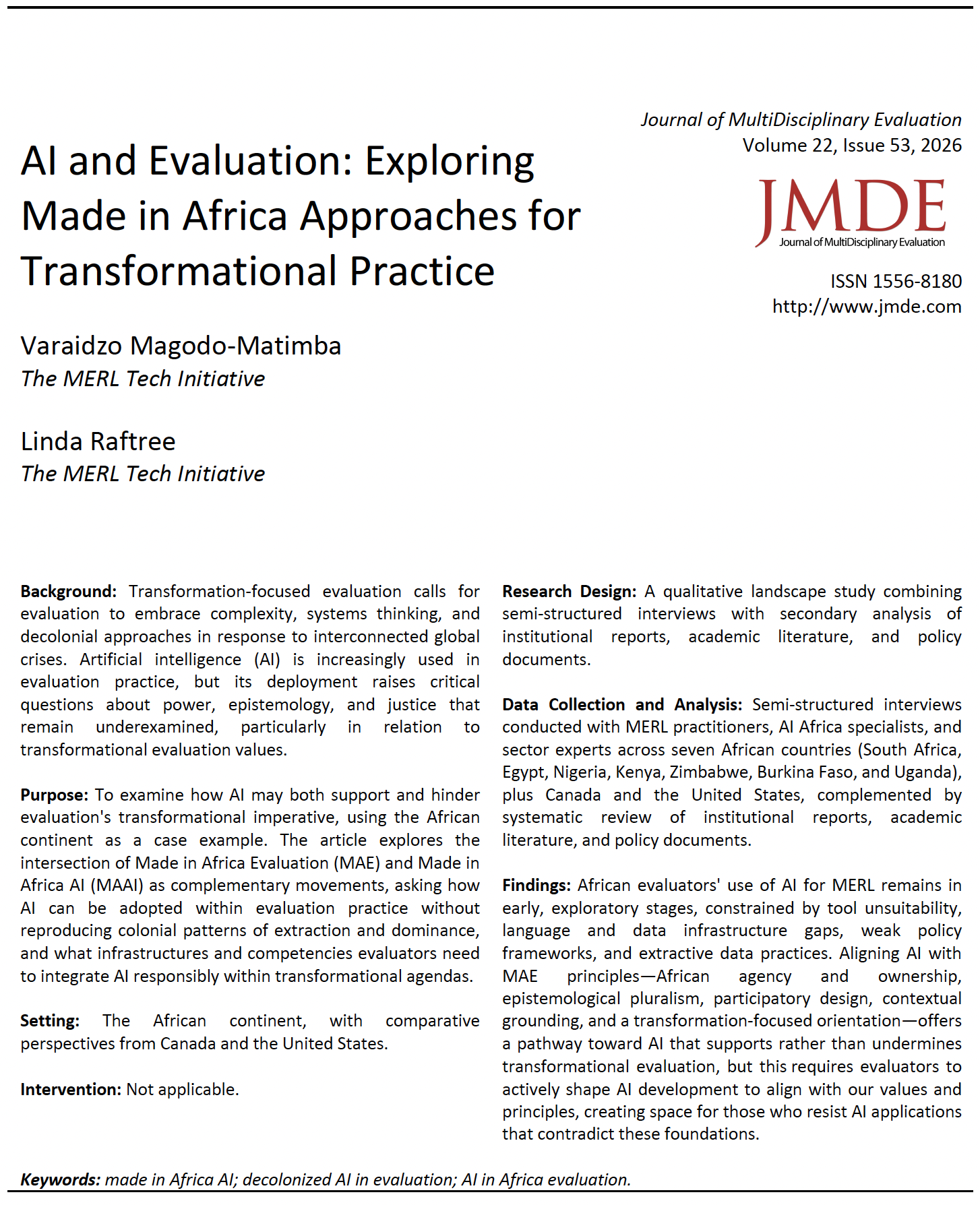
Artificial intelligence (AI) presents both transformational opportunities and challenges for evaluation practice in an era of interconnected global crises. This article examines how evaluators can engage AI in ways that align with the transformational imperative and decolonial commitments, rather than reproducing extractive or exclusionary practices. The central questions guiding this inquiry are: How can AI technologies be adopted within evaluation practice without reproducing colonial patterns of extraction and dominance? What essential infrastructures and competencies do evaluators need to integrate AI systems responsibly within transformational agendas? Drawing on “Made in Africa Evaluation” (MAE) and “Made in Africa AI” (MAAI) as intersecting movements, the article examines tensions between growing interest in AI and fundamental concerns about current AI systems. Environmental costs (energy and water use), extractive labour arrangements, and Western-biased datasets raise questions about alignment with transformational imperatives. The concentration of AI development within Western corporations further challenges decolonized evaluation efforts. Through a decolonial analysis of MAE and MAAI experiences, we show how these movements clarify both practical opportunities for AI-enabled evaluation and the risks of reinforcing existing power asymmetries. Together, they offer pathways toward AI adoption that centers African contexts, languages, and epistemologies while promoting equitable and sustainable evaluation practice.
Downloads
Article Details

This work is licensed under a Creative Commons Attribution-NonCommercial 4.0 International License.
Copyright and Permissions
Authors retain full copyright for articles published in JMDE. JMDE publishes under a Creative Commons Attribution-NonCommercial 4.0 International License (CC BY - NC 4.0). Users are allowed to copy, distribute, and transmit the work in any medium or format for noncommercial purposes, provided that the original authors and source are credited accurately and appropriately. Only the original authors may distribute the article for commercial or compensatory purposes. To view a copy of this license, visit creativecommons.org
References
Adams, R. (2022). AI in Africa: Key concerns and policy considerations for the future of the continent (Policy Brief No. 8). Africa Policy Research Institute. https://afripoli.org/ai-in-africa-key-concerns-and-policy-considerations-for-the-future-of-the-continent
African Union Development Agency-NEPAD. (2024). AI and the future of work in Africa [White paper]. https://www.nepad.org/publication/ai-and-future-of-work-africa-white-paper
Arrillaga, E. S., Grundhoefer, S., & Im, C. (2025). AI with purpose: How foundations and nonprofits are thinking about and using artificial intelligence. Center for Effective Philanthropy. https://cep.org/wp-content/uploads/2025/09/CEP_AI_Layout_FINAL.pdf
Banya, R. M. (2025, July 30). Africa’s digital sovereignty trap: The data center dilemma. New America. https://www.newamerica.org/planetary-politics/briefs/africas-digital-sovereignty-trap/
Becker, B. (2020). Colonial legacies in international aid: Policy priorities and actor constellations. In C. Schmitt (Ed.) From colonialism to international aid: Global dynamics of social policy. Palgrave Macmillan. https://doi.org/10.1007/978-3-030-38200-1_7
Bender, E. M., Gebru, T., McMillan-Major, A., & Shmitchell, S. (2021). On the dangers of stochastic parrots: Can language models be too big? In Proceedings of the 2021 ACM Conference on Fairness, Accountability, and Transparency (FAccT’21) (pp. 610-623). Association for Computing Machinery. https://doi.org/10.1145/3442188.3445922
Birhane, A. (2023) Algorithmic colonization of Africa. In S. Cave & K. Dihal (Eds), Imagining AI: How the world sees intelligent machines. Oxford. https://doi.org/10.1093/oso/9780192865366.003.0016
Birhane, A., Kalluri, P., Card, D., Agnew, W., Dotan, R., & Bao, M. (2022). The values encoded in machine learning research. In Proceedings of the 2022 ACM Conference on Fairness, Accountability, and Transparency (pp. 173–184).
Boadu, E. S. (2023). Factors affecting the integration of cultural values into evaluation: Indigenous perspectives. African Evaluation Journal, 11(1), a702. https://doi.org/10.4102/aej.v11i1.702
Buckton, S. J., Fazey, I., Ball, P., Ofir, Z., Colvin, J., Darby, M., Hejnowicz, A. P., Leicester, G., Newman, R., Page, G. G., Parsons, K., & van Mierlo, B. (2025). Twelve principles for transformation-focused evaluation. PLOS Sustainability and Transformation, 4, Article 4. https://doi.org/10.1371/journal.pstr.0000164
Centre for Intellectual Property and Information Technology Law (CIPIT). (2025). The state of AI in Africa report 2025. Strathmore University. https://cipit.strathmore.edu
Chaplowe, S., & Hejnowicz, A. (2021). Evaluating outside the box: Evaluation's transformational potential. Social Innovations Journal, 5, 1–19. https://socialinnovationsjournal.com/index.php/sij/article/view/704
Chaplowe, S., & Mukoma, J. (2023). Evaluation and the transformational imperative (EVALSDGs Insight #17). EVALSDGs. https://evalsdgs.org/2023/10/11/evalsdgs-insight-17-evaluation-and-the-transformational-imperative/
Chatterji, A., Cunningham, T., Deming, D. J., Hitzig, Z., Ong, C., Shan, C. Y., & Wadman, K. (2025, September). How people use ChatGPT (NBER Working Paper No. 34255). National Bureau of Economic Research. https://doi.org/10.3386/w34255
Chiba, D., & Heinrich, T. (2019). Colonial legacy and foreign aid: Decomposing the colonial bias. International Interactions, 45(3), 474–499. https://doi.org/10.1080/03050629.2019.1593834
Chilisa, B. (2019). Indigenous research methodologies (2nd ed.). Sage Publications.
Chilisa, B., Major, T. E., Gaotlhobogwe, M., & Mokgolodi, H. (2016). Decolonizing and indigenizing evaluation practice in Africa: Toward African relational evaluation approaches. Canadian Journal of Program Evaluation, 30(3), 313–328. https://doi.org/10.3138/cjpe.30.3.05
Chinagorom-Abiakalam, D. (2025, August 24). Africa’s role in the future of artificial intelligence. The Republic. https://rpublc.com/vol9-no3/future-of-artificial-intelligence/
CIF. (2021). Transformational change concepts (Transformational Change Learning Brief). Climate Investment Funds (CIF) https://www.cif.org/sites/cif_enc/files/knowledge-documents/tc_concepts_brief.pdf
Climate Change AI. (n.d.). Climate Change AI. https://www.climatechange.ai/
Coleman, D. (2019). Digital colonialism: The 21st century scramble for Africa through the extraction and control of user data and the limitations of data protection laws. Michigan Journal of Race & Law, 24(2), 417–462. https://repository.law.umich.edu/mjrl/vol24/iss2/6/
EvalSDGs. (2023, November 10). EvalSDGs insight 17: Evaluation and the transformational imperative. https://evalsdgs.org/2023/10/11/evalsdgs-insight-17-evaluation-and-the-transformational-imperative/
Fish, T. E. (2022). An evidence gap map on Made in Africa Evaluation approaches: Exploration of the achievements. African Evaluation Journal, 10(1), Article a626. https://doi.org/10.4102/aej.v10i1.626
Gil de Zúñiga, H., Goyanes, M., & Durotoye, T. (2023). A scholarly definition of artificial intelligence (AI): Advancing AI as a conceptual framework in communication research. Political Communication, 41(2), 317–334. https://doi.org/10.1080/10584609.2023.2290497
Gray, M. L., & Suri, S. (2019). Ghost work: How to stop Silicon Valley from building a new global underclass (Illustrated ed.). Houghton Mifflin Harcourt.
Greenstein, N., & Cho, S.-W. (2025). Ethics & equity in data science for evaluators. In S. B. Nielsen, F. Mazzeo Rinaldi, & G. J. Petersson (Eds.), Artificial intelligence and evaluation: Emerging technologies and their implications for evaluation (pp. 56–77). Routledge. https://doi.org/10.4324/9781003512493
Gothoskar, N. (2024, September 13). The hidden costs of the AI boom. People’s Dispatch. https://peoplesdispatch.org/2024/09/13/the-hidden-costs-of-the-ai-boom/
Head, B. W., Gurd, B., & Ferguson, M. (2024). Transformational evaluation: Addressing wicked problems through reflexive praxis. Evaluation, 30(1), 8–25. https://doi.org/10.1177/13563890231215789
Head, C. B., Jasper, P., McConnachie, M., Raftree, L., & Higdon, G. L. (2023). Large language model applications for evaluation: Opportunities and ethical implications. New Directions for Evaluation, 180, 9–26. https://doi.org/10.1002/ev.20556
Humeau, E., & Deshpande, T. (2024). AI for Africa: Use cases delivering impact. GSMA. https://www.gsma.com/solutions-and-impact/connectivity-for-good/mobile-for-development/wp-content/uploads/2024/07/AI_for_Africa.pdf
Hussen, K. Y., Sewunetie, W. T., Ayele, A. A., Imam, S. H., Alemu, E. N., Muhammad, S. H., & Yimam, S. M. (2025). The state of large language models for African languages: Progress and challenges. arXiv. https://arxiv.org/pdf/2506.02280v1
International Labour Organization. (2023). World employment and social outlook: Trends 2023. https://www.ilo.org/publications/flagship-reports/world-employment-and-social-outlook-trends-2023
Iyer, N. (2023). Digital extractivism in Africa mirrors colonial practices. Stanford HAI. https://hai.stanford.edu/news/neema-iyer-digital-extractivism-africa-mirrors-colonial-practices
JMDE. (2023). Special issue: Decolonizing evaluation: Towards a fifth paradigm [Special issue]. Journal of MultiDisciplinary Evaluation, 19(44), 1–246. https://doi.org/10.56645/jmde.v19i44
Lawrence, M., Homer-Dixon, T., Janzwood, S., Rockström, J., Renn, O., & Donges, J. F. (2024). Global polycrisis: The causal mechanisms of crisis entanglement. Global Sustainability, 7, e6. https://doi.org/10.1017/sus.2024.1
Leeson, W., Resnick, A., Alexander, D., & Rovers, J. (2019). Natural language processing (NLP) in qualitative public health research: A proof of concept study. International Journal of Qualitative Methods, 18. https://doi.org/10.1177/1609406919887021
Luo, C. (2025). Data colonialism and the new extractivism: How digital platforms recreate colonial resource extraction. SSRN Electronic Journal. https://doi.org/10.2139/ssrn.5352498
Magodo-Matimba, V. (2025a). Made in Africa artificial intelligence approaches in monitoring, evaluation, research and learning: A practitioner perspective and landscape study. The MERL Tech Initiative. https://merltech.org/africa-ai-merl-landscape-study/
Magodo-Matimba, V. (2025b, September 1). Event recap: African languages, linguistic complexity, and ethical and inclusive AI. The MERL Tech Initiative. https://merltech.org/event-recap-african-languages-linguistic-complexity-and-ethical-and-inclusive-ai/
Mamdani, M. (1996). Citizen and subject: Contemporary Africa and the legacy of late colonialism. Princeton University Press. https://doi.org/10.2307/j.ctvc77c7w
Masakhane. (n.d.). https://www.masakhane.io/
Masvaure, S., & Motlanthe, S. M. (2022). Reshaping how we think about evaluation: A made in Africa evaluation perspective. African Evaluation Journal, 10(1), Article a618. https://doi.org/10.4102/aej.v10i1.618
McCauley, P., & Scanlan, M. (2025, August 19). Data centers consume massive amounts of water – companies rarely tell the public exactly how much. The Conversation. https://theconversation.com/data-centers-consume-massive-amounts-of-water-companies-rarely-tell-the-public-exactly-how-much-262901
MERL Tech. (2025). Made in Africa AI in MERL landscape study: Reflections from preliminary findings. https://merltech.org/made-in-africa-ai-merl-preliminary-findings/
MERL Tech. (2022). Trends in African MERL tech: Insights from a landscape scan [Panel discussion]. Glocal Evaluation Week. https://www.globalevaluationinitiative.org/event/trends-african-merl-tech-insights-landscape-scan
Microsoft. (2025, January 15). Tapping into Africa’s 230-million AI-powered jobs opportunity. Microsoft Africa News Center. https://news.microsoft.com/source/emea/features/tapping-into-africas-230-million-ai-powered-jobs-opportunity/#:~:text=By%202030%2C%20AI%20is%20projected,every%20corner%20of%20the%20economy.
MIT Technology Review. (n.d.). Power hungry: AI and our energy future. https://www.technologyreview.com/supertopic/ai-energy-package/
Nielsen, S. B. (2025). The evaluation industry and emerging technologies. In S. B. Nielsen, F. Mazzeo Rinaldi, & G. J. Petersson (Eds.), Artificial intelligence and evaluation: Emerging technologies and their implications for evaluation (pp. 266–286). Routledge. https://doi.org/10.4324/9781003512493
Nielsen, S. B., Mazzeo Rinaldi, F., & Petersson, G. J. (2025). Evaluation in the era of artificial intelligence. In S. B. Nielsen, F. Mazzeo Rinaldi, & G. J. Petersson (Eds.), Artificial intelligence and evaluation: Emerging technologies and their implications for evaluation (pp. 1–12). Routledge. https://doi.org/10.4324/9781003512493
Okorie, C., & Marivate, V. (2024, April 30). How African NLP experts are navigating the challenges of copyright, innovation, and access. Carnegie Endowment for International Peace. https://carnegieendowment.org/research/2024/04/how-african-nlp-experts-are-navigating-the-challenges-of-copyright-innovation-and-access?lang=en
Omosa, O., Archibald, T., Niewolny, K., Stephenson, M., & Anderson, J. (2021). Towards defining and advancing ‘Made in Africa Evaluation’. African Evaluation Journal, 9(1), 1–10. https://doi.org/10.4102/aej.v9i1.564
Oxford Insights. (2024). Government AI readiness index 2024. https://www.ictworks.org/african-government-ai-readiness/
Papadimitriou, I., & Manning, C. D. (2021). Language. In On the opportunities and risks of foundation models (pp. 22–27). Center for Research on Foundation Models (CRFM), Stanford Institute for Human-Centered Artificial Intelligence (HAI), Stanford University. https://doi.org/10.48550/arXiv.2108.07258
Patton, M. Q. (2020). Evaluation criteria for evaluating transformation: Implications for the coronavirus pandemic and the global climate emergency. American Journal of Evaluation, 42(1), 53–89. https://doi.org/10.1177/1098214020933689
Perrigo, B. (2023, January 18). OpenAI used Kenyan workers on less than $2 per hour to make ChatGPT less toxic. TIME. https://time.com/6247678/openai-chatgpt-kenya-workers/
Primus, M. (2025, August 14). African languages, linguistic complexity, and ethical AI [Presentation]. NLP Community of Practice AI in Africa Working Group.
Raftree, L. (2023, November 20). A just transition: What does it mean for AI and evaluation? The MERL Tech Initiative. https://merltech.org/a-just-transition-what-does-it-mean-for-ai-and-evaluation/
Raftree, L., & Tilton, Z. (2023, November 6). What’s next for emerging AI in evaluation? Takeaways from the 2023 AEA conference. The MERL Tech Initiative. https://merltech.org/emerging-ai-for-evaluation/
Reid, P., Cormack, D., & Paine, S. J. (2021). Colonial histories, racism and health—The experience of Māori and Indigenous peoples. Public Health, 172, 119–124.
Salami, A. O. (2024). Artificial intelligence, digital colonialism, and the implications for Africa’s future development. Data & Policy, 6, Article e67. https://doi.org/10.1017/dap.2024.75
Santos, B. D. S. (2014). Epistemologies of the South: Justice against epistemicide. Routledge. https://doi.org/10.4324/9781315634876
Štětka, V., Brandao, F., Mihelj, S., Tóth, F., Hallin, D., Rothberg, D., & Klimkiewicz, B. (2024). Have people ‘had enough of experts’? The impact of populism and pandemic misinformation on institutional trust in comparative perspective. Information, Communication & Society, 28(6), 1039–1060. https://doi.org/10.1080/1369118X.2024.2413121
Sub-Saharan Africa AI Report. (2024). Artificial intelligence in Sub-Saharan Africa: Overall report. Google, Sand Technologies, Africa Leadership University. https://aiinafricaresearch.alueducation.com/wp-content/uploads/2025/04/Overall_RGB.pdf
Van den Berg, R. D., Magro, C., & Mulder, S. S. (Eds.). (2019). Evaluation for transformational change: Opportunities and challenges for the Sustainable Development Goals. International Development Evaluation Association (IDEAS). https://ideas-global.org/wp-content/uploads/2019/11/2019-11-05-Final_IDEAS_EvaluationForTransformationalChange.pdf
Vaswani, A., Shazeer, N., Parmar, N., Uszkoreit, J., Jones, L., Gomez, A. N., Kaiser, Ł., & Polosukhin, I. (2017). Attention is all you need. Advances in Neural Information Processing Systems, 30, 5998–6008. https://doi.org/10.48550/arXiv.1706.03762
Wallerstein, N., Duran, B., Oetzel, J. G., & Minkler, M. (Eds.). (2013). Community-based participatory research for health: Advancing social and health equity (3rd ed.). Jossey-Bass.
Weise, K., & Metz, C. (2025, June 24). At Amazon’s biggest data center, everything is supersized for A.I. The New York Times. https://www.nytimes.com/2025/06/24/technology/amazon-ai-data-centers.html
White House. (2025, August 7). Executive order: Improving oversight of federal grantmaking. https://www.whitehouse.gov/presidential-actions/2025/08/improving-oversight-of-federal-grantmaking/