
Measuring Collectivization Initiatives: Creating a Knowledge Base from Collective Voices
Article Sidebar
Main Article Content
Abstract
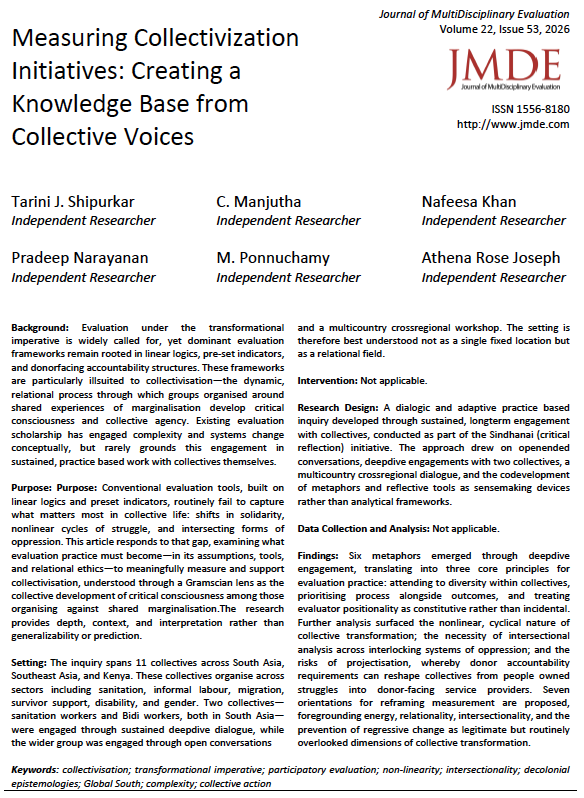
This article offers a practice-based reflection on the challenges and possibilities of evaluating collectivisation under conditions of polycrisis and the transformational imperative. Drawing on the Sindhanai initiative — a multi-year dialogic inquiry developed through sustained engagement with eleven collectives across South Asia, Southeast Asia, and Kenya — it surfaces provisional principles and orientations for evaluation practice that are adequate to the work of collective transformation. Grounded in the lived experiences and analytical voices of collectives organising against caste-based labour exploitation, gender-based violence, migration, and intersecting systems of oppression, the article attends to dimensions of change that conventional evaluation frameworks routinely sideline: relational shifts, collective identity, non-linearity, intersectional change, and the prevention of regressive outcomes. Rather than proposing a new framework, it offers practice-anchored insights into how collectives themselves understand, articulate, and navigate their journeys — and what this demands of those seeking to evaluate alongside them. The article contributes to ongoing debates about how evaluative thinking might be cultivated within and alongside collectives, rather than imposed upon them.
Downloads
Article Details

This work is licensed under a Creative Commons Attribution-NonCommercial 4.0 International License.
Copyright and Permissions
Authors retain full copyright for articles published in JMDE. JMDE publishes under a Creative Commons Attribution-NonCommercial 4.0 International License (CC BY - NC 4.0). Users are allowed to copy, distribute, and transmit the work in any medium or format for noncommercial purposes, provided that the original authors and source are credited accurately and appropriately. Only the original authors may distribute the article for commercial or compensatory purposes. To view a copy of this license, visit creativecommons.org
References
Alpízar Durán, L., Durán, A., & Russo Garrido, A. (Eds.). (2007). Building feminist movements and organizations: Global perspectives: An introduction to new dynamics. Zed Books.
Alvarez, S. E. (2009). Beyond NGO-ization? Reflections from Latin America. Development, 52(2), 175–184. https://doi.org/10.1057/dev.2009.23
Alvarez, S. E., Dagnino, E., & Escobar, A. (Eds.). (1998). Cultures of politics/politics of cultures: Re-visioning Latin American social movements. Westview Press.
Alvarez, S. E., de Lima Costa, C., Feliu, V., Hester, R., Klahn, N., & Thayer, M. (Eds.). (2014). Translocalities/translocalidades: Feminist politics of translation in the Latin/a Américas. Duke University Press. https://doi.org/10.1215/9780822376828
Ambedkar, B. R. (2014). Annihilation of caste (S. Anand, Ed.; Annotated critical ed.). Navayana.
Au, A. (2017). Reconceptualizing social movements and power: Towards a social ecological approach. The Sociological Quarterly, 58(3), 519–545. https://doi.org/10.1080/00380253.2017.1331714
Batliwala, S., & Pittman, A. (2010). Capturing change in women’s realities: A critical overview of current monitoring & evaluation frameworks and approaches. Association for Women’s Rights in Development (AWID). https://www.awid.org/sites/default/files/atoms/files/capturing_change_in_womens_realities.pdf
Buckley, J., Archibald, T., Hargreaves, M., & Trochim, W. M. (2015). Defining and teaching evaluative thinking: Insights from research on critical thinking. American Journal of Evaluation, 36(3), 354–368.
Chambers, R. (1994). Participatory rural appraisal (PRA): Analysis of experience. World Development, 22(9), 1253–1268. https://doi.org/10.1016/0305-750X(94)90003-5
Chambers, R. (2015). Inclusive rigour for complexity. Journal of Development Effectiveness, 7(3), 327–335.
Chaplowe, S. (2023). Confronting the Obsessive Accountability Disorder (OAD) in evaluation. IPASA Quarterly Newsletter.
Chaplowe, S., & Engo-Tjéga, R. B. (2007). Civil society organizations and evaluation: Lessons from Africa. Evaluation, 13(2), 257–274. https://doi.org/10.1177/1356389007075227
Chaplowe, S., & Hejnowicz, A. (2021). Evaluating outside the box: Evaluation’s transformational potential. Social Innovations Journal, 5, 1–19.
Chaplowe, S., Morkel, C., de la Garza, T., Buckton, S., Ferretti, S., Nandi, R., & Zaveri, S. (2026). Rethinking Evaluation Competencies for the Transformational Imperative. Journal of MultiDisciplinary Evaluation, 22(53), 41–69.
Chaplowe, S., & Mukoma, J. (2023). Evaluation and the transformational imperative (EVALSDGs Insight #17). EVALSDGs.
Chilisa, B. (2012). Indigenous research methodologies. SAGE.
Chilisa, B., & Rawlinson, C. (2019). Putting paradigms into practice: Methodological pluralism as a transformative tool for achieving social impact in global health research. Qualitative Health Research, 29(6), 823–835.
Cram, F., & Mertens, D. M. (2016). Negotiating solidarity between indigenous and transformative paradigms in evaluation. Evaluation Matters—He Take Tō Te Aromatawai, 2, 161–189. https://doi.org/10.18296/em.0015
Crenshaw, K. (1989). Demarginalizing the intersection of race and sex: A Black feminist critique of antidiscrimination doctrine, feminist theory and antiracist politics. University of Chicago Legal Forum, 1989(1), 139–167.
Escobar, A. (2020). Pluriversal politics: The real and the possible. Duke University Press.
Eyben, R., Guijt, I., Roche, C., & Shutt, C. (Eds.). (2015). The politics of evidence and results in international development: Playing the game to change the rules? Practical Action Publishing. https://doi.org/10.3362/9781780448855
Fanon, F. (2004). The wretched of the earth (R. Philcox, Trans.). Grove Press. (Original work published 1961)
Freire, P. (1970). Pedagogy of the oppressed. Continuum.
FRIDA. (2022). Collectively imagining what feminist MEL looks like: Introducing FRIDA’s strategic MEL framework. Young Feminist Fund. https://youngfeministfund.org/collectively-imagining-what-feminist-mel-looks-like-introducing-fridas-strategic-mel-framework/
Global Change Center, Praxis Institute for Participatory Practices, & Praxis UK. (2024). An analysis on equity-centered evaluation in international cooperation. Ford Foundation. https://www.fordfoundation.org/work/learning/program-evaluations/an-analysis-on-equity-centered-evaluation-in-international-cooperation/
Global North Dominance Watch. (2024, September). Decolonising CSDDD debates: Through the lens of Anti-Colonial Epistemology. The UnBalance Sheet, 6.
Gokhale, S., & Walton, M. (2022). Adaptive evaluation: A complexity-based approach to systematic learning for innovation and scaling in development. Imagining Good. https://imagogg.org/wp-content/uploads/2022/09/Adaptive_Evaluation_A_Complexity_Based_Approach_To_Learning_for_Scaling.pdf
Gramsci, A. (1971). Selections from the prison notebooks (Q. Hoare & G. Nowell Smith, Eds. & Trans.). Lawrence & Wishart. (Original work written 1929–1935)
Heydari Fard, S. (2024). The transformative power of social movements. Philosophy Compass, 19(1), e12951. https://doi.org/10.1111/phc3.12951
hooks, b. (1984). Feminist theory: From margin to center. South End Press.
hooks, b. (2015). Ain’t I a woman: Black women and feminism. Routledge.
Incite! Women of Color Against Violence (Eds.). (2017). The revolution will not be funded: Beyond the non-profit industrial complex (2nd ed.). Duke University Press.
Jad, I. (2007). NGOs: Between buzzwords and social movements. Development in Practice, 17(4–5), 622–629. http://www.jstor.org/stable/25548261
Jung, C. (2023). Revisiting antisystemic movements in the Global South: Struggles against exclusion and struggles against exploitation. Third World Quarterly, 44(10), 2227–2245. https://doi.org/10.1080/01436597.2022.2106208
Lawrence, M., Homer-Dixon, T., Janzwood, S., Rockström, J., Renn, O., & Donges, J. F. (2024). Global polycrisis: The causal mechanisms of crisis entanglement. Global Sustainability, 7, e6, 1–16. https://doi.org/10.1017/sus.2024.1
Mahomed, H., Hopstein, G., & Krämer, R. (2020, June 2). Entering the funding arena. Alliance Magazine. https://www.alliancemagazine.org/feature/entering-the-funding-arena/
Malpass, D. (2022, September 29). The crisis facing development. Stanford Institute for Economic Policy Research. World Bank Group. https://www.worldbank.org/en/news/speech/2022/09/29/the-crisis-facing-development-speech-by-world-bank-group-president-david-malpass-before-the-2022-annual-meetings
Mbembe, A. (2001). On the postcolony. University of California Press.
Ndlovu-Gatsheni, S. J. (2013). Empire, global coloniality and African subjectivity. Berghahn Books.
Nilsen, A. G., & Motta, S. C. (Eds.). (2011). Social movements in the global south: Dispossession, development and resistance. Palgrave Macmillan.
Patton, M. Q. (2018). Facilitating evaluation: Principles in practice. SAGE.
Patton, M. Q. (2020). Evaluation criteria for evaluating transformation: Implications for the coronavirus pandemic and the global climate emergency. American Journal of Evaluation, 42(1), 53–89. https://doi.org/10.1177/1098214020933689
Picciotto, R. (2020). From disenchantment to renewal. Evaluation, 26(1), 49–60. https://doi.org/10.1177/1356389019897696
Podems, D. R. (2010). Feminist evaluation and gender approaches: There’s a difference? Journal of MultiDisciplinary Evaluation, 6(14), 1–17.
Quijano, A. (2000). Coloniality of power, eurocentrism, and Latin America. Nepantla: Views from South, 1(3), 533–580.
Ramalingam, B., Jones, H., Reba, T., & Young, J. (2008). Exploring the science of complexity: Ideas and implications for development and humanitarian efforts (ODI Working Paper 285). Overseas Development Institute.
Rowlands, J. (1997). Questioning empowerment: Working with women in Honduras. Oxfam.
Schwandt, T. A. (2009). Globalising influences on the Western evaluation imaginary. In K. E. Ryan & J. B. Cousins (Eds.), The SAGE international handbook of educational evaluation (pp. 19–36). SAGE. https://doi.org/10.4135/9781452226606
Smith, L. T. (1999). Decolonizing methodologies: Research and indigenous peoples. Zed Books.
Southern Voices for Global Development. (2023). Sindhanai as contemplative pedagogy: Embedding measurement in collectivisation. Southern Voices for Global Development.
Southern Voices for Global Development. (2024). A Sindhanai on monitoring and evaluation.
Southern Voices for Global Development. (2025, January). Complexities in measuring collectivisation: A Sindhanai.
Thomas, T., & Narayanan, P. (Eds.). (2015). Participation pays: Pathways for post-2015. Practical Action Publishing.
Tooze, A. (2022, June 24). Defining polycrisis: From crisis pictures to the crisis matrix. Chartbook. https://adamtooze.substack.com/p/chartbook-130-defining-polycrisis
UNICEF. (2021, June 13). SBC guidance: Social movements. https://www.sbcguidance.org/understand/social-movements
Woodhill, J. (2007). M&E as learning: Rethinking the dominant paradigm. In J. de Graaff, J. Cameron, S. Sombatpanit, C. Pieri, & J. Woodhill (Eds.), Monitoring and evaluation of soil conservation and watershed development projects (pp. 83–108). Science Publishers.