
Rewiring the Evaluation Marketplace for a Changing World
Article Sidebar
Main Article Content
Abstract
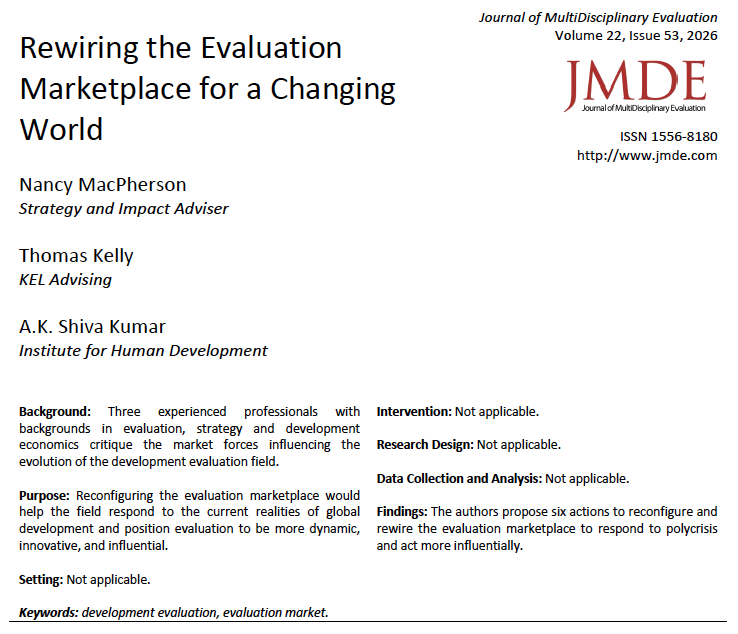
This issue of JMDE asks how evaluation should respond to the transformational imperative to contribute to the radical changes essential for a regenerative, socially just, and equitable future for humanity and the planet. We posit that if the evaluation marketplace was reconfigured to respond to the current realities of global development it could drive innovation and position evaluation to be more dynamic, innovative and influential. Our view is that evaluation in its current form is not fit for this task. Without fundamental change it risks becoming irrelevant in a rapidly transforming global development system. Drawing on our experience across international development, development economics and philanthropy, and our current work in rethinking development and evaluation, we examine the emerging contours of a reconfigured global development system and ask how the evaluation marketplace must evolve to remain influential and relevant. We focus on the evaluation marketplace because it remains an overlooked part of evaluation infrastructure and under-examined relative to methods and theory, yet it powerfully shapes both. The evaluation marketplace can either hold our field back or stimulate innovation to respond to the polycrisis and a reconfigured global development agenda.
Downloads
Article Details

This work is licensed under a Creative Commons Attribution-NonCommercial 4.0 International License.
Copyright and Permissions
Authors retain full copyright for articles published in JMDE. JMDE publishes under a Creative Commons Attribution-NonCommercial 4.0 International License (CC BY - NC 4.0). Users are allowed to copy, distribute, and transmit the work in any medium or format for noncommercial purposes, provided that the original authors and source are credited accurately and appropriately. Only the original authors may distribute the article for commercial or compensatory purposes. To view a copy of this license, visit creativecommons.org
References
Abrahams, M., Etta, F., Frehiwot, M., Kanini, E., Nzabonimpa, J. P., & Theunissen, N. (2024). Editorial: Addressing knowledge asymmetries in memory of D. Sulley Gariba. African Evaluation Journal, 12(2), a762. https://doi.org/10.4102/aej.v12i2.762
Acharya, A. (2018). The end of American world order (2nd ed). Polity.
Acharya, A. (2025, December 16). The decline of the West and the rise of ‘the Rest’ will lead to a new world order. Chatham House. https://www.chathamhouse.org/publications/the-world-today/2025-09/decline-west-and-rise-rest-will-lead-new-world-order
Aghion, P., Bloom, N., Blundell, R., Griffith, R., & Howitt, P. (2005). Competition and innovation: an inverted-U relationship. The Quarterly Journal of Economics, 120(2), 701–728. https://doi.org/10.1093/qje/120.2.701
Alexander, J. (2023, June 15). As the Grand Bargain gets a reboot, the limits of aid reform come into focus. The New Humanitarian. https://www.thenewhumanitarian.org/analysis/2023/06/15/grand-bargain-3-reboot-limits-aid-reform
Arthur, W. B. (2009). The nature of technology: What it is and how it evolves. Free Press.
Baker, J. (2007). Beyond Schumpeter vs. Arrow: How antitrust fosters innovation. Antitrust Law Journal, 74(3), 575–602. https://digitalcommons.wcl.american.edu/facsch_lawrev/1136
Chelimsky, E. (2008). A clash of cultures: Improving the “fit” between evaluative independence and the political requirements of a democratic society. American Journal of Evaluation, 29(4), 400–415. https://doi.org/10.1177/1098214008324465.
Christensen, C. M. (1997). The innovator's dilemma: When new technologies cause great firms to fail. Harvard Business School Press.
Ganga, P. (2024). Ties that bind: Tied aid and economic growth. Studies in Comparative International Development, 60, 613–631. https://doi.org/10.1007/s12116-024-09432-4
Guba, E. G. (1969, February 8). An overview of the evaluation problem. Proceedings of American Educational Research Association Symposium: The world of evaluation needs reshaping. Northwest Regional Educational Laboratory. https://files.eric.ed.gov/fulltext/ED031814.pdf
Kinarsky, A. R. (2018). The evaluation landscape: U.S. foundation spending on evaluation. New Directions for Evaluation, 160, 81–96. https://doi.org/10.1002/ev.20342
Kristof, N., & Robinson, J. (2025, September 27). The human cost of US aid cuts. The New York Times. https://www.nytimes.com/video/opinion/100000010422702/the-human-cost-of-us-aid-cuts.html
Kumar, R. (2026, January 16). The old aid model is dead. Now comes the fight over what replaces it. DevEx.com. https://www.devex.com/news/the-old-aid-model-is-dead-now-comes-the-fight-over-what-replaces-it-111648
Lemire, S., Fierro, L. A., Kinarsky, A. R., Fujita-Conrads, E., & Christie, C. A. (2018). The U.S. federal evaluation market. New Directions for Evaluation, 160, 63–80. https://doi.org/10.1002/ev.20343
Nielsen, S. B., Lemire, S., & Christie, C. A. (Eds.). (2018). The evaluation marketplace: Exploring the evaluation industry. New Directions for Evaluation, 160, 1–163. https://doi.org/10.1002/ev.20282
Nielsen, S. B., & Lemire, S. (2026). What happens when a black swan meets a gray rhino? Reflections on the evaluation market in transformative times. New Directions for Evaluation, 189, 15–21.
Nwankwo, E., Megenasa, Y. T., MacPherson, N., Kumar, A. K. S., & Gupta, T. (2025). Shifting power, resources, and capacity to local actors: Insights on Localisation from a study for the IKEA Foundation. IKEA Foundation.
Ofir, Z. (2025, December 29). International Evaluation Academy week: When evaluation meets polycrisis: Reimagining our field for turbulent times. AEA365. https://aea365.org/blog/when-evaluation-meets-polycrisis-reimagining-our-field-for-turbulent-times-by-zenda-ofir/
Ofosu, F. K. (2025, September 22). President Mahama to launch ‘the Accra reset’ at UNGA 2025 [Press release]. https://presidency.gov.gh/media-advisory-president-mahama-to-launch-the-accra-reset-at-unga-2025/
Schumpeter, J. A. (1942). Capitalism, socialism, and democracy. University of Illinois at Urbana-Champaign's Academy for Entrepreneurial Leadership Historical Research Reference in Entrepreneurship. https://ssrn.com/abstract=1496200
Schwandt, T. A. (2019a). Post-normal evaluation? Evaluation, 25(3), 317–329. https://doi.org/10.1177/1356389019855501
Schwandt, T. A. (2019b, April 11). Rethinking the moral compass for evaluation [Invited presentation]. Center for Evaluation Innovation 2019 Evaluation Roundtable, Eden Prairie, MN, United States.
Slaughter, A.-M. (2004). A new world order. Princeton.
Stern, E., Saunders, M., & Stame, N. (2015). Standing back and looking forward: Editors’ reflections on the 20th anniversary of Evaluation. Evaluation, 21(4), 380–390.
United Nations Evaluation Group. (2016). UNEG evaluation competency framework. https://www.unevaluation.org/uneg_publications/uneg-evaluation-competency-framework
van der Puije, N., & Satzinger, F. (2025). Decolonising international development evaluation: rethinking OECD DAC evaluation criteria from a decolonial perspective. Development in Practice, published online April, 17, 2025. https://doi.org/10.1080/09614524.2025.2482780
von der Leyen, U. (2026, January 19). Special Address by President von der Leyen at the World Economic Forum. European Commission, Davos, Switzerland. https://ec.europa.eu/commission/presscorner/detail/da/speech_26_150