
What’s a Girl Gonna Do? Understanding Evaluation Theory from a Critical-Postcolonial Lens
Article Sidebar
Main Article Content
Abstract
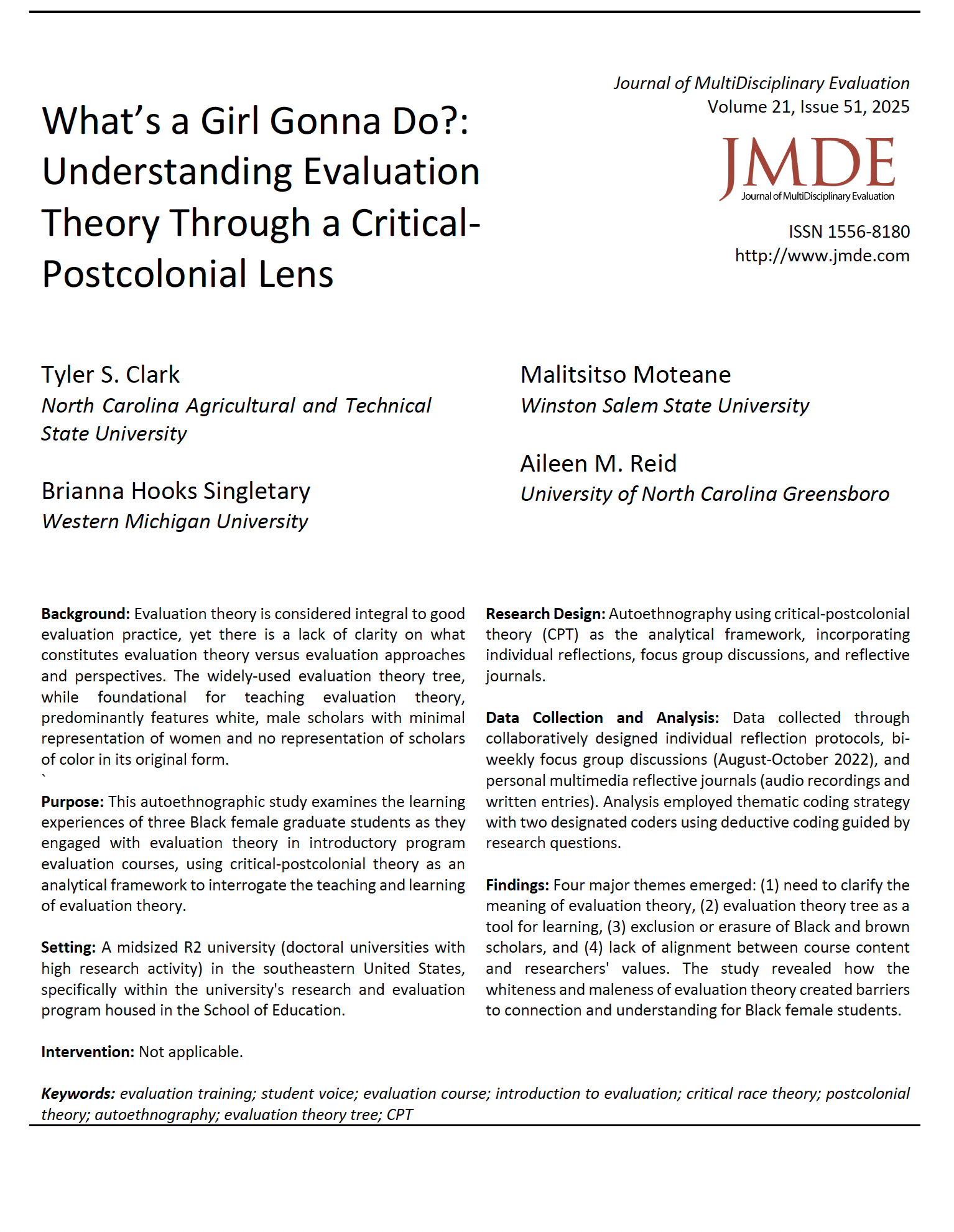
Evaluation theory is considered integral to good evaluation. There is, however, a lack of clarity on the distinction between prescriptive evaluation theory and evaluation approaches and perspectives. The distinction is further complicated by the central role of program theory in the praxis of evaluation. Notwithstanding, evaluation theory and theorists are popularly codified in the Alkin tree (Alkin & Christie, 2004; 2006; 2008) and presented in introductory evaluation classes in graduate programs. While the Alkin tree has seen several revisions, few female evaluators and even fewer evaluators of color are represented. In this study, we (three Black female evaluation graduate students) develop Critical-PostColonial Theory (CPT) as the analytical framework to conduct an autoethnography, interrogating and reflecting on the teaching and learning of evaluation theory in introductory program evaluation graduate classes. The paper concludes with suggestions for decolonizing the teaching and learning of evaluation theory within graduate evaluation programs and courses.
Downloads
Article Details

This work is licensed under a Creative Commons Attribution-NonCommercial 4.0 International License.
Copyright and Permissions
Authors retain full copyright for articles published in JMDE. JMDE publishes under a Creative Commons Attribution-NonCommercial 4.0 International License (CC BY - NC 4.0). Users are allowed to copy, distribute, and transmit the work in any medium or format for noncommercial purposes, provided that the original authors and source are credited accurately and appropriately. Only the original authors may distribute the article for commercial or compensatory purposes. To view a copy of this license, visit creativecommons.org
References
Alkin, M. (Ed.) (2004). Comparing evaluation points of view. SAGE Publications, Inc., https://doi.org/10.4135/9781412984157
Alkin, M. C., & Christie, C. A. (2002). The use of role-play in teaching evaluation. American Journal of Evaluation, 23(2), 209-218. https://doi.org/10.1177/109821400202300210
Alkin, M., & Christie, C. (2004). An evaluation theory tree. In M. C. Alkin (Ed.), Evaluation roots (pp. 13-65). SAGE Publications, Inc., https://doi.org/10.4135/9781412984157.n2
Alkin, M. C., Christie, C. A., & Vo, A. T. (2012). Evaluation theory. Evaluation roots: A wider perspective of theorists' views and influences, 386.
Carter, L. (2004). Thinking differently about cultural diversity: using postcolonial theory to (re)read science education. Science Education, 88(6). https://doi.org/10.1002/sce.20000
Chang, H. (2013). Individual and collaborative autoethnography as method. Handbook of autoethnography, 107-122.
Christophers, B. (2007). Ships in the night: Journeys in cultural imperialism and postcolonialism. International Journal of Cultural Studies, 10(3), 283-302. https://doi.org/10.1177/1367877907080145
Cousins, J. B. (2013). When does a conceptual framework become a theory? reflections from an accidental theorist. Evaluation and Program Planning, 38, 67-67. https://doi.org/10.1016/j.evalprogplan.2012.03.016
Crenshaw, K., & Gotanda, N. (Eds.). (1995). Critical race theory: The key writings that formed the movement. The New Press.
Delgado, R., Stefancic, J., & Harris, A. (2017). Critical race theory : an introduction (Third, Ser. Critical America). New York University Press.
Esposito, J. (2011). Negotiating the gaze and learning the hidden curriculum: a critical race analysis of the embodiment of female students of color at a predominantly white institution. Journal for Critical Education Policy Studies, 9(2), 143-164.
Gibbs, G. R. (2007). Thematic coding and categorizing. Analyzing qualitative data, 703, 38-56. https://doi.org/10.4135/9781849208574.n4
Goldie, J. G. S. (2016). Connectivism: A knowledge learning theory for the digital age?. Medical teacher, 38(10), 1064-1069. https://doi.org/10.3109/0142159X.2016.1173661
Hall, M. E. (2018). Evaluation's race problem in the United States : a call to action for the profession and the American Journal of Evaluation. American Journal of Evaluation, 39(4), 569-583. https://doi.org/10.1177/1098214018792624
Hood, S. (2001). Nobody knows my name: in praise of african american evaluators who were responsive. New Directions for Evaluation, 2001(92), 31-44. https://doi.org/10.1002/ev.33
Hood, S., & Hopson, R. K. (2008). Evaluation roots reconsidered: asa hilliard, a fallen hero in the "nobody knows my name" project, and african educational excellence. Review of Educational Research, 78(3), 410-426. https://doi.org/10.3102/0034654308321211
Hood, S., Hopson, R. K., & Kirkhart, K. E. (2015). Culturally responsive evaluation. Handbook of practical program evaluation, 281-317. https://doi.org/10.1002/9781119171386.ch12
Hytten, K., & Warren, J. (2003). Engaging whiteness: How racial power gets reified in education. International Journal of Qualitative Studies in Education, 16(1), 65-89. https://doi.org/10.1080/0951839032000033509a
Joseph-Salisbury, R. (2019). Institutionalised whiteness, racial microaggressions and black bodies out of place in higher education, Whiteness and education, 4(1), 1-17. https://doi.org/10.1080/23793406.2019.1620629
Ladson-Billings, G. (2021). Critical race theory in education: A scholar's journey. Teachers College Press. https://doi.org/10.4324/9781003340362-16
Mertens, D. M., & Wilson, A. T. (2018). Program evaluation theory and practice. Guilford Publications.
Meyer, M. D. (2020). Black Panther, queer erasure, and intersectional representation in popular culture. Review of Communication, 20(3), 236-243. https://doi.org/10.1080/15358593.2020.1778068
Newcomer, K. E., Hatry, H. P., & Wholey, J. S. (Eds.). (2015). Handbook of practical program evaluation (Fourth, Ser. Essential texts for nonprofit and public leadership and management). Jossey-Bass & Pfeiffer Imprints, Wiley. https://doi.org/10.1002/9781119171386
Okello, W. K., & Morton, C. S. (2022). Speaking our imaginings into existence: Poetry as a contestation of Black erasure in academia. Journal of Diversity in Higher Education 17(2), 256–267. https://doi.org/10.1037/dhe0000411
Omodan, B. I., & Tsotetsi, C. T. (2020). Decolonization of knowledge-construction in university classrooms : The place of social constructivism. African Journal of Gender, Society & Development, 9(2), 183-183-204. https://doi.org/10.31920/2634-3622/2020/9n2a10
Ortlipp, M. (2008). Keeping and using reflective journals in the qualitative research process. The qualitative report, 13(4), 695-705.
Patton, M. Q. (1997). Utilization-focused evaluation: the new century text (Edition 3). Sage Publications.
Pearce, C. (2010). The Crises and Freedoms of Researching Your Own Life. Journal of Research Practice, 6(1), M2.
Rossi, P. H., Lipsey, M. W., Lipsey, M. W., Freeman, H. E., & Freeman, H. E. (2004). Evaluation: a systematic approach (7th ed.). Sage.
Solorzano, D. G., & Yosso, T. J. (2001). Critical race and LatCrit theory and method: Counter-storytelling. International journal of qualitative studies in education, 14(4), 471-495. https://doi.org/10.1080/09518390110063365
Saunders, L., Wong, M. A., & Hinchliffe, L. J. (2020). Instruction in libraries and information centers : An introduction (Ser. Opn textbook series). Windsor & Downs Press. Retrieved December 1, 2022, from https://doi.org/10.21900/wd.12
Scriven, M. (1998). The new science of evaluation. Scandinavian Journal of Social Welfare, 7(2), 79-86. https://doi.org/10.1111/j.1468-2397.1998.tb00206.x
Shadish, W. R. (1998). Evaluation theory is who we are. American Journal of Evaluation, 19(1), 1-19. https://doi.org/10.1016/S1098-2140(99)80177-5
Thomas, V. G., & Campbell, P. B. (2020). Evaluation in Today's World: Respecting Diversity, Improving Quality, and Promoting Usability. Thousand Oaks, CA: Sage Publications.
Thomas, V. G., & Madison, A. (2010). Integration of Social Justice Into the Teaching of Evaluation. American Journal of Evaluation, 31(4), 570-583. https://doi.org/10.1177/1098214010368426
Webster, S. H. (2017). A Qualitative study of the evolution and erasure of Black feminism in historic and contemporary sociopolitical movements, and Black men's resistance to Black feminism. McNair Scholars Research Journal, 10(1), 15.
Woodson, C. G. (2011). The mis-education of the Negro. New York, NY: Tribeka Books. (Original work published 1933)