
Revisiting Evaluation as a Science
Article Sidebar
Main Article Content
Abstract
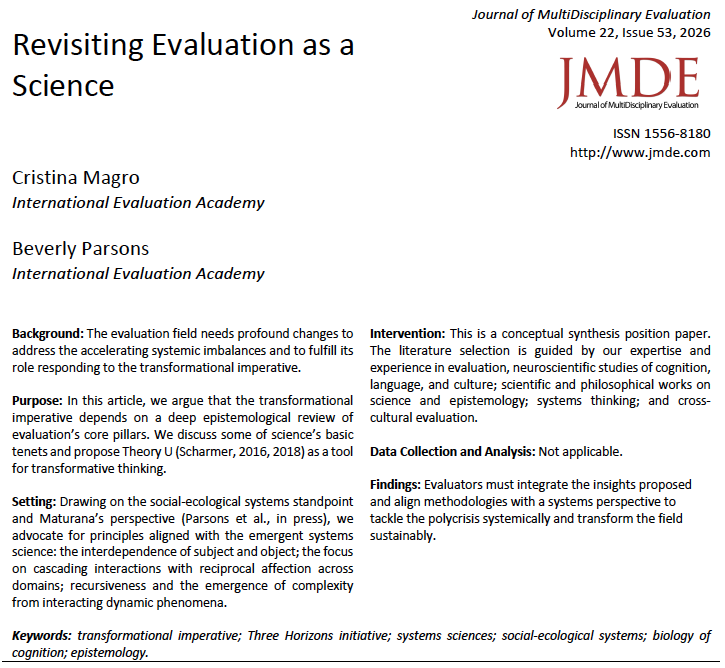
The evaluation field needs profound changes to address the accelerating systemic imbalances, such as environmental health, social justice, equity, and financial investment and distribution, and to fulfill its role responding to the transformational imperative. Transformational and sustainable changes require rethinking its core pillars. This paper addresses evaluation’s epistemological foundations, specifically the scientific tenets that shape the field and the commensurate methodologies: objectivity, causality, predictability, and reductionism. Drawing on the social-ecological systems standpoint and Maturana’s perspective (Parsons et al., 2026, in press), this article advocates for principles aligned with the emergent systems science: the interdependence of subject and object; the focus on cascading interactions with reciprocal affection across domains; recursiveness and the emergence of complexity from interacting dynamic phenomena. These reflections extend current evaluation practice, arguing that the transformational imperative depends on a deep epistemological review grounded in scientific and philosophical principles. Furthermore, the paper proposes Theory U (Scharmer, 2016, 2018) as a tool for transformative thinking, supporting the International Evaluation Academy’s (IEAc) aspirations as expressed in its 3 Horizons (3H) initiative. Embracing these epistemological shifts can make evaluation more adaptive and better equipped to address global challenges. Evaluators must integrate these insights and align methodologies with a systems perspective to effectively tackle systemic issues.
Downloads
Article Details

This work is licensed under a Creative Commons Attribution-NonCommercial 4.0 International License.
Copyright and Permissions
Authors retain full copyright for articles published in JMDE. JMDE publishes under a Creative Commons Attribution-NonCommercial 4.0 International License (CC BY - NC 4.0). Users are allowed to copy, distribute, and transmit the work in any medium or format for noncommercial purposes, provided that the original authors and source are credited accurately and appropriately. Only the original authors may distribute the article for commercial or compensatory purposes. To view a copy of this license, visit creativecommons.org
References
Asante, D., & Archibald, T. (2023). Beyond Ubuntu: Nnoboa and Sankofa as decolonizing and Indigenous evaluation epistemic foundations from Ghana. Journal of MultiDisciplinary Evaluation, 19(44), 156–165.
Baby Professor. (2024). What is science? Science vs. pseudoscience and the characteristics of scientific knowledge | Grade 6–8 Life Science. Baby Professor. E-Book Kindle.
Beall, J. C., & Restall, G. (Eds.). (2006). Logical pluralism. Oxford University.
Berger, P. L., & Luckmann, T. (1966). The social construction of reality: A treatise in the sociology of knowledge. Penguin. https://amstudugm.wordpress.com/wp-content/uploads/2011/04/social-construction-of-reality.pdf
Bowman, N. (2014). Responsive Indigenous evaluation: A cultural and contextual framework for Indian country. Information Age.
Bowman, N. (2018). Looking Backward but Moving Forward: Honoring the Sacred and Asserting the Sovereign in Indigenous Evaluation. American Journal of Evaluation. 39(4). https://doi.org/10.1177/10982140187904
Bowman, N. (2025). Continuing the evaluation journey: Sharing the Lunaape seven-directions medicine wheel (7DMWTM) model. Canadian Journal of Program Evaluation, 39(2). https://doi.org/10.3138/cjpe-2024-0037
Burgelman, J., & Linke, L. (2025). Frontiers Planet Prize: Breakthrough systems thinking powering environmental futures. World Economic Forum. https://www.weforum.org/stories/2025/06/frontiers-planet-prize-systems-thinking-resilient-environmental-futures/
Chilisa, B. (2013). Indigenous research methodologies. Sage.
Chilisa, B., & Bowman, N. (2023). Special issue: Decolonizing evaluation: Towards a fifth paradigm. Journal of MultiDisciplinary Evaluation, 19(44), 2–9.
Damasio, A. (2005). Descartes’ error: Emotion, reason, and the human brain. Penguin.
Einstein, A. (1916). Relativity: The special and general theory. Methuen & Co.
Gates, E. F. (2017). Learning from seasoned evaluators: Implications of systems approaches for evaluation practice. Evaluation, 23(2), 152–171. https://doi.org/10.1177/1356389017697613
Grabmeier, S. (2020). BANI versus VUCA: A new acronym to describe the world. https://stephangrabmeier.de/bani-versus-vuca/
Heisenberg, W. (1927). Über den anschaulichen Inhalt der quantentheoretischen Kinematik und Mechanik. Zeitschrift für Physik, 43, 172–198. https://doi.org/10.1007/BF01397280
Hummelbrunner, R. (2011). Systems thinking and evaluation. Evaluation, 17(4), 395–403. http://evi.sagepub.com/content/17/4/395
International Science Council. (2023b). Flipping the science model: A roadmap to science missions for sustainability. https://council.science/wp-content/uploads/2023/08/Flipping-the-Science-Model-1.pdf
INTRAC. (2017a). Contribution analysis. https://www.intrac.org/app/uploads/2017/01/Contribution-analysis.pdf
INTRAC. (2017b). Outcome harvesting (Contributors N. Simister & A. Napier). INTRAC for Civil Society. M&E Universe. https://www.intrac.org/app/uploads/2024/12/Outcome-harvesting.pdf
International Science Council. (2023a). Annual Report 2023. https://council.science/publications/annual-report-2023/
Journal of MultiDisciplinary Evaluation. (2023). 19, 44.
Latour, B. (1988). The pasteurization of France. Harvard University.
Latour, B., & Woolgar, S. (1979). Laboratory life: The social construction of scientific facts. Sage.
Magro, C. (1999). Languaging language: From biology to language [Unpublished doctoral dissertation]. UNICAMP.
Magro, C. (in press). Evaluation in a multidimensional world: Reflections on value. In E. Diluzio (Ed.), Future/Proof: Charting What's Next for Evaluation Science. New York, NY.
Magro, C., & Van den Berg, R. (2021). Of portals and paradigms: Evaluation, systems thinking and the pandemic. In R. D. Van den Berg, C. Magro, & M.-H. Adrien (Eds.), Transformational evaluation for the global crises of our times (pp. 372–394). IDEAS.
Magro, C., van den Berg, R. D., & Adrien, M.-H. (2021). Transforming evaluation for transformational changes. In R. D. Van den Berg, C. Magro, & M.-H. Adrien (Eds.), Transformational evaluation for the global crises of our times (pp. 1–18). IDEAS. https://ideas-global.org/wp-content/uploads/2021/08/2021-IDEAS-book-Ch-01-Magro-et-al-Transformational-Evaluation.pdf
Maturana, H. R. (1978). Biology of language: Epistemology of reality. In G. A. Miller & E. Lenneberg (Eds.), Psychology and biology of language and thought. Academic.
Maturana, H. R. (1988a). Scientific and philosophical theories. In N. Leser, J. Seifert, & K. Plitzner (Eds.), Die Gedankenwelt Sir Karl Poppers: Kritischer Rationalismus im Dialog (pp. 358–368). Universitätsverlag Carl Winter.
Maturana, H. R. (1988b). Reality: The search for objectivity or the quest for a compelling argument. The Irish Journal of Psychology, 9(1), 25–82.
Maturana, H. R. (1990). Science and daily life: The ontology of scientific explanations. In W. Krohn & G. Kuppers (Eds.), Selbstorganisation: Aspekte einer wissenschaftlichen revolution (pp. 107–138). Vieweg und Sohn.
Maturana, H. R., & Varela, F. (1973). Autopoiesis and cognition: The realization of the living. Reidel. (Original work published 1972.)
Maturana, H. R., & Varela, F. (1992). The tree of knowledge: The biological roots of human understanding. Shambhala.
Meadows, D. H. (2008). Thinking in Systems: A Primer. Chelsea Green. https://www.chelseagreen.com/product/thinking-in-systems/
Merriam-Webster. (n.d.). Crisis. In Merriam-Webster.com dictionary. https://www.merriam-webster.com/dictionary/crisis.
O’Brien, K., Garibaldi, L., Agrawal, A., Bennett, E., Biggs, O., Calderón Contreras, R., Carr, E., Frantzeskaki, N., Gosnell, H., Gurung, J., Lambertucci, S., Leventon, J., Liao, C., Reyes García, V., Shannon, L., Villasante, S., Wickson, F., Zinngrebe, Y., & Perianin, L. (2024). Summary for policymakers of the thematic assessment report on the underlying causes of biodiversity loss and the determinants of transformative change and options for achieving the 2050 vision for biodiversity of the Intergovernmental Science-Policy Platform on biodiversity and ecosystem services. IPBES Secretariat. https://doi.org/10.5281/zenodo.11382230
Ofir, Z., Singh, G., Beauchamp, E., Lucks, D., D’Errico, S., & El-Saddick, K. (2019). From monitoring goals to systems-informed evaluation: Insights from SDG14 (IIED Briefing Paper No. 11). https://tinyurl.com/yy3gmmbe
Parsons, B. A., Magro, C., & Felcis, W. (in press). The quest for systemic transformation: An inspiration to think again and differently. In Uitto, Batra, Spearman, & O’Grady (Eds.), Integrating for sustainability: Evaluation across environmental and socioeconomic domains. Springer.
Parsons, B. A., & Winters, K. (2023). Paradigm-based evaluation for eco-just systems transformation. Journal of MultiDisciplinary Evaluation, 19(44), 24–44.
Patton, M. Q. (2019). Blue marble evaluation: Premises and principles. Guilford Press.
Patton, M. Q. (2022). Panorama of evaluation approaches. [Video]. YouTube. https://www.youtube.com/watch?v=GEGtBnkDyBk
Patton, M. Q. (2023). Honoring the legacy of Michael Scriven, International Evaluation Academy. https://ieac.global/honoring-the-legacy-of-michael-scriven/
Podems, D. (2018). Being an evaluator: Your practical guide to evaluation. Guilford.
Priest, G. (2008). An introduction to non-classical logic: From if to is. Cambridge University.
Ramage, M., & Shipp, K. (2009). Systems thinkers. Springer.
Rorty, R. (1981). Philosophy and the mirror of nature. Princeton University.
Rorty, R. (1990). Science as solidarity. In R. Rorty (Ed.), Objectivity, relativism, and truth: Philosophical papers (pp. 35–45). Cambridge University.
Scharmer, O. (2016). Theory U: Leading from the future as it emerges. Berrett-Koehler.
Scharmer, O. (2018). The essentials of Theory U: Core principles and applications. Berrett-Koehler.
Scriven, M. (1993). Special Issue: Hard-won lessons in program evaluation. New Directions for Program Evaluation, 58, 5–48. https://doi.org/10.1002/ev.1640
Stufflebeam, D. L. (2018). The CIPP model for evaluation: A comprehensive guide to the program evaluation process. Guilford.
Van den Berg, R. D. (2024). Evidence for hope: The emerging sustainability revolution. Amazon.
Wilson-Grau, R. (2015). Outcome harvesting. Better Evaluation. http://betterevaluation.org/plan/approach/outcome_harvesting
Wilson-Grau, R., & Britt, H. (2013). Outcome harvesting. Ford Foundation.