
Multiple Voices, Shared Realities: Gendered Inequities in the Evaluation Profession
Article Sidebar
Main Article Content
Abstract
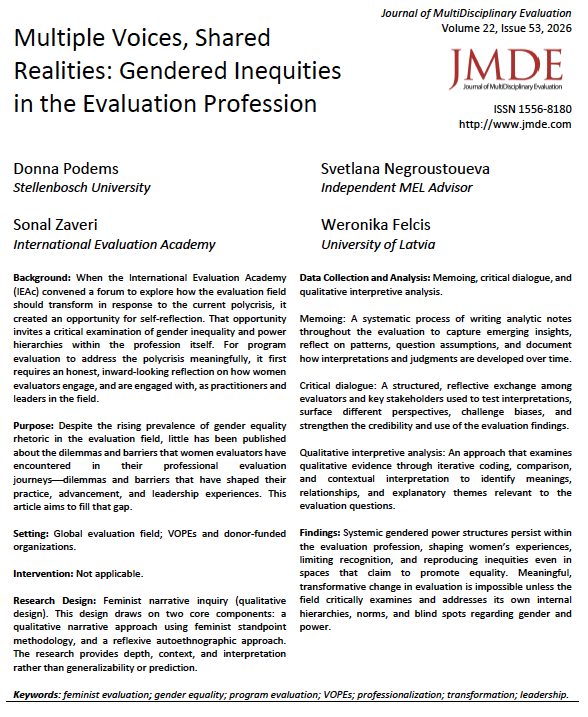
Transformative change in the evaluation sector in response to the polycrisis is unattainable without first turning inward to examine the evaluation profession and recognizing how politics and power hinder women’s ability to pursue the systemic change it advocates. In response to the International Evaluation Academy’s (IEAc) call to make evaluation fit for purpose amid the global polycrisis, and using their Horizons framing, we applied a feminist, inward-focused lens to examine our profession. Shaped by our positionality, we reflect on how our lived experiences are affected by power structures, likely shaped by the legacy of the field’s patriarchal roots, and share these experiences through four illustrative cases. By sharing these narratives, we provide empirical data that others in the evaluation field can engage with, reinterpret, and take meaning from in ways that resonate with their own contexts and experiences, thereby informing the second and third horizon.
Downloads
Article Details

This work is licensed under a Creative Commons Attribution-NonCommercial 4.0 International License.
Copyright and Permissions
Authors retain full copyright for articles published in JMDE. JMDE publishes under a Creative Commons Attribution-NonCommercial 4.0 International License (CC BY - NC 4.0). Users are allowed to copy, distribute, and transmit the work in any medium or format for noncommercial purposes, provided that the original authors and source are credited accurately and appropriately. Only the original authors may distribute the article for commercial or compensatory purposes. To view a copy of this license, visit creativecommons.org
References
Acker, J. (1990). Hierarchies, jobs, bodies: A theory of gendered organizations. Gender & Society, 4(2), 139–158. https://doi.org/10.1177/089124390004002002
Ballantine, J. H., Hammack, F. M., & Stuber, J. (2021). The sociology of education: A systematic analysis (9th ed.). Routledge.
Barry, I., & Stephenson, E. (2025). The gendered, epistemic injustices of generative AI. Australian Feminist Studies, 40(123), 1–21.
Beharrie, T. M., & Mabitsela, T. (2023). Emotional labour as experienced by women in leadership positions. SA Journal of Industrial Psychology, 49(1), 1–11.
Bloom, S. S., & Negroustoueva, S. (2013). Compendium of gender equality and HIV indicators. MEASURE Evaluation, ICF International.
Bourdieu, P. (1986). The forms of capital. In J. G. Richardson (Ed.), Handbook of theory and research for the sociology of education (pp. 241–258). Greenwood.
Bourdieu, P. (1991). Language and symbolic power. Harvard University Press.
Bowles, G., & Duelli Klein, R. (Eds.). (2024). Theories of women's studies. Routledge. (Original work published 1983)
Cornwall, A. (2020). Re-imagining development by (re)claiming feminist visions of development alternatives. Gender & Development, 28(1), 31–49.
DESA Publications. (2025). Gender snapshot 2025: Progress towards achieving SDG 5. United Nations. https://desapublications.un.org/publications/gender-snapshot-2025
Diel, A., & Dzubinski. (2023). Glass walls: Shattering the six gender bias barriers still holding women back at work. The Rowman and Littlefield Publishing Group.
El Saadawi, N. (2018). A daughter of Isis. Zed Books.
FAO. (2023). The status of women in agrifood systems. Food and Agriculture Organization of the United Nations.
Fraser, N. (1995). Recognition or redistribution? A critical reading. New Left Review, 212, 68–93.
Fraser, N. (2013). Fortunes of feminism: From state-managed capitalism to neoliberal crisis. Verso.
Graness, A., & Kopf, M. (2024). Changing the frame: New epistemic frameworks and social transformation in African feminist theory. The Monist, 107(3), 279–293.
Haraway, D. (1988). Situated knowledges: The science question in feminism and the privilege of partial perspective. Feminist Studies, 14(3), 575–599.
Harden, J. (2002). Beyond the dual burden: Theorising gender inequality in Soviet Russia. Critique: Journal of Socialist Theory, 30(1), 43–68.
Harding, S. G. (1986). The science question in feminism. Cornell University Press.
Harding, S. G. (1991). Whose science? Whose knowledge? Thinking from women’s lives. Cornell University Press.
Heilman, M. E., Caleo, S., & Manzi, F. (2024). Women at work: Pathways from gender stereotypes to gender bias and discrimination. Annual Review of Organizational Psychology and Organizational Behavior, 11, 165–192.
Held, V. (2006). The ethics of care: Personal, political, and global. Oxford University Press.
hooks, b. (2000). Feminism is for everybody: Passionate politics. South End Press.
International Labour Organization. (2023). Global wage report 2022–23. International Labour Organization.
Keefe, J. M., & Fisher, K. L. (2020). Narrative inquiry in qualitative and feminist research: The power of story. Online Journal of Complementary & Alternative Medicine, 3(1), 1–2.
LaVelle, J. M., Stephenson, C. L., Donaldson, S. I., & Hackett, J. D. (2024). Findings from an empirical exploration of evaluators’ values. American Journal of Evaluation, 45(1), 6–28.
Lynch, K. (2007). Love labour as a distinct and non-commodifiable form of labour. The Sociological Review, 55(3), 550–570.
Maynes, M. J., Pierce, J. L., & Laslett, B. (2008). Telling stories: The use of personal narratives in the social sciences and history. Cornell University Press.
McCann, C., Seung-kyung, K., & Ergun, E. (2020). Feminist theory reader: Local and global perspectives (4th ed.). Routledge.
McHugh, M. C. (2020). Feminist qualitative research: Working toward transforming science and social justice. In P. Leavy (Ed.), The Oxford handbook of qualitative research (2nd ed., pp. 200–242). Oxford University Press.
Njuki, J., Rietveld, A., Huyer, S., & Waithanji, E. (2022). Gender-transformative approaches in agriculture: A framework for operationalizing gender equality and women’s empowerment. International Food Policy Research Institute (IFPRI).
Ofir, Z., Kendrick, I., Goldman, I., Ferretti, S., Norins, J., Sithole, S., Belzer, A., Chaplowe, S., Diwakar, Y., Kalugampitiya, A., Lareza, A. E., Verveld-Nguyen, L., Zaveri, S. (2026). Where Next for Evaluation? Navigating the Polycrisis Through Three Horizons. Journal of MultiDisciplinary Evaluation, 22(53), 12–40.
Patton, M. Q., & Campbell, A. (2024). Utilization Focused Evaluation (5th ed.). Guilford.
Pillay-Naidoo, D., & Vermeulen, C. (2023). Seeking support through solidarity: Female leaders’ experiences of workplace solidarity in male-dominated professions. Frontiers in Psychology, 14, Article 1119911. https://doi.org/10.3389/fpsyg.2023.1119911
Podems, D. (2018). Making feminist evaluation practical. eVALUation Matters, Fourth Quarter 2018, 55–67. Independent Development Evaluation, African Development Bank.
Podems, D. R. (2024). Feminist principles evaluation. In K. E. Newcomer & S. W. Mumford (Eds.), Research handbook on program evaluation (pp. 174–191). Elgar Publishing.
Podems, D. (in press). The FEM. Guilford Press.
Ridgeway, C. L. (2001). Gender, status, and leadership. Journal of Social Issues, 57(4), 637–655.
Rossiter, M. W. (1993). The Matthew Matilda effect in science. Social Studies of Science, 23(2), 325–341.
Rudman, L., & Phelan, J. (2008). Backlash effects for disconfirming gender stereotypes in organizations. Research in Organizational Behavior, 28, 61–79.
Rudman, L. A., Moss-Racusin, C. A., Phelan, J. E., & Nauts, S. (2012). Status incongruity and backlash effects: Defending the gender hierarchy motivates prejudice against female leaders. Journal of Experimental Social Psychology, 48(1), 165–179.
Schaeffer, H., & Zaveri, S. (2023). Outcome mapping + equity, gender, and social justice. BetterEvaluation.org.
Taheriruh, M., & Moshtari, M. (2024). Symbolic compliance with policy-led public procurement: Decoupling practices and compliance barriers. International Journal of Procurement Management, 19(1), 1–20.
The DHS Program. (2024). Demographic and Health Surveys.
Tronto, J. (1993). Moral boundaries: A political argument for an ethic of care. Routledge.
Tronto, J. (2013). Caring democracy: Markets, equality, and justice. NYU Press.
UNESCO. (2022). Global education monitoring report.
UN Women. (2023). Progress on the Sustainable Development Goals: Gender snapshot 2023.
UN Women. (2024). Gender and climate resilience.
Wang, V. (2025). Performative equity and institutional hypocrisy in higher education: A critique of leadership narratives and policy contradictions. (“How performative equity and hypocrisy affect higher education”). Open Journal of Leadership, 14(3), 387–402.
Wigginton, B., & Lafrance, M. N. (2019). Learning critical feminist research: A brief introduction to feminist epistemologies and methodologies. Feminism & Psychology, 30(2), 235–244.
Williams, J. C. (2004). The maternal wall. Harvard Business Review, 82, 26–32.
World Health Organization. (2021). Violence against women: Prevalence estimates 2021.
World Economic Forum. (2025). Global gender gap report 2025. https://www.weforum.org/publications/global-gender-gap-report-2025/in-full/benchmarking-gender-gaps-2025/