
Where Next for Evaluation? Navigating the Polycrisis Through Three Horizons
Article Sidebar
Main Article Content
Abstract
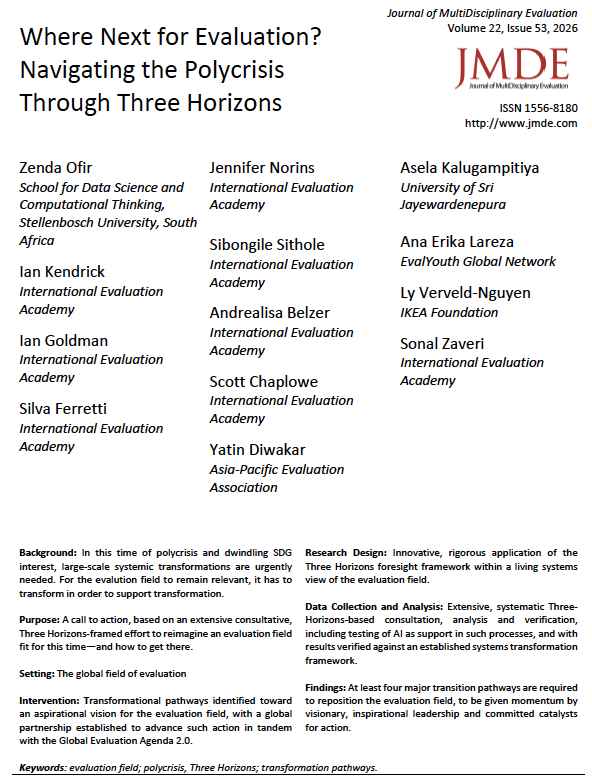
Background: In this time of polycrisis and dwindling SDG interest, large-scale systemic transformations are urgently needed. For the evalution field to remain relevant, it has to transform in order to support transformation.
Purpose: A call to action, based on an extensive consultative, Three Horizons-framed effort to reimagine an evaluation field fit for this time—and how to get there.
Setting: The global field of evaluation
Intervention: Transformational pathways identified toward an aspirational vision for the evaluation field, with a global partnership established to advance such action in tandem with the Global Evaluation Agenda 2.0.
Research Design: Innovative, rigorous application of the Three Horizons foresight framework within a living systems view of the evaluation field.
Data Collection and Analysis: Extensive, systematic Three-Horizons-based consultation, analysis and verification, including testing of AI as support in such processes, and with results verified against an established systems transformation framework.
Findings: At least four major transition pathways are required to reposition the evaluation field, to be given momentum by visionary, inspirational leadership and committed catalysts for action.
Downloads
Article Details

This work is licensed under a Creative Commons Attribution-NonCommercial 4.0 International License.
Copyright and Permissions
Authors retain full copyright for articles published in JMDE. JMDE publishes under a Creative Commons Attribution-NonCommercial 4.0 International License (CC BY - NC 4.0). Users are allowed to copy, distribute, and transmit the work in any medium or format for noncommercial purposes, provided that the original authors and source are credited accurately and appropriately. Only the original authors may distribute the article for commercial or compensatory purposes. To view a copy of this license, visit creativecommons.org
References
Alkin, M. C., & Patton, M. Q. (2020). The birth and adaptation of evaluation theories. Journal of MultiDisciplinary Evaluation, 16(35), 1–13. https://doi.org/10.56645/jmde.v16i35.637
Askar, H., Schmidt-Abbey, B., Lucaciu, L. O., Augustyn, A. M., Chaplowe, S., Dhingra, N., Goldman, I., Gupta, A., Morell, J., Wehipeihana, N., & Matheson, A. (2026). Reframing Evaluation: Complexity, Systems, and Transformation. Journal of MultiDisciplinary Evaluation, 22(53), 86–108.
Beer, S. (1972). Brain of the firm. Allen Lane.
Bourdieu, P., & Wacquant, L. J. D. (1992). An invitation to reflexive sociology. University of Chicago Press.
Brousselle, A., Bremner, L., Parata, K., Hasan, A. A., Felcis, W., Belzer, A., Kêdoté, N. M., Nanda, R. B., Rey, L. O., & Vieira-da-Silva, L. M. (2024). Foundations for a utopia: Can evaluation contribute to achieving a better world, and how? Canadian Journal of Program Evaluation / La Revue canadienne d’évaluation de programme, 39(2), 171–194. https://doi.org/10.3138/cjpe-2023-0026
Buckton, S. J., Fazey, I., Ball, P., Ofir, Z., Colvin, J., Darby, M., Martin, L., Patrick, R., Phillips, T., Pound, D., & Rivera, S. C. (2025). Twelve principles for transformation-focused evaluation. PLOS Sustainability and Transformation, 4(4), e0000164. https://doi.org/10.1371/journal.pstr.0000164
Cajete, G. (2000). Native science: Natural laws of interdependence. Clear Light Publishers.
Chaplowe, S., & Hejnowicz, A. (2021). Evaluating outside the box: Evaluation’s transformational potential. Social Innovations Journal, 5, Article 704. https://socialinnovationsjournal.com/index.php/sij/article/view/704
Chaplowe, S., Morkel, C., de la Garza, T., Buckton, S., Ferretti, S., Nandi, R., & Zaveri, S. (2026). Rethinking Evaluation Competencies for the Transformational Imperative. Journal of MultiDisciplinary Evaluation, 22(53), 41–69.
Chilisa, B., & Bowman, N. R. (Eds.). (2023). Decolonizing evaluation: Towards a fifth paradigm [Special issue]. Journal of MultiDisciplinary Evaluation, 19(44). https://doi.org/10.56645/jmde.v19i44
Chittick, W. C. (2012). In search of the lost heart: Explorations in Islamic thought. State University of New York Press.
Curry, A., & Hodgson, A. (2008). Seeing in multiple horizons: Connecting futures to strategy. Journal of Futures Studies, 13(1), 1–20. https://jfsdigital.org/articles-and-essays/2008-2/vol-13-no-1-august/articles/seeing-in-multiple-horizons-connecting-futures-to-strategy/
Dighe, S. (2023). Moving beyond methods training: Key directions for decolonizing evaluation education in the Global South. New Directions for Evaluation, 177, 85–93. https://doi.org/10.1002/ev.20538
Dighe, S., & Matthias, C. (2023). Deconstructing the imperial episteme: Decolonizing knowledge production in program evaluation. Journal of MultiDisciplinary Evaluation, 19(44), 117–130. https://doi.org/10.56645/jmde.v19i44.781
EvalIndigenous. (2024, May 8). Wolastoq declaration on Indigenous evaluation [Declaration]. https://www.evalindigenous.net/wolastoq-declaration.html
Fazey, I., & Leicester, G. (2022). Archetypes of system transition and transformation: Six lessons for stewarding change. Energy Research & Social Science, 91, 102646. https://doi.org/10.1016/j.erss.2022.102646
Gallagher, L., & Ofir, Z. (2021). The rights of nature: An emerging transformation opportunity for evaluation. Canadian Journal of Program Evaluation, 36(2), 141–161. https://doi.org/10.3138/cjpe.71575
Gaventa, J. (2006). Finding the spaces for change: A power analysis. IDS Bulletin, 37(6), 23–33. https://doi.org/10.1111/j.1759-5436.2006.tb00320.x
Geels, F. W. (2002). Technological transitions as evolutionary reconfiguration processes: A multi-level perspective and a case-study. Research Policy, 31(8–9), 1257–1274. https://doi.org/10.1016/S0048-7333(02)00062-8
Geels, F. W. (2011). The multi-level perspective on sustainability transitions: Responses to seven criticisms. Environmental Innovation and Societal Transitions, 1(1), 24–40. https://doi.org/10.1016/j.eist.2011.02.002
Goldman, I., Cairney, P., Carden, F., Dias, T., Dillon, B., Ferrari, R., & Morgan, G. (2026). Futures, Feedback, and Flexibility: Reimagining Public Sector Management and Evaluation in the Time of Polycrisis. Journal of MultiDisciplinary Evaluation, 22(53), 233–254.
Jordan, L. S., & Hall, J. N. (2023). Framing anticolonialism in evaluation: Bridging decolonizing methodologies and culturally responsive evaluation. Journal of MultiDisciplinary Evaluation, 19(44), 102–116. https://doi.org/10.56645/jmde.v19i44.769
Kania, J., Kramer, M., & Senge, P. (2018). The water of systems change. FSG. https://www.fsg.org/resource/water_of_systems_change/
Kuhn, T. S. (1970). The structure of scientific revolutions (2nd ed., enl.). University of Chicago Press.
Lent, J. (2017). The patterning instinct: A cultural history of humanity’s search for meaning. Prometheus Books.
Lichty, S., Fenio, K., Waibochi, W., & Kamunya, F. (2026). Foresight Insight for the Transformational Imperative: Toward a Futures-Oriented Evaluation Practice. Journal of MultiDisciplinary Evaluation, 22(53), 195–214.
Lukes, S. (2005). Power: A radical view (2nd ed.). Palgrave Macmillan. (Original work published 1974)
Masvaure, S., & Motlanthe, S. M. (2022). Reshaping how we think about evaluation: A Made in Africa evaluation perspective. African Evaluation Journal, 10(1), Article a618. https://doi.org/10.4102/aej.v10i1.618
Mbiti, J. S. (1990). African religions and philosophy (2nd ed.). Heinemann.
Ndlovu-Gatsheni, S. J. (2018). Epistemic freedom in Africa: Deprovincialization and decolonization. Routledge. https://doi.org/10.4324/9780429492204
Ofir, Z. (2025). Evaluation’s Journey to the Future Parts 1-8. Evaluation as practice. Evaluation and Transformation. https://www.zendaofir.com/tag/evaluation-practice/
Ofir, Z., Colvin, J., Ferretti, S., Buckton, S., Goldman, I., & Kendrick, I. (2026a). The H2+ qualities: Designing and evaluating better to help accelerate transformation [Manuscript submitted for publication]. International Evaluation Academy.
Ofir, Z., Kendrick, I., & Goldman, I. (2026b). Three horizons and the reimagining of evaluation for a world in polycrisis. In T. Gale, A. Curry, S. Robinson, & S. Hadidimoud (Eds.), The three horizons approach: Innovation tools for systems transformation and sustainable futures. Palgrave Macmillan. https://link.springer.com/book/9783032190031.
Ofir, Z., & Rugg, D. (2021). Transforming evaluation for times of global transformation (Section on international developments in evaluation). American Journal of Evaluation, 42(1), 47–52. https://doi.org/10.1177/1098214020979070
Ohlander, E. S. (2006). Sufism in an age of transition: ʿUmar al-Suhrawardī and the rise of the Islamic mystical brotherhoods. Brill.
Owusu-Ansah, F. E., & Mji, G. (2013). African indigenous knowledge and research. African Journal of Disability, 2(1), Article 30. https://doi.org/10.4102/ajod.v2i1.30
Parsons, B., Dhillon, L., & Keene, M. (Eds.). (2019). Visionary evaluation for a sustainable, equitable future. Information Age Publishing.
Patton, M. Q. (2019). Blue Marble evaluation: Premises and principles. The Guilford Press.
Picciotto, R. (2023). Evaluation transformation implies its decolonization. Journal of MultiDisciplinary Evaluation, 19(44), 131–141. https://doi.org/10.56645/jmde.v19i44.797
Rockström, J., Gupta, J., Qin, D., Lade, S. J., Abrams, J. F., Andersen, L. S., Armstrong McKay, D. I., Bai, X., Bala, G., Bunn, S. E., Ciobanu, D., DeClerck, F., Ebi, K., Gifford, L., Gordon, C., Hasan, S., Kanie, N., Lenton, T. M., Loriani, S., … Zhang, X. (2023). Safe and just Earth system boundaries. Nature, 619(7968), 102–111. https://doi.org/10.1038/s41586-023-06083-8
Sakschewski, B., Caesar, L., Andersen, L. S., Beringer, T., Braun, J., Dennis, D., Gerten, D., Heilemann, A., Kaiser, J., Kitzmann, N. H., Loriani, S., Lucht, W., Ludescher, J., Martin, M., Mathesius, S., Paolucci, A., te Wierik, S., & Rockström, J. (2025). Planetary health check 2025: A scientific assessment of the state of the planet. Potsdam Institute for Climate Impact Research. https://doi.org/10.48485/pik.2025.017
Scharmer, O. (2007). Theory U: Leading from the future as it emerges. Berrett-Koehler Publishers.
Sharpe, B., Hodgson, A., Leicester, G., Lyon, A., & Fazey, I. (2016). Three horizons: A pathways practice for transformation. Ecology and Society, 21(2), Article 47. https://doi.org/10.5751/ES-08388-210247
Shipurkar, T. J., Narayanan, P., Manjutha, C., Ponnuchamy, M., Khan, N., & Joseph, A. R. (2026). Measuring Collectivization Initiatives: Creating a Knowledge Base from Collective Voices. Journal of MultiDisciplinary Evaluation, 22(53), 255–279.
Stufflebeam, D. L., & Coryn, C. L. S. (2014). Evaluation theory, models, and applications (2nd ed.). Jossey-Bass.
Tu, W. (1989). Centrality and commonality: An essay on Confucian religiousness (Rev. ed.). State University of New York Press.
United Nations. (2025). The Sustainable Development Goals report 2025. https://unstats.un.org/sdgs/report/2025/The-Sustainable-Development-Goals-Report-2025.pdf
Waddock, S. (2023). Catalyzing transformation: Making systems change happen. Business Expert Press.
Waddock, S., & Waddell, S. (2021). Five core dimensions of purposeful system transformation. Journal of Management for Global Sustainability, 9(2), Article 4. https://doi.org/10.13185/2244-6893.1141
Waddock, S., Waddell, S., Jones, P. H., & Kendrick, I. (2022). Convening transformation systems to achieve system transformation. Journal of Awareness-Based Systems Change, 2(1), 77–100. https://doi.org/10.47061/jabsc.v2i1.2023
Weiss, C. H. (1972). Evaluation research: Methods for assessing program effectiveness. Prentice-Hall.
Wunderling, N., von der Heydt, A. S., Aksenov, Y., Barker, S., Bastiaansen, R., Brovkin, V., Brunetti, M., Couplet, V., Kleinen, T., Lear, C., Lohmann, J. J., Roman-Cuesta, R. M., Sinet, S., Swingedouw, D., Winkelmann, R., Anand, P., Barichivich, J., Bathiany, S., Baudena, M., & Willeit, M. (2024). Climate tipping point interactions and cascades: A review. Earth System Dynamics, 15, 41–74. https://doi.org/10.5194/esd-15-41-2024