
Futures, Feedback, and Flexibility: Reimagining Public Sector Management and Evaluation in the Time of Polycrisis
Article Sidebar
Main Article Content
Abstract
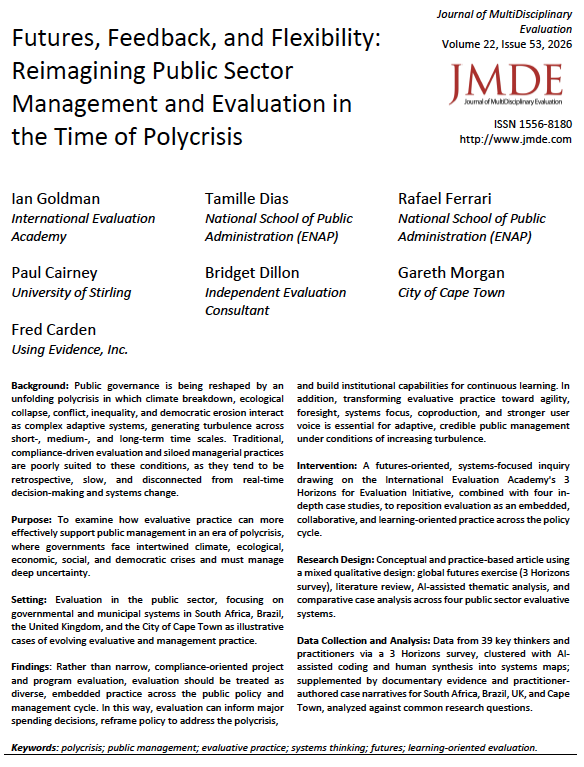
This article examines how evaluative practice can better support public management in an era of “polycrisis” marked by climate breakdown, ecological collapse, conflict, inequality, and democratic erosion. Governments need to manage increasing uncertainty and evaluative practice needs to be repositioned and embedded to support emergent policy and management processes. The article draws on a global futures exercise using the 3 Horizons approach with 39 respondents, combined with literature review, AI-assisted analysis, and four case studies of public sector evaluative systems in South Africa, Brazil, the United Kingdom, and the City of Cape Town. Across the cases, findings show that when evaluation is reconfigured as a diverse set of embedded, collaborative practices, it can inform major spending decisions, reframe policy goals to address the polycrisis, and build institutional capability for continuous learning. The article concludes that transforming evaluation from a narrow, compliance-driven function into an agile, futures-linked, and systems-oriented diverse practice is not optional but a precondition for credible public management in the polycrisis, and calls for deliberate changes in incentives, roles, and governance arrangements to institutionalise this shift.
Downloads
Article Details

This work is licensed under a Creative Commons Attribution-NonCommercial 4.0 International License.
Copyright and Permissions
Authors retain full copyright for articles published in JMDE. JMDE publishes under a Creative Commons Attribution-NonCommercial 4.0 International License (CC BY - NC 4.0). Users are allowed to copy, distribute, and transmit the work in any medium or format for noncommercial purposes, provided that the original authors and source are credited accurately and appropriately. Only the original authors may distribute the article for commercial or compensatory purposes. To view a copy of this license, visit creativecommons.org
References
Arnstein, S. R. (1969). A ladder of citizen participation. Journal of the American Institute of Planners, 35(4), 216–224. https://doi.org/10.1080/01944366908977225
Askar, H., Schmidt-Abbey, B., Lucaciu, L. O., Augustyn, A. M., Chaplowe, S., Dhingra, N., Goldman, I., Gupta, A., Morell, J., Wehipeihana, N., & Matheson, A. (2026). Reframing evaluation: Complexity, systems, and transformation. Journal of MultiDisciplinary Evaluation, 22(53), 85–107.
Bemelmans-Videc, M. L., Rist, R. C., & Vedung, E. O. (Eds.). (2011). Carrots, sticks, and sermons: Policy instruments and their evaluation (Vol. 1). Transaction Publishers.
Bolden, R., Gulati, A. & Edwards, G. (2020). Mobilizing change in public services: Insights from a systems leadership development intervention. International Journal of Public Administration, 43(1), 26–36, https://doi.org/10.1080/01900692.2019.1604748
Buckley, J., Archibald, T., Hargraves, M., & Trochim, W. (2015). Defining and teaching evaluative thinking: Insights from research on critical thinking. American Journal of Evaluation, 36. https://doi.org/10.1177/1098214015581706
Cairney, P. (2016). The politics of evidence-based policy making. Springer.
Cairney, P. (2021). Three habits of successful policy entrepreneurs. In Practical lessons from policy theories (pp. 13–34). Policy Press.
Cairney, P. (2025). Policymaking integration, policy coherence, and whole-of-government approaches: A qualitative systematic review of advice for policymakers. Open Research Europe 5, 75. https://doi.org/10.12688/openreseurope.19864.1
Cairney, P., Boswell, J., Ayres, S., Durose, C., Elliott, I. C., Flinders, M., Martin, S., & Richardson, L. (2024). The state of British policymaking: How can UK government become more effective? Parliamentary Affairs, 77(4), 837–864.
Cairney, P., & Toomey, C. (2024). Collaborative policymaking: A qualitative systematic review of advice for policymakers. Open Research Europe, 4, 204. https://doi.org/10.12688/openreseurope.18440.1
Cairney, P., & Toomey, C. (2025). So you want to be a systems leader? Policy Design and Practice, 1–15. https://doi.org/10.1080/25741292.2025.2545
Carden, F. (2009). Knowledge to policy: Making the most of development research. Sage & International Development Research Centre.
Carey, G., Crammond, B., & Keast, R. (2014). Creating change in government to address the social determinants of health: How can efforts be improved?, BMC Public Health, 14, 1087, http://doi.org/10.1186/1471-2458-14-1087
Chaplowe, S., Morkel, C., de la Garza, T., Buckton, S., Nandi, R., Ferretti, S., & Zaveri, S. (2026). Rethinking evaluation competencies for the transformational imperative. Journal of MultiDisciplinary Evaluation, 22(53), 41–69.
Chattopadhyay, S. (n.d.). Proteeti. https://www.pluriversalplanet.in/home
Chelimsky, E. (1987). The politics of program evaluation. New Directions for Program Evaluation, 34, 5–21.
Chen, H.-t. (1990), Issues in constructing program theory. New Directions for Program Evaluation, 47, 7–18.
City of Cape Town. (2025). Cape Town 2050—Long-Term Plan. https://www.capetown.gov.za
Cousins, J. B., Whitmore, E., & Shulha, L. (2013). Arguments for a common set of principles for collaborative inquiry in evaluation. American Journal of Evaluation, 34(1), 7–22.
Dayal, H. (2023). Knowledge management in the public sector: Lessons from South Africa post COVID-19. Africa Journal of Public Sector Development and Governance, 6(1). https://doi.org/10.55390/ajpsdg.2023.6.1.3
Deaton, A., & Cartwright, N. (2018). Understanding and misunderstanding randomized controlled trials. Social Science & Medicine, 210, 2–21.
Dias, T., Serpa, F. B., Ferrari, R. M., & Gomide, A. de Ávila. (in press). Avaliação e evidências para informar políticas públicas: As experiências da Enap em colaboração, coprodução e fortalecimento de capacidades. In N. M. Koga, M. M. S. Pinheiro, P. L. M. Palotti, R. M. Oliveira, R. R. C. Pires, E. R. Santos, & M. Loureiro (Eds.), Políticas públicas informadas por evidências: conhecimentos, arranjos e capacidades para a governança democrática. Ipea.
Dixon, J., Melloni, E., Orue Echevarria, L., Osimo, D., Hellebø Rykkja, L., Shaw, K., ... & Vasilescu, C. (2021). The Co-creation compass: Interactive policy brief. Creating Public Value Together: from Research to Action. Lisbon Council E-Brief, 27, 1–24.
DPME. (2011). National Evaluation Policy Framework, Department of Planning, Monitoring and Evaluation.
DPME. (2014). DPME Evaluation Guideline No. 2.2.15 – Guideline on Evaluation Synthesis, Department of Planning, Monitoring and Evaluation.
DPME. (2022). Expanding evidence synthesis capability through coproduction. Department of Planning, Monitoring and Evaluation. https://www.ukesa.info/library/view/expanding-evidence-synthesis-capability-through-coproduction
Drath, W. H., McCauley, C. D., Palus, C. J., Van Velsor, E., O’Connor, P. M., & McGuire, J. B. (2008). Direction, alignment, commitment: Toward a more integrative ontology of leadership. The leadership quarterly, 19(6), 635–653.
Engela, R. (2024). Editorial: Spending reviews and the evolution of South African public finance management reforms. Development Southern Africa, 41(5) 825–827. https://doi.org/10.1080/0376835X.2024.2406556
Fetterman, D. M. (2017). Transformative empowerment evaluation and Freirean pedagogy: Alignment with an emancipatory tradition. New Directions for Evaluation, 155, 111–126.
Fetterman, D. M. (June 2024). Empowerment evaluation & social justice [Conference presentation]. Evaluation Week, Enap, Brasília, Brazil. https://repositorio.enap.gov.br/handle/1/8016
Ghate D., Lewis J., & Welbourn D. (2013). Systems leadership: Exceptional leadership for exceptional times [Synthesis paper]. Leadership Centre.
Goldman, I., & Pabari, M. (2020). Lessons for using evidence in policy and practice. In I. Goldman & M. Pabari (Eds.), Using evidence in policy and practice: Lessons from Africa. Routledge. https://www.taylorfrancis.com/books/e/9781003007043
Goldman, I., Pabari, M., & Amisi, M. M., (2021). The importance of knowledge brokering for evidence use in Africa [CLEAR-AA Policy Brief]. https://www.wits.ac.za/clear-aa/supporting-evidence-use-in-policy-and-practice/
Goldman, I., Morkel, C., Agbodjan, E. D., & Molaiwa, T. G. (2024). Decolonising national evaluation systems. African Evaluation Journal, 12(2). https://doi.org/10.4102/aej.v12i2.731
Goss, S. (2021). Systems leadership: A view from the bridge. OPM.
Graham, I. D., Rycroft-Malone, J., Kothari, A., & McCutcheon, C. (2022). Research coproduction in healthcare. John Wiley & Sons Ltd.
Guba, E. G, & Lincoln, Y. S. (1989). Fourth generation evaluation. Sage Publications Inc.
Hansen, M. B., & Vedung, E. (2010). Theory-based stakeholder evaluation. American Journal of Evaluation, 31(3), 295–313.
Heikkila, T., & Gerlak, A. K. (2013). Building a conceptual approach to collective learning: Lessons for public policy scholars. Policy Studies Journal, 41(3), 484–512.
Kania, J., Kramer, M., & Senge, P. (2018). The water of systems change. FSG. https://www.fsg.org/resource/water_of_systems_change/
Kim, J., & Siddiki, S. (2018). Linking diversity of collaborative policymaking venues with procedural justice perceptions: A study of US marine aquaculture partnerships. The American Review of Public Administration, 48(2), 159–174.
Koebele, E. A. (2019). Policy learning in collaborative environmental governance processes. Journal of Environmental Policy & Planning, 21(3), 242–256.
Langer, L. & Weyrauch, V. (2020). Using evidence in Africa: A framework to assess what works, how and why. In I. Goldman & M. Pabari (Eds.), Using evidence in policy and practice: Lessons from Africa. Routledge. https://www.taylorfrancis.com/books/e/9781003007043.
Lowe, T. & Plimmer, D. (2019). Exploring the new world: Practical insights for funding, commissioning and managing in complexity. Northumbria University/Collaborate for Social Change. https://collaboratecic.com/insights-and-resources/exploring-the-new-world-practical-insights-for-funding-commissioning-and-managing-in-complexity/
Mashingaidze, M., Goldman, I., & Hazell, E. (2023). South African experience building capacity and supporting rapid evaluation. eVALUation Matters, 2. https://idev.afdb.org/sites/default/files/documents/files/V2_2023_Eng_Article3.pdf
Mintrom, M. (2019). So you want to be a policy entrepreneur? Policy design and practice, 2(4), 307–323.
Nguyen, L. K. N., Kumar, C., Bisaro Shah, M., Chilvers, A., Stevens, I., Hardy, R., Sarell, C. J., & Zimmermann, N. (2023). Civil servant and expert perspectives on drivers, values, challenges and successes in adopting systems thinking in policy-making. Systems, 11(4), 193. https://doi.org/10.3390/systems11040193
Olejniczak, K. (2017). The game of knowledge brokering: A new method for increasing evaluation use. American Journal of Evaluation, 38(4), 554–576.
O’Sullivan, R. G. (2012). Collaborative evaluation within a framework of stakeholder-oriented evaluation approaches. Evaluation and Program Planning, 35(4), 518–522.
Ofir, Z., Kendrick, I., Goldman, I., Ferretti, S., Norins, J., Sithole, S., Belzer, A., Chaplowe, S., Diwakar, Y., Kalugampitiya, A., Lareza, A. E., Verveld-Nguyen, L., & Zaveri, S. (2026). Where next for evaluation? Navigating the polycrisis through three horizons. Journal of MultiDisciplinary Evaluation, 22(53), 12–40.
Patton, M. Q. (2011). Developmental evaluation: Applying complexity concepts to enhance innovation and use. Guilford Press.
Phillips, S., Goldman, I., Gasa, N., Akhalwaya, I., & Leon, B. (2014). A focus on M&E of results: An example from the Presidency, South Africa. Journal of Development Effectiveness, 6(4), 392–406. https://doi.org/10.1080/19439342.2014.966453
Picciotto, R. (2023). Evaluation transformation implies its decolonization. Journal of MultiDisciplinary Evaluation, 19(44), 131–141. https://doi.org/10.56645/jmde.v19i44.797
Pisani, E. & Kok, M. (2017). In the eye of the beholder: To make global health estimates useful, make them more socially robust. Global Health Action, 10(sup 1). https://doi.org/10.3402/gha.v9.32298
Preiser, R. (2018). Key features of complex adaptive systems and practical implications for guiding action [Policy brief]. Centre for Sustainability Transitions.
Richardson, K., Steffen, W., Lucht, W., Bendtsen, J., Cornell, S. E., Donges, J. F., Drüke, M., Fetzer, I., Bala, G., Von Bloh, W., Feulner, G., Fiedler, S., Gerten, D., Gleeson, T., Hofmann, M., Huiskamp, W., Kummu, M., Mohan, C., Nogués-Bravo, D., Petri, S., Porkka, M., Rahmstorf, S., Schaphoff, S., Thonicke, K., Tobian, A., Virkki, V., Wang-Erlandsson, L., Weber, L., & Rockström, J. (2023). Earth beyond six of nine planetary boundaries. Science Advances, 9(37). https://doi.org/10.1126/sciadv.adh2458
Rodríguez-Campos, L. (2012). Advances in collaborative evaluation. Evaluation and Program Planning, 35(4), 523–528.
Rogers, P. J., Petrosino, A., Huebner, T. A., & Hacsi, T. A. (2000). Program theory evaluation: Practice, promise, and problems. New Directions for Evaluation, 87, 5–13.
Rogers, P. J. (2008). Using programme theory to evaluate complicated and complex aspects of interventions. Evaluation, 14(1), 29–48.
Rose, E. S., Bello-Manga, H., Boafor, T., & Asaduzzaman, M. (2024, January). International collaborative research, systems leadership and education: Reflections from academic biomedical researchers in Africa. In Frontiers in Education (Vol. 8, p. 1217066). Frontiers Media SA.
Siddiki, S., & Ambrose, G. (2023). Evaluating change in representation and coordination in collaborative governance over time: A study of environmental justice councils. Environmental Management, 71(3), 620–640.
Teasdale, R. M. (2021). Evaluative criteria: An integrated model of domains and sources. American Journal of Evaluation, 42(3), 354–376.
Timmins, S. (2015). The practice of system leadership. Being comfortable with chaos. The King’s Fund.
Topp, L., Mair, D., Smillie, L. & Cairney, P. (2018). Knowledge management for policy impact: The case of the European Commission’s Joint Research Centre. Humanities and Social Sciences Communications, 4, 87, https://doi.org/10.1057/s41599-018-0143-3
UN Futures Lab/ISC. (2025). Futures thinking and strategic foresight in action: Insights from the Global South. www.un-futureslab.org/project/futures-thinking-and-strategic-foresight-in-action-insights-from-the-global-south
Weiss, C. H. (1979). The many meanings of research utilization. Public Administration Review, 39(5), 426–431.
Weiss, C. H. (1988). Evaluation for decisions: Is anybody there? Does anybody care? Evaluation Practice, 9(1), 5–19.
Weiss, C. H. (1993). Where politics and evaluation research meet. Evaluation Practice, 14(1), 93–106.
Weiss, C. H. (1997). Theory-based evaluation: Past, present, and future. New Directions for Evaluation, 76, 41–55.
World Economic Forum. (2025). The global risks report 2025, 20th edition. https://www.weforum.org/publications/global-risks-report-2025/