
Reframing Evaluation: Complexity, Systems, and Transformation
Article Sidebar
Main Article Content
Abstract
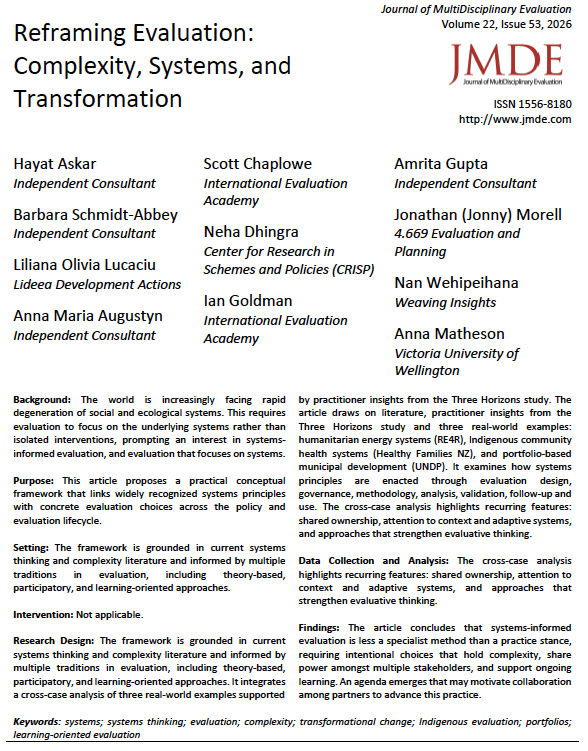
The world is increasingly facing rapid degeneration of social and ecological systems. This requires evaluation to focus on the underlying systems rather than isolated interventions, prompting an interest in systems-informed evaluation, and evaluation that focuses on systems. This article proposes a practical conceptual framework that links widely recognized systems principles with concrete evaluation choices across the policy and evaluation lifecycle. The framework is grounded in current systems thinking and complexity literature and informed by multiple traditions in evaluation, including theory-based, participatory, and learning-oriented approaches. The article draws on literature, practitioner insights from the Three Horizons study and three real-world examples: humanitarian energy systems (RE4R), Indigenous community health systems (Healthy Families NZ), and portfolio-based municipal development (UNDP). It examines how systems principles are enacted through evaluation design, governance, methodology, analysis, validation, follow-up and use. The cross-case analysis highlights recurring features: shared ownership, attention to context and adaptive systems, and approaches that strengthen evaluative thinking. We conclude that systems-informed evaluation is less a specialist method than a practice stance, requiring intentional choices that hold complexity, share power amongst multiple stakeholders, and support ongoing learning. An agenda emerges that may be motivating for interested partners to collaborate on taking forward.
Downloads
Article Details

This work is licensed under a Creative Commons Attribution-NonCommercial 4.0 International License.
Copyright and Permissions
Authors retain full copyright for articles published in JMDE. JMDE publishes under a Creative Commons Attribution-NonCommercial 4.0 International License (CC BY - NC 4.0). Users are allowed to copy, distribute, and transmit the work in any medium or format for noncommercial purposes, provided that the original authors and source are credited accurately and appropriately. Only the original authors may distribute the article for commercial or compensatory purposes. To view a copy of this license, visit creativecommons.org
References
Aston, P., & Apgar, M. (2022). Building confidence in evaluative judgements: Methodological bricolage and contribution analysis in complex contexts. Evaluation, 28(4), 481–499.
Beach, D., & Pedersen, R. B. (2013). Process-tracing methods: Foundations and guidelines. University of Michigan Press.
Befani, B., & Mayne, J. (2014). Process tracing and contribution analysis: A combined approach to generative causal inference for impact evaluation. IDS Bulletin, 45(6), 17–36. https://doi.org/10.1111/1759-5436.12110
Befani, B. (2016). Testing contribution claims with Bayesian updating. CECAN Evaluation and Policy Practice Note No. 2.1. Centre for the Evaluation of Complexity Across the Nexus. https://www.cecan.ac.uk/sites/default/files/2018-01/BARBARA%20v2.5.pdf
Bellamy, J. A., Walker, D. H., McDonald, G. T., & Syme, G. J. (2001). A systems approach to the evaluation of natural resource management initiatives. Journal of Environmental Management, 63(4), 407–423. https://doi.org/10.1006/jema.2001.0493
Binder, C. R., Hinkel, J., Bots, P. W. G., & Pahl-Wostl, C. (2013). Comparison of frameworks for analyzing social-ecological systems. Ecology and Society, 18(4). https://doi.org/10.5751/es-05551-180426
Buckton, S. J., Fazey, I., Ball, P., Ofir, Z., Colvin, J., Darby, M., Hejnowicz, A. P., Leicester, G., Newman, R., Page, G. G., Parsons, K., & van Mierlo, B. (2025). Twelve principles for transformation-focused evaluation. PLOS Sustainability and Transformation, 4(4), e0000164. https://doi.org/10.1371/journal.pstr.0000164
Chaplowe, S., & Gupta, T. (2022). Final report: Independent evaluation (systems impact assessment) of the Renewable Energy for Refugees project. Practical Action and UNHCR.
Climate Investment Funds (CIF). (2021). Transformational change concepts: Working definition, dimensions, questions and signals. Retrieved from https://www.cif.org/knowledge-documents/transformational-change-concepts-working-definition-dimensions-questions-and
Coffman, J. (2007). A framework for evaluating systems initiatives. Harvard Family Research Project.
Darnhofer, I., Gibbon, D., & Dedieu, B. (2017). Towards a complexity-aware theory of change for participatory research programs. Agricultural Systems, 153, 36–45.
Department for Environment, Food and Rural Affairs (Defra). (2020). Complexity evaluation framework: Recognising complexity and key considerations for complexity-appropriate evaluation (Version 2.0, updated by Steer Economic Development). https://www.betterevaluation.org/tools-resources/complexity-evaluation-framework-recognising-complexity-key-considerations-for-complexity-appropriate
Douthwaite, B., & Hoffecker, E. (2017). Towards a complexity-aware theory of change for participatory research programs working within agricultural innovation systems. Agricultural Systems, 155, 88–98. https://doi.org/10.1016/j.agsy.2017.04.002
European Commission / UNDP. (n.d.). Mayors for Economic Growth (M4EG). https://eum4eg.com
Garcia, J. R., & Uitto, J. I. (2025). Using a systems lens in evaluations at the nexus of environment and development. Evaluation and Program Planning, 112, 102560. https://doi.org/10.1016/j.evalprogplan.2025.102560
Geels, F. W., & Schot, J. (2007). Typology of sociotechnical transition pathways. Research Policy, 36(3), 399-417.
Goldman, I., Cairney, P., Carden, F., Dias, T., Dillon, B., Ferrari, R., & Morgan, G. (2026). Futures, Feedback, and Flexibility: Reimagining Public Sector Management and Evaluation in the Time of Polycrisis. Journal of MultiDisciplinary Evaluation, 22(53), 233–254.
Goldman, I., & Pabari, M. (2020). Lessons for using evidence in policy and practice. In I. Goldman & M. Pabari (Eds.), Using evidence in policy and practice: Lessons from Africa. Routledge. https://www.taylorfrancis.com/books/e/9781003007043
Ison, R., Blackmore, C., & Collins, L. (2021). Fostering complexity thinking in action research for change in social-ecological systems. Systemic Practice and Action Research, 34(1), 1–19.
Latham, N. (2014). Pathways to system change: The evaluation of complex systems. Evaluation, 20(1), 60–77.
Leeuw, F. L., & Furubo, J.-E. (2008). Evaluation systems: What are they and why study them? Evaluation, 14(2), 157–169. https://doi.org/10.1177/1356389007087537
Matheson, A., Gray, R., Wehipeihana, N., et al. (2020). Evaluation of Healthy Families NZ: Interim report 2020. Te Herenga Waka – Victoria University of Wellington, Wellington.
Mingers, J., & Gill, A. (Eds.). (1997). Multimethodology: Theory and practice of combining management science methodologies. John Wiley & Sons.
Morell, J. A. (2010). Evaluation in the face of uncertainty: Anticipating surprise and responding to the inevitable. Guilford Press.
Morell, J. A. (2025). Characteristics of sustainability: A complexity-based view to inform evaluation. Evaluation and Program Planning, 111, 102561.
Morell, J. A., Hilscher, R., Magura, S., & Ford, J. (2010). Integrating evaluation and agent-based modeling: Rationale and an example for adopting evidence-based practices. Journal of MultiDisciplinary Evaluation, 6(14), 32–57. https://doi.org/10.56645/jmde.v6i14.275
Ndhlovu, L., Smith, L., & Narsoo, S. (2017). The search for a method to unpack urban complexity: Case study of the City of Johannesburg. African Evaluation Journal, 5(1), 1–11. https://doi.org/10.4102/aej.v5i1.195
Ofir, Z. (2021). Evaluation in transition: The promise and challenge of South-South cooperation. Canadian Journal of Program Evaluation, 36(1), 18–38. https://doi.org/10.3138/cjpe.71630
Ofir, Z., Kendrick, I., Goldman, I., Ferretti, S., Norins, J., Sithole, S., Belzer, A., Chaplowe, S., Diwakar, Y., Kalugampitiya, A., Lareza, A. E., Verveld-Nguyen, L., Zaveri, S. (2026). Where Next for Evaluation? Navigating the Polycrisis Through Three Horizons. Journal of MultiDisciplinary Evaluation, 22(53), 12–40.
Patton, M. Q. (2010). Developmental evaluation applying complexity concepts to enhance innovation and use. Guildford Press. http://www.guilford.com/cgi-bin/cartscript.cgi?page=pr/patton.htm&dir=research/res_eval&cart_id=519053.25995
Patton, M. Q. (2011). A complexity-based plan for evaluating transformation. Evaluation, 17(4), 373–389.
Pawson, R., & Tilley, N. (1997). Realistic evaluation. Sage Publications.
Reynolds, M., Gates, E., Hummelbrunner, R., Marra, M., & Williams, B. (2016). Towards systemic evaluation. Systems Research and Behavioral Science, 33(5), 662–673. https://doi.org/10.1002/sres.2423
Schweitzer, F., Fagiolo, G., Sornette, D., Vega-Redondo, F., White, H., & Helbing, D. (2009). Economic networks: The new challenges. Science, 325(5939), 422–425.
Snowden, D. J., & Boone, M. E. (2007). A leader’s framework for decision making. Harvard Business Review, 85(11), 68–149.
Systems in Evaluation Topical Interest Group (SETIG). (2018). Principles for effective use of systems thinking in evaluation practice. American Evaluation Association. https://www.betterevaluation.org/sites/default/files/SETIG-Principles-FINAL-DRAFT-2018-9-9.pdf
Shipurkar, T. J., Narayanan, P., Manjutha, C., Ponnuchamy, M., Khan, N., & Joseph, A. R. (2026). Measuring Collectivization Initiatives: Creating a Knowledge Base from Collective Voices. Journal of MultiDisciplinary Evaluation, 22(53), 255–279.
UNDP. (2021). UNDP evaluation guidelines. https://erc.undp.org/pdf/UNDP_Evaluation_Guidelines.pdf
UNDP. (2022). System change: A guidebook for adopting portfolio approaches. https://www.undp.org/publications/system-change-guidebook-adopting-portfolio-approaches
UNDP. (2024). Mayors for Economic Growth: Final evaluation report. https://erc.undp.org/evaluation/documents/download/23754
UNDP. (n.d.). Systems portfolio resource hub. https://www.undp.org/systems-portfolio
van den Berg, R. D., & McCollum, D. (2021). Meta-analysis of climate mitigation evaluations. Evaluation and Program Planning, 85, 101910.
Williams, B., & Hummelbrunner, R. (2010). Systems concepts in action: A practitioner’s toolkit. Stanford University Press.
Wilson-Grau, R., & Britt, H. (2012). Outcome harvesting. Ford Foundation. https://www.betterevaluation.org/tools-resources/outcome-harvesting-0
Zaveri, S., Goldman, I., Norins, J., Ghiano, C., Kotschy, K., & Soal, S. (in press). How can evaluations support a socially just transition to planetary health? In G. Batra, J. I. Uitto, & M. A. Spearman (Eds.), Integrating for sustainability: Evaluation across environmental and socioeconomic domains (Chapter 11). Springer.