
Regenerative-Focused Evaluation: Centering Place in Evaluation Theory and Practice
Article Sidebar
Main Article Content
Abstract
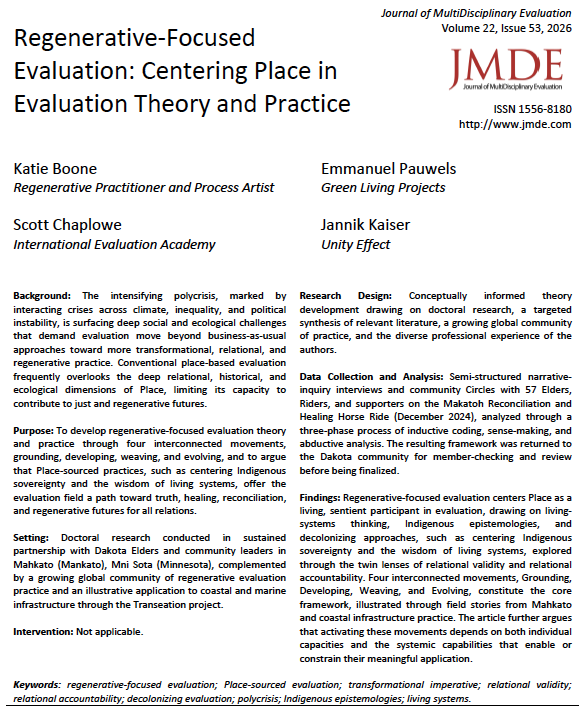
The intensifying polycrisis — marked by interacting crises across climate, inequality, and political instability — is surfacing deep social and ecological challenges that demand evaluation move beyond business-as-usual approaches toward more transformational, relational, and regenerative practice. Regenerative-focused evaluation has emerged as one response — centering Place as a living, sentient participant rather than a geographic backdrop. Drawing on living-systems thinking, Indigenous epistemologies, and decolonizing approaches, this article explores regenerative-focused evaluation through the twin lenses of relational validity and relational accountability to the people, communities, and living systems where evaluation is conducted. It argues that conventional place-based evaluation frequently overlooks the deep relational, historical, and ecological dimensions of Place — and that Place-sourced practices, such as centering Indigenous sovereignty and the wisdom of living systems, offer the evaluation field a path toward truth, healing, reconciliation, and regenerative futures for all relations.
Downloads
Article Details

This work is licensed under a Creative Commons Attribution-NonCommercial 4.0 International License.
Copyright and Permissions
Authors retain full copyright for articles published in JMDE. JMDE publishes under a Creative Commons Attribution-NonCommercial 4.0 International License (CC BY - NC 4.0). Users are allowed to copy, distribute, and transmit the work in any medium or format for noncommercial purposes, provided that the original authors and source are credited accurately and appropriately. Only the original authors may distribute the article for commercial or compensatory purposes. To view a copy of this license, visit creativecommons.org
References
Alkin, M. C. (2013). Evaluation roots: A wider perspective of theorists’ views and influences. SAGE.
American Evaluation Association. (2018). The 2018 AEA evaluator competencies. https://www.eval.org/Portals/0/Docs/AEA%20Evaluator%20Competencies.pdf
Basso, K. H. (1996). Wisdom sits in places: Landscape and language among the Western Apache. UNM Press.
Boone, K. (2025). Putting evaluation in its place *In a good way [Doctoral dissertation]. University of Minnesota. https://hdl.handle.net/11299/278772
Brousselle, A. (2026). Foundations of evaluation for planetary health. University of Victoria Libraries. https://doi.org/10.18357/9781550587364
Brousselle, A., Curren, M., Dunbar, B., McDavid, J., Logtenberg, R., & Ney, T. (2024). Planetary health: Creating rapid impact assessment tools. Evaluation: The International Journal of Theory, Research and Practice, 30(2). https://doi.org/10.1177/13563890241227433
Cajete, G. (1994). Look to the mountain: An ecology of Indigenous education. Kivakí Press.
Cavino, H. M. (2013). Across the colonial divide. American Journal of Evaluation, 34(3), 339–355. https://doi.org/10.1177/1098214013489338
Chaplowe, S., Morkel, C., de la Garza, T., Buckton, S., Ferretti, S., Nandi, R., & Zaveri, S. (2026). Rethinking Evaluation Competencies for the Transformational Imperative. Journal of MultiDisciplinary Evaluation, 22(53), 41–69.
Chilisa, B., Bowman, N., & Harnar, M. (Eds.). (2023). Decolonizing evaluation: Towards a fifth paradigm [Special issue]. Journal of MultiDisciplinary Evaluation, 19(44). https://jmde.com/index.php/jmde_1/issue/view/77
Cram, F., LaFrance, J., & Tibbetts, K. A. (2023). “The past is rich in glory and knowledge”, The intersection of Indigenous evaluation and culturally responsive evaluation. New Directions for Evaluation, 180, 51–56.
Deloria, E. C. (1998). Speaking of Indians. U of Nebraska Press.
Deloria, V., Jr. (1992). God is red: A native view of religion (2nd ed.). North American Press.
Deloria, V., & Wildcat, D. R. (2001). Power and place: Indian education in America. Fulcrum Publishing.
Elliott-Groves, E., Hardison-Stevens, D., & Ullrich, J. (2019). Indigenous relationality is the heartbeat of Indigenous existence during COVID-19. Journal of Indigenous Social Development, 9(3), 158–169.
Erfani, G. (2022). Reconceptualising sense of place: Towards a conceptual framework for investigating individual-community-place interrelationships. Journal of Planning Literature, 37(3), 452–466.
Fabian, J. (2002). Time and the other: How anthropology makes its object. Columbia University Press.
Fletcher, G., Waters, J., Yunkaporta, T., Marshall, C., Davis, J., & Bancroft, J. M. (2023). Indigenous systems knowledge applied to protocols for governance and inquiry. Systems Research and Behavioral Science, 40(4), 757–760. https://doi.org/10.1002/sres.2932
Gibbons, L. V. (2020). Regenerative, The new sustainable? Sustainability, 12(13), 5483.
Goeman, M. (2013). Mark my words: Native women mapping our nations. U of Minnesota Press.
Greene, J. C. (1997). Evaluation as advocacy. Evaluation Practice, 18(1), 25–35. https://doi.org/10.1177/109821409701800103
Guba, E. G., & Lincoln, Y. S. (1994). Competing paradigms in qualitative research. In N. K.
Denzin & Y. S. Lincoln (Eds.), Handbook of qualitative research (pp. 105–117). Sage
Publications.
Harun, N. Z., Mansor, M., & Said, I. (2015). Place rootedness suggesting the loss and survival of historical public spaces. Procedia Environmental Sciences, 28, 528–537. https://doi.org/10.1016/j.proenv.2015.07.063
Hopson, R. K. (2014). Justice signposts in evaluation theory, practice, and policy. New Directions for Evaluation, 142, 83–94. https://onlinelibrary.wiley.com/doi/10.1002/ev.20087
Kawakami, A. J., Aton, K., Cram, F., Lai, M. K., & Porima, L. (2007). Improving the practice of evaluation through Indigenous values and methods: Decolonizing evaluation practice, Returning the gaze from Hawai’i and Aotearoa. Fundamental Issues in Evaluation, 4, 219–242. http://www.nwtontheland.ca/uploads/8/6/5/1/86514372/10_improving_the_practice_of_evaluation_through_indigenous_values_and_methods.pdf
Kirkhart, K. E. (2010). Eyes on the prize: Multicultural validity and evaluation theory. American Journal of Evaluation, 31(3), 400–413. https://doi.org/10.1177/1098214010373645
LaFrance, J., & Nichols, R. (2010). Reframing evaluation: Defining an Indigenous evaluation framework. Canadian Journal of Program Evaluation, 23(2), 13–31. https://doi.org/10.3138/cjpe.23.003
LaFrance, J., Nichols, R., & Kirkhart, K. E. (2012). Culture writes the script: On the centrality of context in Indigenous evaluation. New Directions for Evaluation, 135, 59–74.
Lewin, K. (1943). Defining the ‘field at a given time.’ Psychological Review, 50(3), 292–310. https://doi.org/10.1037/h0062738
Lincoln, Y. S., & Guba, E. G. (2000). Paradigmatic controversies, contradictions, and emerging
confluences. In N. K. Denzin & Y. S. Lincoln (Eds.), Handbook of qualitative research
(2nd ed., pp. 163–188). Sage Publications.
Mang, P., & Haggard, B. (2016). Regenerative development and design: A framework for evolving sustainability. Wiley.
Mang, P., & Reed, B. (2012). Designing from place: A regenerative framework and methodology. Building Research & Information, 40(1), 23–38. https://doi.org/10.1080/09613218.2012.621341
Mark, M. M. (2001). Evaluation’s future: Furor, futile, or fertile? American Journal of Evaluation, 22(3), 457–479. https://doi.org/10.1177/109821400102200324
Massey, D. B. (2005). For space. Sage Publications.
Meixi, Moreno-Dulcey, F., Alcalá, L., Keyser, U., & Elliott-Groves, E. (2022). When learning is life giving: Redesigning schools with Indigenous systems of relationality. AERA Open, 8, 1–16. https://doi.org/10.1177/23328584211062587
Mohseni, H., Silvennoinen, J., & Kujala, T. (2024). Place-belongingness in real-life contexts: A review of practical meanings, contributing factors, and evaluation methods. GeoJournal, 89(5), Article 187. https://doi.org/10.1007/s10708-024-11173-9
Ofir, Z., Kendrick, I., Goldman, I., Ferretti, S., Norins, J., Sithole, S., Belzer, A., Chaplowe, S., Diwakar, Y., Kalugampitiya, A., Lareza, A. E., Verveld-Nguyen, L., Zaveri, S. (2026). Where Next for Evaluation? Navigating the Polycrisis Through Three Horizons. Journal of MultiDisciplinary Evaluation, 22(53), 12–40.
Patton, M. Q. (2011). Developmental evaluation: Applying complexity concepts to enhance innovation and use. Guilford Press.
Patton, M. Q. (2020). Blue Marble evaluation: Premises and principles. Guilford Press.
Pauwels, E. (2026). Regenerative evaluation for coastal and marine infrastructure [Report in preparation]. Green Living Projects.
Poelina, A., Wooltorton, S., Blaise, M., Aniere, C. L., Horwitz, P., White, P. J., & Muecke, S. (2022). Regeneration time: Ancient wisdom for planetary wellbeing. Australian Journal of Environmental Education, 38(3–4), 397–414. https://doi.org/10.1017/aee.2021.34
Prado, J. (2011). “Honor the context”: Opening lines for a critical multicultural Evaluative Practice. American Journal of Evaluation, 32(3), 418–427. https://doi.org/10.1177/1098214010397531
Relph, E. (1976) Place and placelessness. Pion.
Reo, N. J. (2019). Inawendiwin and relational accountability in Anishnaabeg studies: The crux of the biscuit. Journal of Ethnobiology, 39(1), 65–75. https://doi.org/10.2993/0278-0771-39.1.65
Regenerative Evaluation Community of Practice (2026, March 24). Regenerative evaluation influences, pathways & practices. Unity Effect. https://cdn.prod.website-files.com/60129aa0de82235a505a0fca/69c28722cc60b7111455983a_Regenerative%20Evaluation%20Living%20Paper%20(2025-2026)%20(1).pdf
Rog, D. J. (2012). When background becomes foreground: Toward context-sensitive evaluation practice. New Directions for Evaluation, 135, 25–40.
Rowe, A. (2012). Evaluation of natural resource interventions. American Journal of Evaluation, 33(3), 384–394. https://doi.org/10.1177/1098214012440026
Rowe, G. (2018). Na-gah mo waabishkizi ojijaak bimise keetwaatino: Singing white crane flying north. Canadian Centre for Policy Alternatives.
Rowe, G. (2023). When we say evaluation, it isn’t the same thing. Canadian Journal of Program Evaluation, 38(2), 159–162.
Scott, S., & Petillo, M. (2021, October 31). Decolonizing evaluation week: Welcome to decolonizing evaluation. AEA365.
Scharmer, O. (2024). Cultivating planetary coherence. Medium / Presencing Institute Blog.
Seamon, D. (2000). A way of seeing people and Place. In S. Wapner, J. Demick, T. Yamamoto, & H. Minami (Eds.), Theoretical Perspectives in Environment-Behavior Research. Springer. https://doi.org/10.1007/978-1-4615-4701-3_13
Shadish, W. R., Cook, T. D., Campbell, D. T., & Leviton, L. C. (1991a). Good theory of social program evaluation. In W. R. Shadish, T. D. Cook, & L. C. Leviton (Eds.), Foundations of program evaluation: Theories of practice (pp. 36–67). Sage.
Shadish, W. R., Cook, T. D., & Leviton, L. C. (1991b). Foundations of program evaluation: Theories of practice. Sage Publications.
Shamai, S. (1991). Sense of place: An empirical measurement. Geoforum, 22(3), 347–358. https://doi.org/10.1016/0016-7185(91)90017-k
Simpson, L. B. (2011). Dancing on our Turtle’s back: Stories of Nishnaabeg re-creation, resurgence and a new emergence. Arbeiter Ring Pub.
Smith, L. T. (2012). Decolonizing methodologies: Research and Indigenous peoples (2nd ed). Zed Books.
Smith, L. T., Tuck, E., & Yang, K. W. (Eds.). (2018). Indigenous and decolonizing studies in education. Routledge.
Soja, E. W. (2013). Seeking spatial justice (Vol. 16). U of Minnesota Press.
Symonette, H. (2004). Walking pathways toward becoming a culturally competent evaluator: Boundaries, borderlands, and border crossings. New Directions for Evaluation, 102, 95–109. https://doi.org/10.1002/ev.118
Thapa, A. (2020, January 17). Northwestern professor emphasizes Native history and inclusion. The Daily Northwestern. https://dailynorthwestern.com/2020/01/16/city/northwestern-professor-emphasizes-native-history-and-inclusion/
Tuan, Y.-F. (1977, 2011). Space and place: The perspective of experience. University of Minnesota Press.
Tuck, E., & McKenzie, M. (2015). Place in research: Theory, methodology, and methods. Routledge.
Tuck, E., & Yang, K. W. (2012). Decolonization is not a metaphor. Decolonization: Indigeneity, Education and Society, 1(1), 1–40.
Waapalaneexkweew (Nicole R. Bowman-Farrell, Mohican/Lunaape). (2018). Looking backward but moving forward: Honoring the sacred and asserting the sovereign in Indigenous evaluation. American Journal of Evaluation, 39(4), 543–568. https://doi.org/10.1177/1098214018790412
Waziyatawin, A. W. (2008). What does justice look like: The struggle for liberation in Dakota homeland. Living Justice Press.
Weick, K. E. (1995). Sensemaking in organizations. SAGE Publications.
Wilson, A. C., & Taylor, E. (2005). Remember this!: Dakota decolonization and the Eli Taylor narratives. U of Nebraska Press.
Wilson, S. (2008). Research is ceremony: Indigenous research methods. Fernwood Publishing.
Winkel, G., Saegert, S., & Evans, G. W. (2009). An ecological perspective on theory, methods, and analysis in environmental psychology: Advances and challenges. Journal of Environmental Psychology, 29(3), 318–328. https://doi.org/10.1016/j.jenvp.2009.02.005
Wolfe, P. (2006). Settler colonialism and the elimination of the Native. Journal of Genocide Research, 8(4), 387–409. https://doi.org/10.1080/14623520601056240
Wright, A. L., Gabel, C., Ballantyne, M., Jack, S. M., & Wahoush, O. (2019). Using two-eyed seeing in research with Indigenous people: An integrative review. International Journal of Qualitative Methods, 18, 160940691986969. https://doi.org/10.1177/1609406919869695
Yellow Horse Brave Heart, M. (1999). Oyate Ptayela: Rebuilding the Lakota Nation through addressing historical trauma among Lakota parents. Journal of Human Behavior in the Social Environment, 2(1–2), 109–126.
Yellow Horse Brave Heart, M., & Chase, J. (2016). Historical trauma among Indigenous peoples of the Americas: Concepts, research, and clinical considerations. In J. Salberg & S. Grand (Eds.), Wounds of history: Repair and resilience in the trans-generational transmission of trauma, (pp. 270–287).