
Rethinking Evaluation Competencies for the Transformational Imperative
Article Sidebar
Main Article Content
Abstract
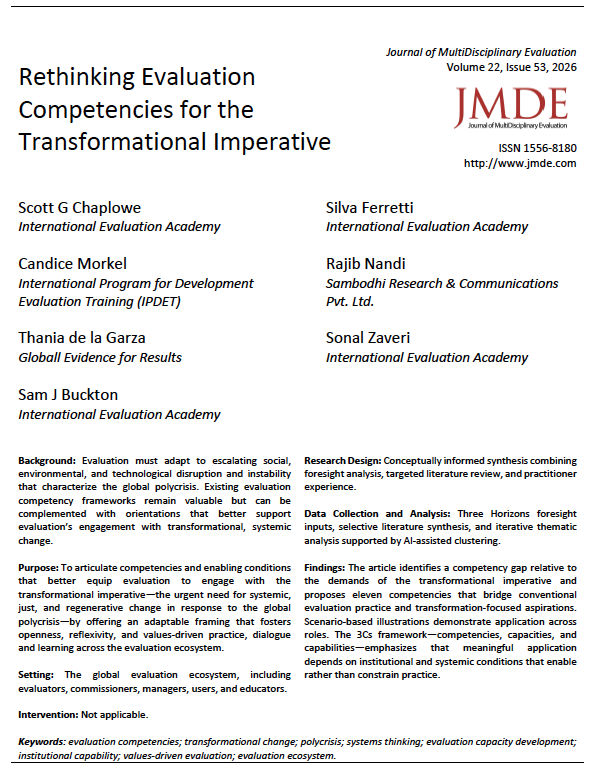
Evaluation is increasingly called upon to remain relevant amid escalating social, environmental, and technological disruption and instability. Existing evaluation competency frameworks offer valuable foundations, but can be complemented by orientations that better support engagement with the transformational imperative: the urgent need for systemic, just, and regenerative change in response to the global polycrisis. Drawing on a Three Horizons foresight exercise, a targeted literature review, and practitioner experience, this article identifies a competency gap and proposes eleven competencies that bridge conventional evaluation practice and transformation-focused aspirations. These competencies extend beyond evaluators to include commissioners, managers, users, and educators. Scenario-based illustrations demonstrate how they may manifest across roles, while the 3Cs framework—competencies, capacities, and capabilities—emphasizes that their meaningful application depends on supportive institutional and systemic conditions. Rather than a prescriptive model, the competencies offer an adaptable framing to orient evaluation toward openness, reflexivity, and values-driven practice. The aim is to catalyze dialogue, experimentation, and adaptive learning across the evaluation ecosystem.
Downloads
Article Details

This work is licensed under a Creative Commons Attribution-NonCommercial 4.0 International License.
Copyright and Permissions
Authors retain full copyright for articles published in JMDE. JMDE publishes under a Creative Commons Attribution-NonCommercial 4.0 International License (CC BY - NC 4.0). Users are allowed to copy, distribute, and transmit the work in any medium or format for noncommercial purposes, provided that the original authors and source are credited accurately and appropriately. Only the original authors may distribute the article for commercial or compensatory purposes. To view a copy of this license, visit creativecommons.org
References
Abrahams, M., Masvaure, S., & Morkel, C. (2022). Made in Africa evaluation. African Evaluation Journal, 10(1), a665. https://doi.org/10.4102/aej.v10i1.665
AEA (American Evaluation Association). (2011). Public statement on cultural competence in evaluation. https://www.eval.org/About/Competencies-Standards/Cultural-Competence-Statement
AEA (American Evaluation Association). (2018). Evaluator competencies. https://www.eval.org/Portals/0/Docs/AEA%20Evaluator%20Competencies.pdf
AES (Australian Evaluation Society). (2013). Evaluators’ professional learning competency framework. https://www.aes.asn.au/evaluator-competencies
AfrEA (African Evaluation Association). (2020). The African evaluation principles. https://alnap.cdn.ngo/media/documents/The-African-Evaluation-Principles.pdf
AI Now. (2023). Algorithmic accountability: Moving beyond audits. https://ainowinstitute.org/publications/algorithmic-accountability
ANZEA (Aotearoa New Zealand Evaluation Association). (2011). 2011 evaluator competencies. https://anzea.org.nz/assets/Key-ANZEA-Files/110801_anzea_evaluator_competencies_final.pdf
Arnold, J. S., & Bartels, W.-L. (2014). Participatory methods for measuring and monitoring governance. In G. Barnes & B. Child (Eds.), Beyond decentralization: Adaptive cross scalar governance of natural resources (Chap. 12). Earthscan.
Baguios, A., King, M., Martins, A., & Pinnington, R. (2021). Are we there yet? Localisation as the journey towards locally led practice — Models, approaches and challenges. Overseas Development Institute. https://globalfundcommunityfoundations.org/wp-content/uploads/2021/10/ODI-SH-Localisation-Report-Oct21-Proof06.pdf
Bamberger, M. (2016). The importance of a mixed methods approach for evaluating complexity. In M. Bamberger, J. Vaessen, & E. Raimondo (Eds.), Dealing with complexity in development evaluation: A practical approach (pp. 144–161). Sage.
Bamberger, M., Vaessen, J., & Raimondo, E. (Eds.). (2016). Dealing with complexity in development evaluation: A practical approach. Sage.
Bender, E. M., Gebru, T., McMillan-Major, A., & Shmitchell, S. (2021). On the Dangers of stochastic parrots: Can language models be too big? Proceedings of the 2021 ACM Conference on Fairness, Accountability, and Transparency (pp. 610–623). https://doi.org/10.1145/3442188.3445922
Berkes, F. (2012). Sacred ecology (3rd ed.). Routledge.
BetterEvaluation. (2024, May). Localization analysis framework. BetterEvaluation. https://www.betterevaluation.org/sites/default/files/2024-10/Localization%20Analysis%20Framework_May%202024_EN%20(1).pdf
BetterEvaluation. (n.d.). Foresight and evaluation. https://www.betterevaluation.org/methods-approaches/themes/foresight-evaluation
Blundo-Canto, G., Ferré, M., Tibaduiza-Castañeda, L., Andrieu, N., Fréguin-Gresh, S., Rodriguez-Borray, G., Santacruz-Castro, A., & Mercandalli, S. (2024). Adapting and combining foresight and ex-ante impact pathway evaluation for place-based research planning with stakeholders. New Directions for Evaluation, 182, 63–76. https://doi.org/10.1002/ev.20608
Bourgeois, I., & Cousins, B. J. (2013). Understanding dimensions of organizational evaluation capacity. American Journal of Evaluation, 34(3), 299–319. https://doi.org/10.1177/1098214013477235
Bourgeois, I., Lemire, S. T., Fierro, L. A., Castleman, A. M., & Cho, M. (2022). Laying a solid foundation for the next generation of evaluation capacity building: Findings from an Integrative Review. American Journal of Evaluation, 44(1), 29–49. https://doi.org/10.1177/10982140221106991
Buckton, S. J., Fazey, I., Ball, P., Ofir, Z., Colvin, J., Darby, M., Hejnowicz, A. P., Leicester, G., Newman, R., Page, G. G., Parsons, K., & van Mierlo, B. (2025). Twelve principles for transformation-focused evaluation. PLOS Sustainability and Transformation, 4(4), e0000164. https://doi.org/10.1371/journal.pstr.0000164
Busuioc, M. (2021). Accountable artificial intelligence: Holding algorithms to account. Public Administration Review, 81(5), 825–836. https://doi.org/10.1111/puar.13293
Calanan, R. M., Bonds, M. E., Bedrosian, S. R., Laird, S. K., Satter, D., & Penman-Aguilar, A. (2023). CDC’s guiding principles to promote an equity-centered approach to public health communication. Preventing Chronic Disease, 20. https://doi.org/10.5888/pcd20.230061
CES (Canadian Evaluation Society). (2018). Competencies for Canadian Evaluation Practice. https://evaluationcanada.ca/files/pdf/2_competencies_cdn_evaluation_practice_2018.pdf
Cekova, D., Corsetti, L., Ferretti, S., & Vaca, S. (2025). Considerations and Practical Applications for using AI in Evaluations [Technical Note]. CGIAR. https://iaes.cgiar.org/sites/default/files/pdf/Considerations%20and%20Practical%20Applications%20for%20Using%20Artificial%20Intelligence%20AI%20in%20Evaluations%202.pdf
Chambers, R. (1997). Whose reality counts? Putting the first last. Intermediate Technology Publications.
Chaplowe, S. (2024). Seven tools to leverage the institutionalization of transformation-smart evaluation [Conference presentation]. Global Evaluation Forum IV, EvalPartners, Rabat, Morocco.
Chaplowe, S., & Cousins, B. J. (2016). Monitoring and evaluation training: A systemic approach. Sage.
Chaplowe, S., & Hejnowicz, A. (2021). Evaluating outside the box: Evaluation’s transformational potential. Social Innovations Journal, 5. https://socialinnovationsjournal.com/index.php/sij/article/view/704
Chilisa, B., & Bowman, N. (2023). Special issue editors’ introductory note: The why and how of the decolonization discourse. Journal of MultiDisciplinary Evaluation, 19(44), 2–10. https://doi.org/10.56645/jmde.v19i44.919
Chilisa, B., & Mertens, D. M. (2021). Indigenous Made in Africa evaluation frameworks: Addressing epistemic violence and contributing to social transformation. American Journal of Evaluation, 42(2), 241–253. https://static1.squarespace.com/static/58063ab215d5db704f249787/t/639625b25ce887045695cae4/1670784434259/ChilisaMertensIndigTransf.pdf
CIF (Climate Investment Funds). (2020). Signals of transformational change: Insights from the evaluation of transformational change in the Climate Investment Funds. Climate Investment Funds TCLP. https://www.climateinvestmentfunds.org/sites/cif_enc/files/knowledge-documents/evaluation_of_transformational_change_in_the_cif_final2.pdf
CIF (Climate Investment Funds). (2021). Transformational change concepts [Transformational Change Learning Brief]. https://www.cif.org/sites/cif_enc/files/knowledge-documents/tc_concepts_brief.pdf
CIF (Climate Investment Funds). (n.d.). Transformational change learning partnership (TCLP). https://www.cif.org/tclp
Clinton, J. M., & Hattie, J. (2021). Cognitive complexity of evaluator competencies. Evaluation and Program Planning, 89, 102006. https://doi.org/10.1016/j.evalprogplan.2021.102006
Coffey, A. (2021, July 8). Nine ways to strengthen program evaluations by centering community voice. Urban Institute. https://www.urban.org/urban-wire/nine-ways-strengthen-program-evaluations-centering-community-voice
Coon, R. T., Vataja, K., & Parkkonen, P. (2024). Fusing foresight and futures thinking for a new transformative evaluation paradigm. New Directions for Evaluation, 182, 91–101. https://doi.org/10.1002/ev.20607
Cousins, J. B., & Whitmore, E. (1998). Framing participatory evaluation. New Directions for Evaluation, 80, 5–23. https://doi.org/10.1002/ev.1114
Cox, J., & Barbrook-Johnson, P. (2021). How does the commissioning process hinder the uptake of complexity-appropriate evaluation? Evaluation, 27, 32–56. https://doi.org/10.1177/1356389020976157
Dasgupta, P. (2021). The economics of biodiversity: The Dasgupta review. HM Treasury. https://www.gov.uk/government/publications/final-report-the-economics-of-biodiversity-the-dasgupta-review
De Silva, S. (2023). Evaluation competencies and evaluation use: Some reflections. Journal of Multidisciplinary Evaluation, 19(46), 90–105.
Dell’Acqua, F., McFowland III, E., Mollick, E. R., Lifshitz-Assaf, H., Kellogg, K., Rajendran, S., Krayer, L., Candelon, F., & Lakhani, K. R. (2023). Navigating the jagged technological frontier: Field experimental evidence of the effects of AI on knowledge worker productivity and quality (SSRN Scholarly Paper No. 4573321). Social Science Research Network. https://doi.org/10.2139/ssrn.4573321
Diaz, J., Chaudhary, A. K., Jayaratne, K. S. U., & Assan, E. (2020). Expanding evaluator competency research: Exploring competencies for program evaluation using the context of non-formal education. Evaluation and Program Planning, 79, 101790. https://www.sciencedirect.com/science/article/abs/pii/S0149718920300276
Donella Meadows Project. (n.d.). Systems thinking resources. https://donellameadows.org/systems-thinking-resources/
EES (European Evaluation Society). (2012). The EES evaluation capabilities framework. https://europeanevaluation.org/wp-content/uploads/2020/03/The-EES-Evaluation-Capabilities-Framework-leaflet.pdf
EvalIndigenous. (2024, June 2). The Wolastoq declaration on Indigenous evaluation: Honouring, protecting, and mobilizing Indigenous knowledge. Indigenous Evaluation Blog. https://www.evalindigenous.net/blog/the-wolastoq-declaration-on-indigenous-evaluation-honouring-protecting-and-mobilizing-indigenous-knowledge
Feinstein International Center. (2021). Localization: A “landscape” report. Tufts University. https://fic.tufts.edu/wp-content/uploads/Localization-FINAL-12.30.21.pdf
Ferretti, S. (2023). Hacking by the prompt: Innovative ways to utilize ChatGPT for evaluators. New Directions for Evaluation, 178–179, 73–84. https://doi.org/10.1002/ev.20557
Frahm, N., & Schiølin, K. (2024). The rise of tech ethics: Approaches, critique, and future pathways. Science and Engineering Ethics, 30(5), 45. https://doi.org/10.1007/s11948-024-00510-3
Gallagher, L., & Ofir, Z. (2021). The Rights of Nature: An emerging transformation opportunity for evaluation. Canadian Journal of Program Evaluation, 36(2), 141–161. https://doi.org/10.3138/cjpe.71575
García, J. R., & Zazueta, A. (2015). Going beyond mixed methods to mixed approaches: A systems perspective to asking the right questions. Institute of Development Studies Bulletin, 46(1), 30–43.
García, M. A., & Uitto, J. I. (2025). Using a systems lens in evaluations at the nexus of environment and development. Evaluation and Program Planning, 112, Oct 2025, 102560. https://doi.org/10.1016/j.evalprogplan.2025.102560
Gardner, A. L., Davies, R., & Kelly, T. (2024). Bridging foresight and evaluation: A bridge worth building. New Directions for Evaluation, 182, 117–128. https://doi.org/10.1002/ev.20605
Gates, E., Page, G., Crespo, J., Oporto, M., & Bohórquez, J. (2022). Ethics of evaluation for socio-ecological transformation: Case-based critical systems analysis of motivation, power, expertise, and legitimacy. Evaluation, 29, 23–49. https://doi.org/10.1177/13563890221129640
GEF IEO (GEF Independent Evaluation Office) et al. (2024). Global declaration on evaluation for transformational change. https://ieac.global/global-declaration-on-evaluation-for-transformational-change-public-comments/
GEI (Global Evaluation Initiative). (2025). GEI evaluation competency framework. https://www.globalevaluationinitiative.org/sites/default/files/2025-05/GEI_competency-framework.pdf
GO-Science. (2017). The futures toolkit: Tools for futures thinking and foresight across UK government. Waverley Consultants for the UK Government Office for Science (Go-Science). https://www.gov.uk/government/publications/futures-toolkit-for-policy-makers-and-analysts/the-futures-toolkit-html
Goldman, I., Cairney, P., Carden, F., Dias, T., Dillon, B., Ferrari, R., & Morgan, G. (2026). Futures, Feedback, and Flexibility: Reimagining Public Sector Management and Evaluation in the Time of Polycrisis. Journal of MultiDisciplinary Evaluation, 22(53), 233–254.
Goldman, I., Morkel, C., Agbodjan, E. D., & Molaiwa, T. G. (2024). Decolonising national evaluation systems. African Evaluation Journal, 12(2), a731. https://doi.org/10.4102/aej.v12i2.731
Hanberger, A. (2022). Power in and of evaluation: A framework of analysis. Evaluation, 28(3), 277–293. https://doi.org/10.1177/13563890221102190
Harnar, M. A. (2023). Developing the wisdom of a mindfulness competency. Journal of MultiDisciplinary Evaluation, 19(46), 148–150. https://journals.sfu.ca/jmde/index.php/jmde_1/article/view/979
Hedges, C. (2009). Empire of illusion: The end of literacy and the triumph of spectacle. Nation Books.
Herberg, M., & Torgersen, G.-E. (2021). Resilience competence face framework for the unforeseen: Relations, emotions, and cognition. Frontiers in Psychology, 12, 669904. https://doi.org/10.3389/fpsyg.2021.669904
Hertwig, R., Michie, S., West, R., & Reicher, S. (2025). Moving from nudging to boosting: empowering behaviour change to address global challenges. Behavioural Public Policy 2025;9(4). https://doi.org/10.1017/bpp.2025.9
ICVA, & Humanitarian Leadership Academy. (2019, October). Unpacking localization. https://www.icvanetwork.org/uploads/2021/08/Unpacking-Localization-ICVA-HLA.pdf
IDEAS. (2012). Competencies for development evaluation evaluators, managers, and commissioners. IDEAS Working Group on Evaluation Competencies. BetterEvaluation. https://www.betterevaluation.org/tools-resources/competencies-for-development-evaluation-evaluators-managers-commissioners
IDEAS (International Development Evaluation Association). (2019). Prague declaration on evaluation for transformational change.
IPCC (Intergovernmental Panel on Climate Change). (2022). Climate change 2022: Impacts, adaptation and vulnerability (WG II contribution to the Sixth Assessment Report). Cambridge University Press. https://www.ipcc.ch/report/ar6/wg2/
Janzen, R., Switzer, S., Basabose, J. d. D., Docherty, M., & Heidebrecht, P. (2023). Community-based evaluation when localizing Sustainable Development Goals. Canadian Journal of Program Evaluation, 38(2), 396–407. https://utppublishing.com/doi/full/10.3138/cjpe.75810
JMDE. (2023). Special issue: Rethinking evaluator competencies in an age of discontinuity. Journal of MultiDisciplinary Evaluation, 19(46). https://doi.org/10.56645/jmde.v19i46
Joseph, B. (2018). 9 terms to avoid in communications with Indigenous peoples. Indigenous Corporate Training Inc. https://www.ictinc.ca/blog/9-terms-to-avoid-in-communications-with-indigenous-peoples
Junge, K., Cullen, J., & Iacopini, G. (2020). Using contribution analysis to evaluate large-scale, transformational change processes. Evaluation, 26, 227–245. https://doi.org/10.1177/1356389020912270
Kelly, L. M., & Htwe, P. P. T. (2024). Decolonizing community development evaluation in Rakhine State, Myanmar. American Journal of Evaluation, 45(1), 68–85.
King, J. A. (2023). Evaluator education for the twenty-first century: The centrality of developing evaluators’ interpersonal competencies. Journal of MultiDisciplinary Evaluation, 19(46), 10–22. https://doi.org/10.56645/jmde.v19i46.877
King, J. A., Stevahn, L., Ghere, G., & Minnema, J. (2001). Toward a taxonomy of essential evaluator competencies. American Journal of Evaluation, 22(2), 229–247. https://doi.org/10.1177/109821400102200206
Kirkhart, K. (1981). Defining evaluator competencies: New light on an old issue. American Journal of Evaluation, 2(2), 188–192.
Konjore, M. J. (2024). Two decades of evaluating evaluation capacity building: A bibliographic coupling review. New Directions for Evaluation, 183, 1–18. https://doi.org/10.1002/ev.20616
Kuji-Shikatani, K., Campbell-Patton, C., & Rowe, W. (2023). Glocal evaluation competencies for learning as we go: Zooming in and zooming out to connect systems-level solutions to local beneficiaries. Journal of MultiDisciplinary Evaluation, 19(46), 31–53. https://doi.org/10.56645/jmde.v19i46.881
Leeuw, F., & Pleger, L. (2023). Evaluation capture, evaluator resilience, and the need for competencies of evaluators. Journal of MultiDisciplinary Evaluation, 19(46), 45–53. https://doi.org/10.56645/jmde.v19i46.863
Levelt, L., & Pauw, N. (2022). Speaking truth to power: Exploring a Ministry’s evaluation department through evaluators’ and policymakers’ eyes. Evaluation, 28(3), 379-395. https://doi.org/10.1177/13563890221109620
Lichty, S., Fenio, K., Waibochi, W., & Kamunya, F. (2026). Foresight Insight for the Transformational Imperative: Toward a Futures-Oriented Evaluation Practice. Journal of MultiDisciplinary Evaluation, 22(53), 195–214.
Lloyd, R., & Colnar, M. (2023, March 21). Three ways global evaluation organisations can help to localise MEL. ITAD. https://www.itad.com/article/three-ways-global-evaluation-organisations-can-help-to-localise-mel/
Luna Pinzon, A., Stronks, K., Dijkstra, C., et al. (2022). The ENCOMPASS framework: A practical guide for the evaluation of public health programmes in complex adaptive systems. International Journal of Behavioral Nutrition and Physical Activity, 19, 33. https://link.springer.com/article/10.1186/s12966-022-01267-3
Masvaure, S., Fish, T., & Mkhize, S. (2024). Elusive equitable development? In S. Masvaure, T. Chirau, T. Fish, S. Mkhize, & C. Morkel (Eds.), Evaluation as a mechanism to foster an equitable society in the Global South, Evaluation: African Perspectives, vol. 2 (pp. 1–12). AOSIS Books. https://doi.org/10.4102/aosis.2024.BK465.01
Mertens, D. M. (2018). Transformative mixed methods and policy evaluation. Diritto & Questioni Pubbliche, XVIII(1), 247–264. https://www.dirittoequestionipubbliche.org/page/2018_n18-1/12-mono2_Mertens.pdf
Mertens, D. M., Bazeley, P., Bowleg, L., Fielding, N., Maxwell, J., Molina-Azorin, J. F., & Niglas, K. (2016). Expanding thinking through a kaleidoscopic look into the future: Implications of the MMIRA task force report on the future of mixed methods. Journal of Mixed Methods Research, 10(3), 221–227. https://doi.org/10.1177/1558689816649719
Milligan, K., Zerda, J., & Kania, J. (2022, January 18). The relational work of systems change. Stanford Social Innovation Review. https://ssir.org/articles/entry/the_relational_work_of_systems_change
Mollick, E. R. (2024). Co-Intelligence. Penguin Random House. https://www.penguinrandomhouse.com/books/741805/co-intelligence-by-ethan-mollick/
Montrosse-Moorhead, B. (2023). Evaluation criteria for artificial intelligence. New Directions for Evaluation, 178–179, 123–134. https://doi.org/10.1002/ev.20566
Morkel, C., & Sibanda, A. (2022). Country-led monitoring and evaluation systems through the lens of participatory governance and co-production: Implications for a Made in Africa evaluation approach. African Evaluation Journal, 10(1), a622. https://doi.org/10.4102/aej.v10i1.622
Muhomba, S., Pule, K., & Zibi, L. (2024). Gender and equity responsiveness in evaluation: The case of South Africa. In S. Masvaure, T. Chirau, T. Fish, S. Mkhize, & C. Morkel (Eds.), Evaluation as a mechanism to foster an equitable society in the Global South, Evaluation: African Perspectives, vol. 2 (pp. 117–136). AOSIS Books. https://doi.org/10.4102/aosis.2024.BK465.07
Nandi, R., & De, A. (2023). Reorienting evaluator competencies: Learnings from evaluation practice during the COVID-19 pandemic. Journal of MultiDisciplinary Evaluation, 19(46), 54–64. https://doi.org/10.56645/jmde.v19i46.941
Nielsen, S. B. (2023). Disrupting evaluation? Emerging technologies and their implications for the evaluation industry. New Directions for Evaluation, 178–179, 47–57. https://doi.org/10.1002/ev.20558
OECD. (2024). Governing with artificial intelligence. https://www.oecd.org/en/publications/governing-with-artificial-intelligence_26324bc2-en.html
Ofir, Z. (2021). Evaluation in transition: The promise and challenge of South—South cooperation. Canadian Journal of Program Evaluation, 36(2), 120–140. https://doi.org/10.3138/cjpe.71630.
Ofir, Z., & Rugg, D. (2021). American Journal of Evaluation section on international developments in evaluation: Transforming evaluation for times of global transformation. American Journal of Evaluation, 42(1), 47–52. https://doi.org/10.1177/1098214020979070
Ofir, Z., Kendrick, I., Goldman, I., Ferretti, S., Norins, J., Sithole, S., Belzer, A., Chaplowe, S., Diwakar, Y., Kalugampitiya, A., Lareza, A. E., Verveld-Nguyen, L., Zaveri, S. (2026). Where Next for Evaluation? Navigating the Polycrisis Through Three Horizons. Journal of MultiDisciplinary Evaluation, 22(53), 12–40.
Ofosu-Asare, Y. (2025). Cognitive imperialism in artificial intelligence: Counteracting bias with indigenous epistemologies. AI & SOCIETY, 40(4), 3045–3061. https://doi.org/10.1007/s00146-024-02065-0
Ordóñez Llanos, A., Taylor, P., Khanduja, G., Nelson, E., & Mamoun, T. (2024, June 1). Envisioning an equitable future for research across the North—South divide (Synthesis report). Southern Voice. https://southernvoice.org/wp-content/uploads/2024/06/240619-SV_Sintaxis-3-V1.1.pdf
O’Sullivan, R. G. (2012). Collaborative evaluation within a framework of stakeholder-oriented evaluation approaches. Evaluation and Program Planning, 35(4), 518–522. https://doi.org/10.1016/j.evalprogplan.2011.12.005
Otrel-Cass, K. (2023). Transformative evaluation through the lens of intersectionality theory. In K. Otrel-Cass (Ed.), Transformative and inclusive practices in evaluation (pp. 89–104). Springer. https://doi.org/10.1007/978-3-658-40997-5_5
Oxfam. (2020). Confronting carbon inequality: Putting climate justice at the heart of the COVID-19 recovery. Oxfam International. https://policy-practice.oxfam.org/resources/confronting-carbon-inequality-putting-climate-justice-at-the-heart-of-the-covid-621052/
Patton, M. Q. (2018). Principles-focused evaluation: The GUIDE. Guilford Press. https://www.guilford.com/books/Principles-Focused-Evaluation/Michael-Quinn-Patton/9781462531820
Patton, M. Q. (2019a). Blue Marble Evaluation: Premises and principles. Guilford Press.
Patton, M. Q. (2019). Expanding futuring foresight through evaluative thinking. World Futures Review, 11(4), 296–307. https://doi.org/10.1177/1946756719862116
Patton, M. Q. (2021). Evaluation criteria for evaluating transformation: Implications for the coronavirus pandemic and the global climate emergency. American Journal of Evaluation, 42, 53–89. https://doi.org/10.1177/1098214020933689
Perera, M., Vidanaarachchi, R., Chandrashekeran, S., Kennedy, M., Kennedy, B., & Halgamuge, S. (2025). Indigenous peoples and artificial intelligence: A systematic review and future directions. Big Data & Society, 12(2), 20539517251349170. https://doi.org/10.1177/20539517251349170
Picciotto, R. (2021). Evaluation as a social practice: Disenchantment, rationalities and ethics. Evaluation and Program Planning, 87, 101927. https://pubmed.ncbi.nlm.nih.gov/33765579/
Preiser, R., Hichert, T., Biggs, R., van Velden, J., Magadzire, N., Peterson, G., Pereira, L., Mayer, K., & Benessaiah, K. (2024). Transformative foresight for diverse futures: The Seeds of Good Anthropocenes initiative. Development Policy Review, 42(Suppl. 1), e12791. https://doi.org/10.1111/dpr.12791
Preskill, H., & Boyle, S. (2008). A multidisciplinary model of evaluation capacity building. American Journal of Evaluation, 29(4), 443–459. https://doi.org/10.1177/1098214008324182
Proctor, H. S., Carder, G., & Cornish, A. R. (2013). Searching for animal sentience: A systematic review of the scientific literature. Animals, 3(3), 882–906. https://doi.org/10.3390/ani3030882
Quito, T., & Raftree, L. (2025). Exploring emerging AI as subject and object in democracy-focused evaluation. Preval Expertisen. https://preval.hsfk.de/fileadmin/PrEval/PrEval_Expertise_2_2025.pdf
Raftree, L. (2024, September 11). Push that boundary! Hold that boundary! Exploring multiple paths of inquiry for AI and Evaluation. MERL Tech. https://merltech.org/push-that-boundary-hold-that-boundary-exploring-multiple-paths-of-inquiry-for-ai-and-evaluation/
Rao, N., & Nambiar, D. (2023). Reflections on required competencies for health systems monitoring, evaluation, and learning in India. Journal of MultiDisciplinary Evaluation, 19(46), 65–84. https://doi.org/10.56645/jmde.v19i46.873
Rockström, J., Gupta, J., Qin, D., et al. (2023). Safe and just Earth system boundaries. Nature, 619, 102–111. https://doi.org/10.1038/s41586-023-06083-8
Roepstorff, K. (2020). A call for critical reflection on the localisation agenda in humanitarian action. Third World Quarterly, 41(2), 284–301. https://doi.org/10.1080/01436597.2019.1644160
Rowe, A. (2019). Sustainability-ready evaluation: A call to action. New Directions for Evaluation, 162, 109–120. https://doi.org/10.1002/ev.20365
Scharmer, O. (2024, November 17). An emerging third option: Reclaiming democracy from dark money & dark tech. Field of the Future Blog. https://medium.com/presencing-institute-blog/an-emerging-third-option-reclaiming-democracy-from-dark-money-dark-tech-3886bcd0469b
Scharmer, O. (2025, March 29). Universities as innovation ecologies for human & planetary flourishing. Field of the Future Blog. https://medium.com/presencing-institute-blog/universities-as-innovation-ecologies-for-human-and-planetary-flourishing-84313c75c0d7
Schwandt, T. A. (2015a). Evaluation foundations revisited: Cultivating a life of the mind for practice. Stanford University Press.
Schwandt, T. A. (2015b). Reconstructing professional ethics & responsibility: Implications of critical systems thinking. Evaluation, 21, 462–466.
Schwandt, T. A. (2017). Professionalization, ethics, and fidelity to an evaluation ethos. American Journal of Evaluation, 38, 546–553.
Schwandt, T. A. (2019). Post-normal evaluation? Evaluation, 25(3), 317–329. https://journals.sagepub.com/doi/abs/10.1177/1356389019855501
Schwandt, T. A. (2023). Competencies for evaluation as a civic science. Journal of MultiDisciplinary Evaluation, 19(46). https://doi.org/10.56645/jmde.v19i46.859
Schwandt, T. A., & Gates, E. F. (2016). What can evaluation do? An agenda for evaluation in service of an equitable society. In S. Donaldson & R. Picciotto (Eds.), Evaluation for an equitable society (pp. 67–81). Information Age Publishing.
Sharfstein, J. M. (2016). Banishing “stakeholders.” The Milbank Quarterly, 94(3), 476–479. https://doi.org/10.1111/1468-0009.12208
Sibanda, A., & Ofir, Z. (2021). Evaluation in an uncertain world: A view from the global south. In R. D. Van den Berg, C. Magro, & M.-H. Adrien (Eds.), Transformational evaluation for the global crises of our times (pp. 37–61). IDEAS. https://ideas-global.org/wp-content/uploads/2021/07/2021-IDEAS-book-Transformational-Evaluation.pdf
Sibanda, A., Moyo, S., & Makhubele, J. (2023). Towards equitable evaluation through the use of the African Evaluation Principles. African Evaluation Journal, 11(1), a621. https://scielo.org.za/scielo.php?script=sci_arttext&pid=S2306-51332023000100006
Sridharan, S., & Nakaima, A. (2020). Valuing and embracing complexity: How an understanding of complex interventions needs to shape our evaluation capacities building initiatives. Evaluation and Program Planning, 80, 101440. https://doi.org/10.1016/j.evalprogplan.2017.05.001
Sridharan, S., Gibson, R., & Nakaima, A. (2023). Rethinking evaluator competencies in an age of discontinuity — implications of inequities, sustainability, and the pandemic for training evaluators: An introduction to a special volume. Journal of MultiDisciplinary Evaluation, 19(46), 1–9. https://doi.org/10.56645/jmde.v19i46.969
Teasdale, R., & Avent, C. (2025). Investigating equity and social justice within programs: A framework of evaluative criteria. Journal of MultiDisciplinary Evaluation, 18(42), 1–15. https://jmde.journals.publicknowledgeproject.org/index.php/jmde_1/article/view/1095
Thapa, S., Shiwakoti, S., Shah, S. B., Adhikari, S., Veeramani, H., Nasim, M., & Naseem, U. (2025). Large language models (LLM) in computational social science: Prospects, current state, and challenges. Social Network Analysis and Mining, 15(1), 4. https://doi.org/10.1007/s13278-025-01428-9
Trevisan, M. S. (2004). Practical training in evaluation: A review of the literature. American Journal of Evaluation, 23(3), 255–272. https://doi.org/10.1177/109821400402500212
Uitto, J. I., & Batra, G. (Eds.). (2022). Transformational change for people and the planet: Evaluating environment and development (Sustainable Development Goals Series). Springer. https://doi.org/10.1007/978-3-030-78853-7
UN Futures Lab/Global Hub & International Science Council (2025). Futures thinking and strategic foresight in action: Insights from the Global South. United Nations Futures Lab/Global Hub & International Science Council. https://un-futureslab.org/project/futures-thinking-and-strategic-foresight-in-action-insights-from-the-global-south/
United Nations. (2009). State of the world’s Indigenous peoples (Vol. I). United Nations Department of Economic and Social Affairs. https://www.un.org/esa/socdev/unpfii/documents/SOWIP/en/SOWIP_web.pdf
United Nations Development Programme — Strategic Innovation. (2022, May 20). Rethinking monitoring and evaluation in complex systems—When learning is a result in itself. https://medium.com/@undp.innovation/rethinking-monitoring-and-evaluation-in-complex-systems-when-learning-is-a-result-in-itself-3d1fc90d22fc
UNEG. (2016). Evaluation competency framework. United Nations Evaluation Group. https://www.unevaluation.org/uneg_publications/uneg-evaluation-competency-framework.
UNEP. (2019). Global Environment Outlook — GEO-6: Healthy planet, healthy people. Cambridge University Press. United Nations Environment Programme. https://www.unep.org/resources/global-environment-outlook-6
UNEP. (2024). Artificial Intelligence (AI) end-to-end: The environmental impact of the full AI lifecycle needs to be comprehensively assessed — Issue Note. United Nations Environment Programme. https://wedocs.unep.org/xmlui/handle/20.500.11822/46288
UNESCO. (2023). Guidelines for the governance of digital platforms: Safeguarding freedom of expression and access to information through a multi-stakeholder approach—UNESCO Digital Library. https://unesdoc.unesco.org/ark:/48223/pf0000387339
Van den Berg, R. D., Magro, C., & Mulder, S. S. (Eds.). (2019). Evaluation for transformational change: Opportunities and challenges for the Sustainable Development Goals. International Development Evaluation Association (IDEAS). https://ideas-global.org/transformational-evaluation/
Van den Berg, R. D., Magro, C., & Adrien, M.-H. (Eds.). (2021). Transformational evaluation for the global crises of our times. International Development Evaluation Association (IDEAS). https://ideas-global.org/wp-content/uploads/2021/07/2021-IDEAS-book-Transformational-Evaluation.pdf
Watson, A., & Huntington, O. H. (2008). They’re here—I can feel them: The epistemic spaces of Indigenous and Western ecological knowledge. Social & Cultural Geography, 9(3), 257–281. https://doi.org/10.1080/14649360801990488
Whynot, J. (2023). In plain sight or just plain obscured?: A review of professional evaluation associations’ frameworks for evaluation practice supporting equity, diversity, and inclusion (EDI). Journal of MultiDisciplinary Evaluation, 19(46), 76–89. https://journals.sfu.ca/jmde/index.php/jmde_1/article/view/893
Whyte, K. P. (2013). On the role of traditional ecological knowledge as a collaborative concept: A philosophical study. Ecological Processes, 2, 7. https://doi.org/10.1186/2192-1709-2-7
Wilcox, Y., & King, J. A. (2013). A professional grounding and history of the development and formal use of evaluator competencies. Canadian Journal of Program Evaluation, 28(3), 1–28.
Wilde Ganzen Foundation. (2024). Participatory evaluation: How to implement it (Part 2 of 3). https://www.wildeganzen.org/uploaded/2024/12/Part-2-Participatory-Planning-Monitoring-Evaluation-and-Learning.pdf
Williams, B., & Hummelbrunner, R. (2010). Systems concepts in action: A practitioner’s toolkit. Stanford University Press.
Williams, B., Matt, E., Klier, S., Chaplowe, S., & Korswagen, S. I. (2024). Toward a systemic approach to evaluating evaluation capacity development. New Directions for Evaluation, 183, 125–136. https://doi.org/10.1002/ev.20612
World Inequality Lab. (2022). World inequality report 2022. https://wir2022.wid.world/
Zaveri, S. (2014). The importance of context in participatory evaluations: Reflections from South Asia. In K. E. Hay & S. Kumar Range (Eds.), Making evaluation matter: Writings from South Asia (pp. 59–84). SAGE Publications India.