
Evaluating for Transformational Responses: Climate Change, Ecosystem Degradation, and Social Inequality
Article Sidebar
Main Article Content
Abstract
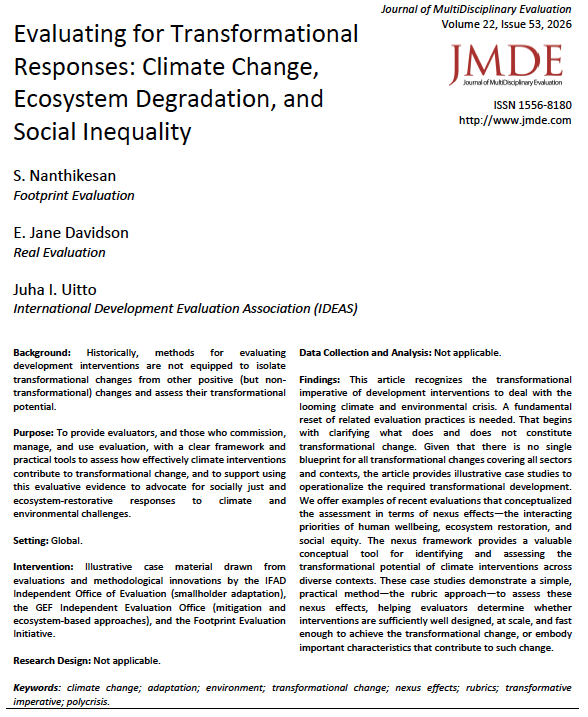
To combat the escalating climate crisis, transformational interventions and evaluations that identify and assess such interventions are imperative and urgently needed. Current methods for evaluating climate adaptation and mitigation interventions are failing to identify and assess the profound, systemic shifts required. In the context of transformation-washing (any positive improvement being portrayed as transformational), this article presents a holistic approach to ensuring evaluations contribute to transformational climate and environmental responses that promote livelihoods, restore ecosystems, and advance social justice. First, it distils from existing literature the characteristics of transformational change and how they can be distinguished from changes that reinforce the status quo. Second, it identifies shortfalls in current evaluation conceptual frameworks for assessing the transformational potential of interventions. Third, recognizing the need to move away from anthropocentric conceptualization of merit and worth of development interventions, it illustrates an alternate conceptual framework: a Nexus approach that focuses not only on human system needs, including social equity, but also on the interconnected need for ecosystem restoration. Fourth, it points to proven innovative, practical methods to operationalize assessments based on such conceptual frameworks. Fifth, it discusses the barriers to integrating evidence emerging from such evaluations to facilitate transformational development interventions, providing pathways to enable duty-bearers and claimholders to mainstream transformational interventions.
Downloads
Article Details

This work is licensed under a Creative Commons Attribution-NonCommercial 4.0 International License.
Copyright and Permissions
Authors retain full copyright for articles published in JMDE. JMDE publishes under a Creative Commons Attribution-NonCommercial 4.0 International License (CC BY - NC 4.0). Users are allowed to copy, distribute, and transmit the work in any medium or format for noncommercial purposes, provided that the original authors and source are credited accurately and appropriately. Only the original authors may distribute the article for commercial or compensatory purposes. To view a copy of this license, visit creativecommons.org
References
Adaptation Fund. (2023). Evaluation policy of the Adaptation Fund. https://www.adaptation-fund.org/document/evaluation-policy-of-the-adaptation-fund-graphically-edited/
Chaplowe, S. (2025). The approach to transformational change in multilateral climate funds: AF, CIF, GEF, and GCF [Synthesis report]. Adaptation Fund Technical Evaluation Reference Group, Climate Investment Funds, Global Environment Facility Independent Evaluation Office & Green Climate Fund Independent Evaluation Unit. https://www.adaptation-fund.org/document/the-approach-to-transformational-change-in-multilateral-climate-funds-af-cif-gef-and-gcf/
Chaplowe, S., & Hejnowicz, A. (2021). Evaluating outside the box: Evaluation’s transformational potential. Social Innovations Journal, 5, 1–19. https://socialinnovationsjournal.com/index.php/sij/article/view/704/510
Cobourn, K., & Ignaciuck, A. (2025). Enabling agriculture’s transformative capacity to respond to climate change in the long run. OECD Food, Agriculture and Fisheries Papers No. 215. https://dx.doi.org/10.1787/7cef69bc-en.
Davidson, E. J. (2005). Evaluation methodology basics: The nuts and bolts of sound evaluation. Sage. https://doi.org/10.4135/9781452230115
Davidson, E. J., Chianca, T. K., Dulieu, N., & Sigdel, A. (2025a). Rubrics as a powerful tool to turn children’s stories of change into rich, trackable outcomes: Save the Children’s journey in child-led development and evaluation. Journal of MultiDisciplinary Evaluation, 21(49), 38–55. https://journals.sfu.ca/jmde/index.php/jmde_1/article/view/1047
Davidson, E. J., Chianca, T. K., & Rowe, A. (2025b). The Footprint Evaluation typology guide: Making clear evaluative judgments about environmental sustainability using mixed-method evidence. Footprint Evaluation / German Institute for Development Evaluation (DEval). https://footprintevaluation.org/resources/typology-guide
FAO. (2021). Greenhouse gas emissions from agrifood systems: Global, regional and country trends, 1990–2019. Rome.
GCF. (2021). Investment framework. Green Climate Fund. https://www.greenclimate.fund/about/policies/investment
GEF. (2016). Biodiversity mainstreaming in practice: A review of GEF experience. Global Environment Facility. https://www.thegef.org/publications/biodiversity-mainstreaming-practice-review-gef-experience
GEF EO. (2006). The role of local benefits in global environmental programs. Global Environment Facility Evaluation Office.
https://www.gefieo.org/en/types/evaluations/lb-global-environmental-programs-2006
GEF IEO. (2018a). Evaluation of GEF support for transformational change. Global Environment Facility Independent Evaluation Office. https://www.gefieo.org/en/types/evaluations/transformational-change
GEF IEO. (2018b). Evaluation of the multiple benefits of GEF’s support through its multifocal area portfolio. Global Environment Facility Independent Evaluation Office. https://www.gefieo.org/en/types/evaluations/multiple-benefits-2016
GEF IEO. (2022). Working toward a greener global recovery. Seventh Comprehensive Evaluation (OPS7). Global Environment Facility Independent Evaluation Office. https://www.gefieo.org/en/types/evaluations/ops7
GEF IEO. (2025). Learning from challenges in GEF projects. Global Environment Facility Independent Evaluation Office. https://www.gefieo.org/en/types/evaluations/learning-challenges
GEF/STAP. (2021). Enabling elements to achieve durable global environmental benefits. Scientific and Technical Advisory Panel of the Global Environment Facility. https://www.thegef.org/sites/default/files/2021-11/EN_GEF.STAP_.C.61.Inf_.03_Enabling_elements_achieve_durable_benefits.pdf
Giles, J., Grosjean, G., Le Coq, J-F., Huber, B., Bui, V. L., & Läderach, P. (2021). Barriers to implementing climate policies in agriculture: A case study from Viet Nam. Frontiers in Sustainable Food Systems, 5, 439881. https://doi.org/10.3389/fsufs.2021.439881
IFAD IOE. (2022). Thematic evaluation of IFAD’s support for smallholder farmers’ adaptation to climate change. International Fund for Agricultural Development Independent Office of Evaluation. https://ioe.ifad.org/en/w/thematic-evaluation-of-ifad-s-support-for-smallholder-farmers-adaptation-to-climate-change
ILO. (2025). What labour income reveals about gender inequalities at work. ILOSTAT. International Labour Organization.
ITAD. (2019). Evaluation of transformational change in the Climate Investment Funds. Final Evaluation Report. Climate Investment Funds.
Juschten, M., Reinwald, F., & Jiricka-Pürrer, A. (2025). Challenge accepted: Identifying barriers and facilitating climate change adaptation in spatial development. Environmental Science & Policy, 171. https://doi.org/10.1016/j.envsci.2025.104152
Meadows, D. (2008). Thinking in systems. Chelsea Green Publishing. https://www.chelseagreen.com/product/thinking-in-systems/
Patton, M. Q. (2010). Developmental evaluation: Applying complexity concepts to enhance innovation and use. Guilford Press. https://www.guilford.com/books/Developmental-Evaluation/Michael-Quinn-Patton/9781606238721
Patton, M. Q. (2020a). Blue marble evaluation. Guilford Press. https://www.guilford.com/books/Blue-Marble-Evaluation/Michael-Quinn-Patton/9781462541942
Patton, M. Q. (2020b). Evaluation criteria for evaluating transformation: Implications for the coronavirus pandemic and the global climate emergency. American Journal of Evaluation, 42(1). https://doi.org/10.1177/1098214020933689
Rist, R. C., & Stame, N. (Eds.). (2006). From studies to streams: Managing evaluative systems. Routledge. https://doi.org/10.4324/9780203791189
Rowe, A. (2021). Evaluation at the nexus: Evaluating sustainable development in the 2020s. In J. I. Uitto (Ed.), Evaluating environment in international development (2nd ed., pp. 46–60). Routledge. https://doi.org/10.4324/9781003094821
Rowe, A. (2022). Evaluation at the endgame: Evaluating sustainability and the SDGs by moving past dominion and institutional capture. In J. I. Uitto & G. Batra (Eds.), Transformational change for people and the planet: Evaluating environment and development (pp. 207–221). Routledge. https://doi.org/10.1007/978-3-030-78853-7_14
Rowe, A., Davidson, E. J., & Chianca, T. K. with Warnholz, A. (2025a). Integrating environmental sustainability into evaluations and decision-making: An introduction for governments and organizations. Footprint Evaluation & EvalConnect. https://footprintevaluation.org/resources/integrating-sustainability-govt-org-guide
Rowe, A., Davidson, E. J., & Chianca, T. K. with Warnholz, A. (2025b). Colombia’s journey in sustainability-inclusive evaluation: Key insights and lessons learned. Footprint Evaluation & EvalConnect. https://footprintevaluation.org/resources/colombia-dnp-case-study/
Rowe, A., & Uitto, J. I. (2023). Sustainability, evaluation, and credentials. Journal of MultiDisciplinary Evaluation, 19(46), 124–134. https://doi.org/10.56645/jmde.v19i46.887
Thomas, V. (2024). Risk and resilience in the era of climate change. Palgrave Macmillan. https://doi.org/10.1007/978-981-97-2769-8
Uitto, J. I. (2019). Sustainable development evaluation: Understanding the nexus of natural and human systems. New Directions for Evaluation, 162, 49–67. https://doi.org/10.1002/ev.20364
UNDP. (2016). Guidance note: Scaling development programmes. United Nations Development Programme. https://www.undp.org/publications/guidance-note-scaling-development-programmes
UNEP & FAO. (2024) Global Nitrous Oxide Assessment. https://wedocs.unep.org/handle/20.500.11822/46562
West, C., Rabescini, G,, Singh, C., Kastner, T., Bastos Lima, M., Dermawan, A., Croft, S., & Persson, U. M. (2025). The global deforestation footprint of agriculture and forestry. Nature Reviews Earth and Environment, 6, 325–341. https://doi.org/10.1038/s43017-025-00660-3
Whitton, J., & Carmichael, A. (2025). Systemic barriers preventing farmer engagement in the agricultural climate transition. Sustainability Science, 20, 1667–1680. https://doi.org/10.1007/s11625-024-01504-7
Williams, B., & Hummelbrunner, R. (2010). Systems concepts in action: A practitioner’s toolkit. Stanford Business Books. https://www.sup.org/books/business/systems-concepts-action
World Bank. (2020). Transformative climate finance. The World Bank. https://documents1.worldbank.org/curated/en/548391592335609551/pdf/Transformative-Climate-Finance-A-New-Approach-for-Climate-Finance-to-Achieve-Low-Carbon-Resilient-Development-in-Developing-Countries.pdf